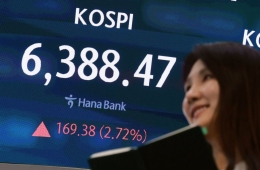
President Lee to Attend Virtual Summit on Hormuz... Led by UK and France, US Absent
70 to 80 Countries Join Summit Led by UK and France
Discussion on Energy Supply Chains and International Solidarity

President Lee Jaemyung (pictured) decided on April 17 to attend the multilateral summit on the Strait of Hormuz led by the United Kingdom and France, a strategic move reflecting the importance of freedom of navigation and energy supply chains. This is also closely linked to South Korea’s growing stature on the diplomatic stage.
A senior official at the presidential office explained, "Free navigation in the Strait of Hormuz is a matter of common interest and is also critical to our national interests," adding, "It is part of efforts to strengthen solidarity with countries sharing similar positions."
The scale of participation has expanded from the initial 30 to 40 countries to now include 70 to 80 countries as well as international organizations. While there are various interpretations regarding the absence of the United States, the presidential office cautioned against overinterpretation. The rationale is that, as a party directly involved in the conflict, the United States does not take center stage within the framework of international solidarity. It was added that decisions are being made in consultation with the U.S.
The meeting, which was initially planned for ministers and other high-ranking officials, was elevated to a summit of national leaders in consideration of the gravity of the issue. A diplomatic official explained, "This marks the convergence of diplomatic and military tracks led by the UK and France since March." Experts are focusing on the various implications of this meeting.
Shin-hwa Lee, a professor of political science and international relations at Korea University, commented, "The Strait of Hormuz issue has become a critical factor influencing the global economy," and analyzed, "With the United States focusing on hard power and neglecting value-based soft power, this has become an experimental moment for European countries to unite in defense of multilateralism and universal values." She added, "The gathering of more than 80 countries signals that middle powers can come together even without the United States."
In-whi Park, Dean of the Graduate School of International Studies at Ewha Womans University, said, "For countries that could not respond to U.S. requests for troop deployments, this is an appropriate way to send a message that they hope for a restoration of U.S.-led stability," and added, "It will serve as a channel for sending a universal message that does not put either the United States or Iran in a difficult position."
Hot Picks Today
 "Even Luxury Cars Drive Off Without Paying"... ...
- "Only the Top 1% Winning Big in Stocks Smile... '300 Million Won Splurges' or '1...
- Applied Just for Skin Soothing...Study Finds It Suppresses Antibiotic Resistance
- "Is the Starting Salary Really 4 Million Won?"... Surprise as Navy Salary and Sa...
- “Nothing Left to Protect” as Japan Drops Its “Peace State” Banner... Lifts B...
Experts evaluated the government’s dispatch of Jeong Byungha as special envoy to Iran as a pragmatic ‘two-track’ strategy. Hyunjin Choi, professor of political science and international relations at Kyung Hee University, said, "Given South Korea’s high dependence on the Strait of Hormuz and the current situation with 26 ships trapped, it is difficult to remain satisfied with only a joint statement," and added, "Since any joint statement from this meeting will not be binding, it is unlikely to negatively affect the envoy’s negotiations." Dean Park predicted, "There is a high possibility that the situation will be resolved before the U.S.-China summit."
© The Asia Business Daily(www.asiae.co.kr). All rights reserved.




![Is This a Boom or a Recession? Queues for Both Luxury and Bargain Goods [K-Shaped Consumption Era]](https://cwcontent.asiae.co.kr/asiaresize/307/2026042114133834494_1776748418.png)