Koo Yoon-chul: “Semiconductor Boom Could Push Growth Above 2% This Year... U.S.-Korea Strategic Investment Corporation to Launch in Sejong in June”
G20 Press Briefing Held in Washington, D.C. on the 15th
Bilateral Meeting Scheduled with Treasury Secretary Bessent
Supply Chain Diversification to Be Pursued as a Matter of National Security After the War
Deputy Prime Minister and Minister of Strategy and Finance Koo Yoon-chul stated that, despite external uncertainties stemming from the Middle East war, "achieving an economic growth rate of 2.0% this year is possible, and we can even expect more."

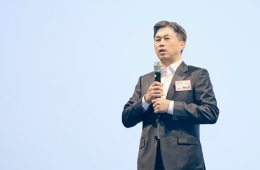
Koo Yoon-chul, Deputy Prime Minister and Minister of Finance and Economy, who is visiting Washington D.C., USA to attend the G20 Finance Ministers' Meeting and the International Monetary Fund (IMF) and World Bank (WB) Spring Meetings, is delivering opening remarks at a briefing session with accompanying reporters held at the IMF on the 15th (local time). Ministry of Finance and Economy
View original imageKoo: "Semiconductor boom offsets impact of the war... Supplementary budget effect is 0.2 percentage points"
Visiting Washington D.C. to attend the G20 Finance Ministers' Meeting, Deputy Prime Minister Koo explained at a briefing with accompanying reporters held at the International Monetary Fund (IMF) headquarters on the 15th (local time), "The semiconductor boom is offsetting the effects of the war, so we can look forward to even higher growth."
Previously, the Organisation for Economic Co-operation and Development (OECD) had revised Korea's growth forecast downward from 2.1% to 1.7%, while the IMF maintained its existing forecast of 1.9%, interpreting the impact of the Middle East war differently. The government's own forecast remains at 2.0%.
Deputy Prime Minister Koo said, "If you add the effect of the supplementary budget (0.2%) to the OECD's 1.7% forecast, that brings it to 1.9%," and added, "Since corporate tax is directly linked to growth, we will have a clearer picture by August, when interim tax payments are completed."
"WGBI, RIA, and FX hedging boost foreign currency supply... Exchange rate will normalize"
He also predicted that once the Middle East war is resolved, the won-dollar exchange rate, which has been fluctuating around 1,500 won, will stabilize. Deputy Prime Minister Koo explained, "Since the launch of the Resumption of Investment Accounts (RIA), 110,000 accounts have been opened; there has been an additional USD 5.1 billion in new inflows following inclusion in the World Government Bond Index (WGBI); and the National Pension Service has increased its FX hedging ratio to 15%. Along with the semiconductor boom, these three factors are driving continued foreign currency supply," adding, "When the Middle East war risk is resolved, the exchange rate, which has diverged excessively from fundamentals, will return to normal."
After hosting an Investor Relations (IR) session for the Korean economy in New York and meeting with global investment firms, Deputy Prime Minister Koo also remarked that he could sense Korea's elevated status in the global capital market. He said, "John Studzinski, Vice Chairman of PIMCO, commented, 'Korea is an amazing country, I don't know why people aren't investing,' suggesting that foreign investors' assessments of Korea are even more positive than those of Koreans themselves." PIMCO is the world's largest bond investment firm, founded in 1971 by Bill Gross, who is known as the "Bond King."

Gu Yoonchul, Deputy Prime Minister and Minister of Strategy and Finance, who is visiting Washington D.C., USA to attend the G20 Finance Ministers Meeting and the International Monetary Fund (IMF) and World Bank (WB) Spring Meetings, is answering reporters' questions at the joint press briefing held at the IMF on the 15th (local time). Ministry of Strategy and Finance
View original imageKorea-U.S. Strategic Investment Corporation to be headquartered in Sejong... Bilateral meeting with Treasury Secretary Bessent
Deputy Prime Minister Koo announced that the headquarters of the Korea-U.S. Strategic Investment Corporation, which will oversee investment work in the United States, will be established in Sejong. The decision was made to locate the headquarters in Sejong, where related agencies such as the Ministry of Trade, Industry and Energy and the Ministry of Strategy and Finance are concentrated, rather than Seoul, in consideration of balanced regional development. The inauguration ceremony will be held in Sejong on June 18.
On the 17th, Deputy Prime Minister Koo will hold a bilateral meeting with U.S. Treasury Secretary Scott Bessent. They are expected to exchange views on a range of issues, including the Middle East war, exchange rates, and investment in the United States.
"Supply chain diversification must be approached from a national security perspective"
Deputy Prime Minister Koo stressed the need to diversify supply chains from a national security perspective in light of the Middle East war. He said, "Rather than being overly dependent on countries with low costs, we must prepare for national crises by expanding the supply chain for items such as helium, bromine, and urea through investments in both domestic and overseas production," adding, "Once the war ends, these efforts will be accelerated."
He also emphasized the need for a bold energy transition to reduce dependence on oil. Deputy Prime Minister Koo said, "There is no guarantee that a situation like the Middle East war will not happen again," and added, "While pursuing decarbonization, we are considering offering incentives to citizens who use public transportation or bicycles to help reduce oil consumption."
Hot Picks Today
 "With This Certificate, Even Those in Their 60s...
- Popcorn Container Craze at Theaters Sparks Sell-Out Frenzy, Emerges as New Reven...
- "Bear Destroyed My Rolls-Royce"... US Car Owners Who Claimed $200,000 Insurance ...
- Passed Through Just Before Hormuz Re-closure... 1 Million Barrels of Crude Oil H...
- "Quit Office Job to Earn Over 200 Million Won a Year"… Chinese Woman in Her 30s...
To address the polarization of Korea’s economy, which is excessively concentrated in the semiconductor industry, he said, "We will actively discover ultra-innovative economic items that can revitalize local economies, such as power semiconductors that reduce electricity consumption, sensors that serve as the 'eyes' of all objects, and superconducting graphene." He added, "Large corporations should earn profits in the global market through innovation, while small and venture companies should be given more room to operate in the domestic market."
© The Asia Business Daily(www.asiae.co.kr). All rights reserved.


!["They Said It Was 'Delicious' Milk... Is the 'List of Fake Milk Products in Korea' for Real? [Matjal X-File]"](https://cwcontent.asiae.co.kr/asiaresize/307/2023072413274517286_1690172865.jpg)