[New York Stock Exchange] Will the Second Talks Bring a Ceasefire Agreement?... S&P 500 and Nasdaq Hit Record Highs
White House: "Talks Proceeding Productively"
Iran: "Messages Exchanged with the U.S."
Market Reflects Expectations for Ceasefire Agreement at Second Talks

On the 15th (local time), the three major U.S. stock indices ended the session mostly flat. As negotiations for the second ceasefire talks between the United States and Iran progressed smoothly and U.S. President Donald Trump hinted at the possibility of a deal by the end of April, the S&P 500 and Nasdaq indices reached record highs.
At the New York Stock Exchange (NYSE), the Dow Jones Industrial Average closed at 48,463.72, down 72.27 points (0.15%) from the previous trading day. The S&P 500 index, which focuses on large-cap stocks, rose by 55.57 points (0.80%) to finish at 7,022.95, while the tech-heavy Nasdaq index jumped 376.934 points (1.60%) to close at 24,016.017.
Expectations that a deal could be reached at the second ceasefire talks to end the Iran war drove the S&P 500 above the 7,000 mark at the close for the first time. The Nasdaq also hit its highest level in six months since October 29 of last year, reflecting optimism for an end to the conflict.
President Trump’s interview helped lift the indices that day. In an interview with the UK’s Sky News, President Trump said it was “very possible” that an agreement could be reached with Iran before King Charles III’s state visit to the U.S. With King Charles III scheduled to visit the United States from April 27 to 30, the market interpreted this as a sign that ceasefire negotiations could be concluded before the end of April.
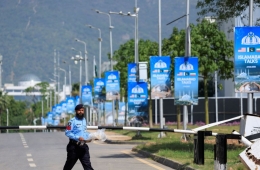
White House spokesperson Karoline Leavitt also added momentum to the possibility of a second ceasefire meeting, stating, “The next meeting location will be Pakistan.”
![[New York Stock Exchange] Will the Second Talks Bring a Ceasefire Agreement?... S&P 500 and Nasdaq Hit Record Highs](http://www.asiae.co.kr/news/img_view.htm?img=2026041608203527929_1776295235.jpg)
Thomas Martin, Senior Portfolio Manager at Globalt Investments, analyzed, “At the outbreak of the war, market participants had reduced risks, anticipating the situation could worsen. Now, as the likelihood of further escalation seems lower, they are turning to buying.”
International oil prices closed flat that day. On the New York Mercantile Exchange, West Texas Intermediate (WTI) crude for May delivery rose by 1 cent to settle at $91.29 per barrel. On the ICE Futures Exchange, June Brent crude futures closed at $94.93 per barrel, up 0.1% from the previous session.
Optimism over an end to the Iran war and comments from Treasury Secretary Scott Bessent appeared to have curbed oil price volatility. At a White House briefing, Secretary Bessent stated, “During the driving season, gasoline prices will fall back to the $3 per gallon level.”
He went further, specifying, “I am optimistic that at some point between June 20 and September 20, gasoline prices will return to the $3 range.”
Adam Turnquist, Chief Technical Strategist at LPL Financial, said, “Signs of easing tensions in the Middle East have increased risk appetite, and falling oil prices have helped ease concerns about inflation.”
Gains in large-cap stocks stood out. Apple rose 2.94%, Microsoft (MS) 4.97%, Alphabet 1.08%, Tesla 7.95%, Netflix 1.41%, and AMD 1.10%.
Hot Picks Today
 Applied Just for Skin Soothing...Study Finds It...
- "Only the Top 1% Winning Big in Stocks Smile... '300 Million Won Splurges' or '1...
- "Paying More Than the Listed Price?"... Academies Caught in the Act of Illicit T...
- "If You Pay, I'll Close the Case"... Former Korea Customs SJPO Who Took 145 Mill...
- "Please Launch It in Korea!" After All the Hype... This Coffee Finally Arrives i...
Jonathan Krinsky of BTIG LLC analyzed that easing tensions in the Middle East and the stock market’s break above major support levels suggest a continued uptrend. He stated, “Given various signals, the probability of retesting the recent lows at this point is low.”
© The Asia Business Daily(www.asiae.co.kr). All rights reserved.




![Is This a Boom or a Recession? Queues for Both Luxury and Bargain Goods [K-Shaped Consumption Era]](https://cwcontent.asiae.co.kr/asiaresize/307/2026042114133834494_1776748418.png)