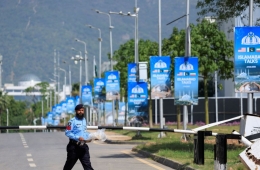
Iranian Military Warns: "Red Sea Blockade If U.S. Maritime Blockade Continues" (Comprehensive)

Iran has warned that it will block access to the Red Sea if the United States continues its maritime blockade. This marks the first time that the Iranian military has officially mentioned the possibility of blocking additional key maritime trade routes, such as the Red Sea, in response to the U.S. blockade. Analysts view this as a strategy by Iran to strengthen its negotiating power by issuing a hardline message ahead of the second round of ceasefire talks with the United States.
According to Iran's state-run IRIB broadcaster on April 15 (local time), Ali Abdollahi, a major general at the Khatam al-Anbiya Central Headquarters, which oversees all Iranian armed forces, stated in a declaration, "The aggressive and terrorist United States continues an illegal maritime blockade, threatening the safety of Iranian merchant ships and oil tankers."
He emphasized, "Such actions by the United States could signal a violation of the ceasefire agreement," adding, "If the U.S. blockade continues, we will launch a strong military response."
Major General Abdollahi also threatened, "Iran’s powerful armed forces will not tolerate any import or export activity passing through the Persian Gulf, the Gulf of Oman, or the Red Sea." He stressed that "Iran will act decisively, mobilizing every possible means to defend our national sovereignty and interests."
Experts have expressed concerns that if the United States blocks Iranian ports through a maritime blockade, the Houthi rebels in Yemen—members of the 'Axis of Resistance'—could restrict passage through the Bab el-Mandeb Strait at the entrance to the Red Sea. The Bab el-Mandeb Strait, a strategic chokepoint, is a waterway between southwestern Yemen and Djibouti, connecting to the Suez Canal and the Mediterranean Sea.
Approximately 10% of global maritime trade passes through this strait, with an average of 50 to 60 merchant vessels passing daily. The daily volume of crude oil and petroleum products is about 9 million barrels. At its narrowest, the strait is only about 30 kilometers wide, making it extremely vulnerable to military blockades.
Hot Picks Today
 Applied Just for Skin Soothing...Study Finds It...
- "Only the Top 1% Winning Big in Stocks Smile... '300 Million Won Splurges' or '1...
- "Paying More Than the Listed Price?"... Academies Caught in the Act of Illicit T...
- "If You Pay, I'll Close the Case"... Former Korea Customs SJPO Who Took 145 Mill...
- "Please Launch It in Korea!" After All the Hype... This Coffee Finally Arrives i...
When the war in the Gaza Strip broke out, the Houthi rebels attacked merchant ships passing through the strait in 2024, claiming to support Palestinian Hamas. As a result, cargo volume dropped by more than 40%. Unlike the bottlenecked Strait of Hormuz, there is an alternative detour around the Cape of Good Hope at the southern tip of Africa if this route is blocked, but this would increase transit time by more than 10 days.
© The Asia Business Daily(www.asiae.co.kr). All rights reserved.




![Is This a Boom or a Recession? Queues for Both Luxury and Bargain Goods [K-Shaped Consumption Era]](https://cwcontent.asiae.co.kr/asiaresize/307/2026042114133834494_1776748418.png)