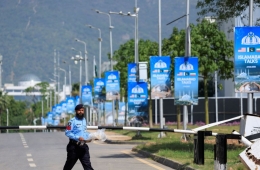
Samsung and SK hynix Combined Market Cap Surpasses 2,000 Trillion Won... "Next Target: 3,000 Trillion" [Click eStock]
"Beyond the Supercycle"... AI Reshapes Demand Structure
"PER Around 4x... With Enhanced Shareholder Returns, Revaluation Expected"
Amid the combined market capitalization of Korea’s leading semiconductor companies—Samsung Electronics and SK hynix—surpassing 2,000 trillion won (excluding Samsung Electronics preferred shares), securities analysts are predicting significant further growth potential. They forecast that structural changes in the industry, such as the expansion of artificial intelligence (AI) demand and growth in long-term contracts, will drive stock prices higher.
On April 15, Ryu Hyungkeun, a researcher at Daishin Securities, maintained a ‘buy’ rating for Samsung Electronics and SK hynix and raised the target prices to 3.3 million won and 1.7 million won, respectively. These new targets represent increases of 22.2% and 17.2% over previous estimates. As of the previous day’s close, Samsung Electronics stood at 2,110,000 won and SK hynix at 1,136,000 won.
Ryu commented, “The next stop is 3,000 trillion won,” adding, “A steeper near-term earnings growth trajectory, long-term contract structural shifts, and the value of a prolonged cycle will drive stock price revaluation.”
Short-Term Earnings Surprise...Profit Growth to Accelerate Further
The core factor is the fundamental change in the structure of semiconductor demand. The explosive growth in data processing volume due to the spread of AI is fueling the expansion of semiconductor demand.
![Samsung and SK hynix Combined Market Cap Surpasses 2,000 Trillion Won... "Next Target: 3,000 Trillion" [Click eStock]](http://www.asiae.co.kr/news/img_view.htm?img=2026041517245327561_1776241492.jpg)
Ryu explained, “In the past, demand was determined by population and the number of devices, but now it is determined by token usage.” He added, “Demand is expanding simultaneously in new applications such as AI, autonomous driving, and robotics, as well as in traditional IT.” On the supply side, a continuation of conservative investment strategies has created structural bottlenecks. The sharp increase in demand, combined with supply constraints, has created an environment that exceeds previous ‘super cycles.’
Daishin Securities estimates that in the second quarter of this year, the operating profits of Samsung Electronics and SK hynix will reach 8.55 trillion won and 6.25 trillion won, respectively—far exceeding market consensus. Notably, price increases are spreading from server memory to mobile memory.
Ryu said, “The price increases that began in server memory in the first quarter are now spreading to mobile memory in the second quarter,” forecasting, “Mobile memory prices will rise by more than 80% quarter-on-quarter.”
Expansion of Long-Term Contracts...“Reducing Structural Volatility”
The expansion of long-term contracts is another key investment point. Whereas the memory industry was previously considered a highly cyclical sector with extreme price volatility, the recent proliferation of multi-year contracts based on prepayments is reducing structural volatility.
Ryu emphasized, “Long-term contracts are not just a change in sales methods, but a transformation of the industry structure.” He explained, “As the number of contracts accumulates, available production capacity decreases, making subsequent contracts more favorable to suppliers.” For commodity DRAM, the share of long-term contracts is projected to exceed the mid-10% range by the second quarter of 2026, with further increases expected in the second half of the year.
![Samsung and SK hynix Combined Market Cap Surpasses 2,000 Trillion Won... "Next Target: 3,000 Trillion" [Click eStock]](http://www.asiae.co.kr/news/img_view.htm?img=2025021710490034501_1739756940.jpg)
On the supply side, structural bottlenecks are intensifying. The major manufacturers are not scheduled to bring new plants online until next year or later, meaning there is limited potential to increase supply before then. As a result, competition among clients to secure volume is intensifying, shifting bargaining power towards suppliers. Ryu noted, “DRAM production capacity is essentially locked in through the end of 2027,” diagnosing, “Competition among clients for the remaining volume is now heating up.”
In such an environment, it is highly likely that the price floor will rise and the ceiling will open further with each contract signed.
HBM Drives Profitability...“ASP to Rise 42%”
The increasing production share of high bandwidth memory (HBM) is also boosting profitability. HBM consumes more wafers compared to standard DRAM, which restricts supply, while surging demand for AI servers allows for higher prices to be maintained.
Ryu analyzed, “The average selling price of HBM in 2027 is expected to rise by 42% year-on-year,” adding, “Both changes in product mix and a price normalization strategy will play a role.” For NAND as well, the expansion of AI inference workloads is increasing data storage demand, and conservative investment is contributing to a continued upward price trend.
Hot Picks Today
 Applied Just for Skin Soothing...Study Finds It...
- "Only the Top 1% Winning Big in Stocks Smile... '300 Million Won Splurges' or '1...
- 46 Voice Phishing Ring Members Repatriated from Cambodia Sentenced to Prison in ...
- "If You Pay, I'll Close the Case"... Former Korea Customs SJPO Who Took 145 Mill...
- "Please Launch It in Korea!" After All the Hype... This Coffee Finally Arrives i...
Valuation (the stock price relative to corporate value) is also assessed positively. For this year, the price-to-earnings ratio (PER) for Samsung Electronics and SK hynix is estimated at 4.8x and 3.9x, respectively, and, considering their earnings growth, there is ample room for further revaluation. Ryu added, “The increase in cash flow resulting from profit growth will strengthen shareholder returns, including share buybacks and higher dividends,” concluding, “This will serve as another driver for stock price appreciation.”
© The Asia Business Daily(www.asiae.co.kr). All rights reserved.





![Is This a Boom or a Recession? Queues for Both Luxury and Bargain Goods [K-Shaped Consumption Era]](https://cwcontent.asiae.co.kr/asiaresize/307/2026042114133834494_1776748418.png)