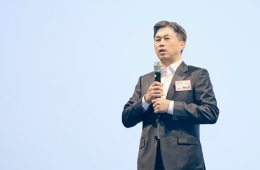
Hyun-Song Shin: "Monetary Policy May Play a Role if Middle East Crisis Prolongs... I Regret Personal Controversies" (Comprehensive)
Bank of Korea Governor Nominee Faces Confirmation Hearing
Rejects "Pragmatic Hawk" Label
On April's High Exchange Rate: "NDF Impact, the Tail Wags the Dog"
Household Debt Should Be Addressed Through Real Estate or Macro Policies
On Per
Shin Hyun Song, nominee for Governor of the Bank of Korea, stated on April 15 that while the possibility of stagflation due to the Middle East war is low, if high inflation persists, monetary policy could play a role. He explained that, as positive economic growth is still expected for Korea, mainly driven by the IT industry, the likelihood of simultaneous inflation and economic recession is low. However, if high prices for oil and other goods continue, the Bank of Korea may intervene through measures such as interest rates.
Regarding personal controversies, such as his transfer to Korea University and his family's nationality, Shin expressed his regret but clarified, "There was no deliberate intent to seek personal gain."
At the National Assembly confirmation hearing, when Assemblyman Jung Ilyoung of the Democratic Party of Korea asked about potential Middle East-related risks to the Korean economy, Shin responded, "Stagflation refers to a phenomenon where economic recession occurs simultaneously with inflation. While growth is slowing, stagflation presupposes negative growth, which I believe is unlikely."
However, he did express concerns about the Middle East situation and the potential shock from rising oil prices. Shin stated, "If the Middle East crisis is not resolved swiftly, inflationary pressures will intensify," adding, "If it is a temporary shock, there is no need to respond with monetary policy. However, if it persists long enough to affect prices and lead to overall inflation, then monetary policy will have a role to play."
When asked about being labeled a "pragmatic hawk" (meaning a preference for monetary tightening), Shin denied the characterization, saying, "I do not agree with that assessment." This is interpreted as a response mindful of the impact his comments on interest rate hikes could have on the market. Shin added, "Dividing people into hawks and doves is not desirable."
When Assemblyman Jin Sungjoon of the Democratic Party referred to Shin's past media interview, which suggested "raising interest rates to respond to inflation is better than underreacting," Shin explained, "At the time, in 2022 during the Ukraine war, inflation in major countries was rising into double digits, so I thought a preemptive response was needed." He further emphasized, "It is not appropriate to always respond with the same tools and methods. Policy should be managed with a comprehensive consideration of economic and financial conditions."
Shin Hyun Song: "In a High Exchange Rate Environment, the Tail Wags the Dog... Household Debt Must Be Addressed with Macro Policies"

Shin Hyun-song, nominee for the Governor of the Bank of Korea, appeared at the confirmation hearing held on April 15 at the National Assembly's Finance and Economy Planning Committee, responding to members' questions. 2026.4.15 Photo by Kim Hyunmin
View original imageShin assessed that the recent high won-dollar exchange rate, fluctuating above 1,500 won, was due to the increased off-exchange derivatives trading by foreign investors, resulting in the tail wagging the dog. He particularly noted, "As seen in March this year, when there are significant changes due to shocks to the financial system itself, the market can be driven by movements that are not captured in standard capital flows. The non-deliverable forward (NDF) market is especially important in this context."
He further emphasized, "Not only this time, but also in April last year during the U.S. reciprocal tariff issue, and two years ago during the unwinding of yen carry trades, there was more off-exchange derivatives trading than on-book capital outflow. This time as well, offshore NDF transactions in Korea seem to have played a significant role."
Shin agreed with the recent decision by the Bank of Korea's Monetary Policy Board to keep the base rate unchanged at 2.5% for the seventh consecutive time. In response to a question from Assemblyman Kwon Youngse of the People Power Party about the recent rate decision, Shin said, "At that time, it was the early stage of the Middle East crisis, and uncertainty was extremely high. Although the oil supply shock could potentially lead to higher expected inflation or core prices, there was no such sign at that stage. Therefore, I believe it was appropriate to take a wait-and-see approach."
He also expressed concern about household debt, identifying it as a problem that should be addressed through government real estate supply policies and macroprudential measures. Shin noted, "Household debt is not only an issue of financial stability but is also directly connected to growth. When household debt is high, consumption dynamics weaken and there is significant pressure on the overall economic flow."
He continued, "The debt-to-GDP ratio is measured at around 80% to 85%. If it falls below 80%, household debt does not act as a drag on growth. However, if it remains at or above 80% or 85%, it reaches a level that impacts growth. This issue cannot be resolved by monetary policy alone and must be addressed through macroprudential measures and various structural policies, as I mentioned earlier."
At the Hearing: Korea University Transfer, Daughter's Nationality, Foreign Assets, and Real Estate Disputes... "Regret for Personal Issues... No Deliberate Intent"

Shin Hyun Song, nominee for Governor of the Bank of Korea, is speaking at the confirmation hearing held by the National Assembly's Planning and Finance Committee on the 15th. April 15, 2026 Photo by Hyunmin Kim
View original imageAt the confirmation hearing, Shin faced intense questioning over his transfer to Korea University, his daughter's nationality, and controversies regarding his foreign currency assets. He stated regarding these issues, "There was no deliberate intent to seek personal benefit," and emphasized, "If I am appointed as Governor, I will promptly address all outstanding issues and do my utmost for the Korean economy."
Assemblyman Park Sunghoon from the People Power Party requested clarification regarding allegations of "dual academic status" related to Shin's transfer to Korea University. Shin graduated from high school in the United Kingdom in July 1978 and was admitted to Oxford University, but postponed enrollment and returned to Korea, transferring to Korea University in September of the same year. This led to controversy over his dual academic status.
Shin explained, "I graduated from high school in the United Kingdom in 1978 and returned to Korea to fulfill my military service. At the time, I was too young to receive a draft notice, so I applied for a transfer to continue my studies." On transferring as a first-year student to Korea University, he added, "In the UK, high school is four years and university is three years, so my academic record seems to have been processed in line with the British system." However, Assemblyman Park argued that this did not align with public expectations, requesting submission of supporting documents regarding special provisions for dual academic status between the two universities and their academic regulations at the time.
There was further criticism regarding Shin's eldest daughter, who lost her Korean citizenship upon obtaining British citizenship in 1999, for failing to report her loss of nationality and for registering as a domestic resident in December 2023 at his apartment in Gangnam-gu. Assemblyman Chun Haram from the Reform Party presented a copy of the relocation report Shin had handwritten, stating, "In cases of false relocation reports, the law prescribes imprisonment for up to three years for clear violations of the Resident Registration Act." Assemblyman Chun further pointed out, "Shin stated that his daughter has been living independently abroad since getting married five years ago, but in December 2023, he registered her as living together with his family. One of the two statements is clearly false. It is necessary to verify whether failing to report her loss of nationality and even submitting a false relocation report as a domestic resident was an attempt to obtain benefits reserved for Korean nationals." When Assemblyman Chun requested documentation on his daughter's health insurance, immigration records, real estate ownership, and housing applications, Shin replied, "I will obtain my daughter's consent and submit the documents as soon as possible."
Hot Picks Today
 "With This Certificate, Even Those in Their 60s...
- Popcorn Container Craze at Theaters Sparks Sell-Out Frenzy, Emerges as New Reven...
- "Bear Destroyed My Rolls-Royce"... US Car Owners Who Claimed $200,000 Insurance ...
- Passed Through Just Before Hormuz Re-closure... 1 Million Barrels of Crude Oil H...
- "Quit Office Job to Earn Over 200 Million Won a Year"… Chinese Woman in Her 30s...
Regarding the controversy over foreign currency assets, Shin explained, "I have already disposed of a significant portion. All assets have been converted to won, and I will continue to reduce them." On the allegations of gap investing, he stated, "At the time, it was neither speculative nor intended for gap investment. Although my mother owned a house, she lacked living expenses. I bought a house to help support her," and added, "If my mother's residency is considered a form of gifting, I will confirm this with my tax advisor and take the necessary tax measures."
© The Asia Business Daily(www.asiae.co.kr). All rights reserved.



!["They Said It Was 'Delicious' Milk... Is the 'List of Fake Milk Products in Korea' for Real? [Matjal X-File]"](https://cwcontent.asiae.co.kr/asiaresize/307/2023072413274517286_1690172865.jpg)