Ahead of Second Talks, Trump Pressures Iran to Abandon Nuclear Program..."Dissatisfied with 20-Year Enrichment Suspension" (Comprehensive)
Emphasizing Iran's Nuclear Abandonment as a "Red Line" Condition
"Concerns Over a Deal Similar to Obama's JCPOA"
U.S. Treasury: "Sanctions on Iranian Oil Transactions to Resume"

U.S. President Donald Trump has hinted that a second round of ceasefire talks with Iran could take place within two days, while demanding Iran's complete abandonment of its nuclear program. He indicated that a proposal to suspend uranium enrichment for 20 years—which the U.S. reportedly suggested in the first round of talks but was rejected by Iran—was not satisfactory. The suspension of uranium enrichment was also part of the Iran nuclear agreement (JCPOA, Joint Comprehensive Plan of Action) signed during the Obama administration, so it is not considered a significant achievement, according to analysts. The U.S. government announced it would resume sanctions on Iranian crude oil exports to induce Iran to give up its nuclear ambitions, and also mentioned the possibility of additional sanctions.
Within Two Days of Talks...Trump: "Iran Cannot Possess Nuclear Weapons"

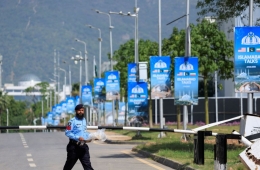
On April 14 (local time), President Trump hinted at the possibility of a second summit with Iran during a phone interview with the New York Post. Speaking to a New York Post reporter stationed in Islamabad, the capital of Pakistan, he said, "You really should stay there (in Islamabad), because something could happen in the next two days, and the chances of us going there have increased."
He expressed dissatisfaction with the proposal raised during the first round of talks to limit uranium enrichment for 20 years. President Trump said, "I have said that Iran cannot have nuclear weapons," adding, "I don't like the 20-year period. I don't want Iran to feel like it has won." He emphasized that Iran's complete abandonment of nuclear weapons is an uncompromising core condition. This suggests that U.S. demands will become even tougher in the second round of negotiations. According to the Wall Street Journal, the U.S. negotiating team demanded a 20-year suspension of uranium enrichment during the first talks with Iran. However, the talks broke down when Iran counter-proposed a five-year suspension.
Vice President J.D. Vance, who led the first negotiation team, also stressed that Iran's abandonment of its nuclear program is President Trump's key demand. At an event hosted by the U.S. conservative group Turning Point USA on the same day, Vice President Vance said, "The reason an agreement has not yet been reached is that the President genuinely wants a deal in which Iran does not possess nuclear weapons," adding, "He is saying, 'If you promise not to possess nuclear weapons, we will help Iran prosper.'"
"A 20-Year Suspension of Uranium Enrichment Is No Different from the Previous Nuclear Deal"

The reason President Trump insists on Iran's complete abandonment of its nuclear program, rather than just suspending uranium enrichment, is out of concern that the ceasefire talks could end with an agreement similar to previous nuclear deals.
The New York Times reported, "What President Trump and his aides are concerned about is that the current negotiations with Iran might end up similar to the nuclear agreement reached in 2015," adding, "At that time, the agreement included a sunset clause that limited uranium enrichment activities for 15 years, and President Trump severely criticized the agreement as a 'terrible and one-sided deal that should never have been signed.'" Under that agreement, Iran agreed to halt new uranium enrichment for 15 years, export 11,000 kilograms of low-enriched uranium to Russia, and keep domestic uranium enrichment to a maximum of 3.67% purity and under 300 kilograms in stock.
The issue of exporting Iran's current stockpile of 440 kilograms of highly enriched uranium abroad is also expected to become a key agenda item in future talks. President Trump has stated his intention to send ground troops to Iran to extract this uranium, but Iran opposes this. The New York Times pointed out, "Instead, Iran continues to propose diluting the uranium so that it cannot be used to manufacture nuclear weapons."
Iran Oil Sanctions to Resume on the 19th: "No Extensions"

With President Trump expressing a hardline stance ahead of the second round of talks, the U.S. government's pressure on Iran is expected to intensify. The U.S. Department of the Treasury announced on the social networking service X (formerly Twitter) that "the temporary permission to sell Iranian crude oil at sea will expire in a few days and will not be renewed." The statement added, "We will use all available means to maintain pressure on Iran."
The department further warned, "The Treasury will continue to maximize pressure on Iran through 'Economic Fury' and is prepared to impose secondary sanctions on foreign financial institutions that continue to support Iran’s activities." "Economic Fury" appears to be a reference to the U.S. military operation name "Epic Fury" against Iran.
The U.S. government temporarily eased sanctions on Iranian and Russian oil for a month as international oil prices soared above $100 per barrel. The set deadline is the 19th of this month, after which the sanctions will continue. It has also been determined that the U.S. did not extend the exemption for maritime Russian oil transactions, which expired on the 11th.
Hot Picks Today
 Applied Just for Skin Soothing...Study Finds It...
- "Only the Top 1% Winning Big in Stocks Smile... '300 Million Won Splurges' or '1...
- "Paying More Than the Listed Price?"... Academies Caught in the Act of Illicit T...
- "If You Pay, I'll Close the Case"... Former Korea Customs SJPO Who Took 145 Mill...
- "Please Launch It in Korea!" After All the Hype... This Coffee Finally Arrives i...
On the same day, U.S. Secretary of Energy Chris Wright also suggested that the U.S. may use other means to increase economic pressure on Iran. He told Fox News that a maritime blockade is "one way to end this conflict," but added, "There may be additional means of economic pressure."
© The Asia Business Daily(www.asiae.co.kr). All rights reserved.




![Is This a Boom or a Recession? Queues for Both Luxury and Bargain Goods [K-Shaped Consumption Era]](https://cwcontent.asiae.co.kr/asiaresize/307/2026042114133834494_1776748418.png)