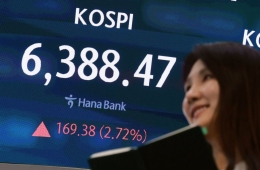
[Paradox of the Maximum Price Policy]② Card Fees Hit Gas Stations: 29.8 Won Fee per Liter, Only 25 Won Left... Negative Margin After Rent and Other Costs
Application of Proportional "Fixed-Rate" Fee System
Gas Stations Forced to Pay Card Fees Even on Fuel Taxes
Sales Increase, but Profits Decline—A Structural Reversal
Amid high oil prices and price controls, the burden of card processing fees is further distorting the profit structure of the gas station industry. Industry insiders say the paradoxical situation of "the more you sell, the more you lose" is becoming entrenched.
![[Paradox of the Maximum Price Policy]② Card Fees Hit Gas Stations: 29.8 Won Fee per Liter, Only 25 Won Left... Negative Margin After Rent and Other Costs](http://www.asiae.co.kr/news/img_view.htm?img=2026041510032026653_1776214999.jpg)
According to the oil distribution industry on April 15, recent developments at gas stations reveal that the core factor worsening profitability is the cost structure, rather than the price itself. While rising oil prices have led to increased sales volume, costs and expenses have risen as well, resulting in no actual increase in profit.
The root of the problem lies in the “fixed-percentage” card fee system, which deducts a fee proportional to total sales. Gas stations are low-margin businesses, with profits of only a few dozen won per liter. However, the current fee structure imposes charges based on the entire sales price, not on the margin. In particular, despite the fact that more than half of the fuel price is made up of taxes (fuel taxes) that gas stations collect on behalf of the government, they must still pay card fees on these taxes as well.
For example, if gasoline purchased at the fixed maximum price of 1,934 won per liter is sold at the domestic average price of 1,989 won per liter, applying a card fee of about 1.5% would deduct 29.8 won. Excluding this, the actual remaining amount is only about 25 won. This means the card fee exceeds the sales margin. After factoring in other operating expenses such as rent and labor costs, there are even cases where a negative margin occurs.
The industry points to the card fee system's failure to reflect the characteristics of low-margin industries as a structural problem. The method of charging fees based on sales regardless of oil price fluctuations only increases the burden.
The issue of card fees has been cited as a structural challenge since the late 1980s, when credit cards were first introduced. Initially, the “fixed-percentage” method of charging a certain share of sales was not a significant burden, as card usage was low. However, as the payment environment rapidly shifted to being card-centric, the fee burden increased sharply.
Since oil price liberalization in 1997, competition has intensified, and per-liter margins have decreased. At the same time, the higher the oil price and sales volume, the heavier the burden from card fees—causing this structure to become entrenched. As a result, the current system is evaluated as a factor that perpetuates the paradox of “expanding sales and declining profits” occurring simultaneously.
To address this, the industry has called for a shift to a “fixed-fee” system, imposing fees per transaction or per liter, but these demands have been rejected due to concerns about fairness among industries. As a result, the structure in which increased sales are accompanied by shrinking profits repeats whenever oil prices are high.
Currently, the card fee rate for gas stations is about 0.5% for annual sales of up to 3 billion won, and rises to around 1.5% for sales exceeding that amount. However, with a significant number of domestic gas stations recording annual sales of 5 billion won or more, the actual benefit of the lower rate is limited. Another burden is the “sales illusion,” where more than half of the fuel price is made up of taxes, making the sales volume appear much larger compared to the actual margin.
Accordingly, an amendment to the Specialized Credit Finance Business Act was proposed in July last year to recalculate card fee brackets based on net sales, excluding fuel taxes, when determining gas station revenue. However, it is still pending review in the National Assembly.
Hot Picks Today
 "Even Luxury Cars Drive Off Without Paying"... ...
- "Only the Top 1% Winning Big in Stocks Smile... '300 Million Won Splurges' or '1...
- Applied Just for Skin Soothing...Study Finds It Suppresses Antibiotic Resistance
- "Is the Starting Salary Really 4 Million Won?"... Surprise as Navy Salary and Sa...
- “Nothing Left to Protect” as Japan Drops Its “Peace State” Banner... Lifts B...
A card industry official explained, “Gas stations already benefit from preferentially low card fee rates, so changing the structure is not easy.” However, he added, “Nonetheless, the need to reform the fee system continues to be discussed.”
© The Asia Business Daily(www.asiae.co.kr). All rights reserved.





![Is This a Boom or a Recession? Queues for Both Luxury and Bargain Goods [K-Shaped Consumption Era]](https://cwcontent.asiae.co.kr/asiaresize/307/2026042114133834494_1776748418.png)