U.S. and Iran Consider Second Talks Before Truce Expires... Enriched Uranium Remains Key Issue (Comprehensive)
"Second Round of Talks Underway Before April 21 Truce Deadline"
Trump Emphasizes "Iran Desperately Wants an Agreement"
Main Point of Contention: 'Enriched Uranium'... Disagreement Over Transfer

There are growing predictions that a second round of ceasefire talks between the United States and Iran will take place before the ceasefire deadline between the two countries expires on the 21st of this month. While the United States continues to pressure Iran through maritime counter-blockades, it has also expressed its intention to keep the dialogue going. Iran has also signaled its willingness to negotiate, raising expectations that a meeting schedule will be set soon. However, there are also concerns that meaningful results may be difficult to achieve, as differences remain unresolved over major issues such as the removal of enriched uranium from Iran—a key sticking point during the first round of ceasefire talks.
Trump: "Iran Desperately Hopes for an Agreement"... Location and Date Still Unknown

CNN reported on the 13th (local time), citing U.S. government sources, that "the two countries are internally discussing holding a second face-to-face meeting before the ceasefire period expires on the 21st," adding, "The United States and Iran are still continuing negotiations as they seek ways to end the war diplomatically." The report also noted, "Although specific dates and locations have not yet been determined, Geneva, Switzerland, and Islamabad, Pakistan are currently being considered as possible venues."
Bloomberg News also cited anonymous sources, reporting that "Pakistan, Turkey, and Egypt, which played a mediating role in the first meeting, continue to serve as mediators," and that "the second meeting could be held not only in Islamabad, but also in either Turkey or Egypt."
U.S. President Donald Trump also hinted at the possibility of additional talks with Iran. At a press conference on the same day, President Trump said regarding the resumption of negotiations with Iran, "What I can say is that we received a call from the other side," emphasizing, "They very desperately want an agreement."
J.D. Vance, Vice President of the United States, who led the U.S. delegation in the first round of talks with Iran, also said there had been some progress in the first meeting and expressed optimism for further negotiations. In an interview with Fox News, Vice President Vance commented on the breakdown of the initial face-to-face negotiations, saying, "It's not accurate to simply say things went wrong—there were positive developments as well." He explained, "The negotiation team on the ground did not have the authority to reach a deal and had to return to Tehran to get approval for the conditions we proposed, either from the supreme leader or someone else."
Iranian President: "Dialogue with the U.S. Will Continue Within the Framework of International Law"

The Iranian side has also stated its intention to continue dialogue with the United States. According to Iran's state-run IRNA news agency, Iranian President Masoud Pezeshkian, in a phone call with French President Emmanuel Macron, said, "Iran has clearly stated the conditions for a ceasefire and will adhere to them," and added, "Iran will only continue dialogue within the framework of international law." He warned, "Any acts threatening the Strait of Hormuz will have widespread repercussions around the world." This is interpreted as Iran opposing the U.S. maritime blockade measures but indicating it will not halt talks with the United States.
Israel and Lebanon have also announced that they will hold talks in the United States. According to The New York Times (NYT), Israeli Prime Minister Benjamin Netanyahu said at a press conference that "the meeting between the Israeli and Lebanese ambassadors to the U.S., scheduled for the 14th in Washington, D.C., will focus on the disarmament of Hezbollah and efforts to achieve lasting peace between the two countries."
Lebanese President Joseph Aoun also emphasized, during his meeting with Italian Deputy Prime Minister and Minister of Foreign Affairs Antonio Tajani, who visited Lebanon on the same day, "Lebanon hopes that this meeting will lead to direct talks between Lebanon and Israel, and ultimately conclude with a ceasefire agreement."
Main Issue: 'Enriched Uranium'... Disagreement Over Overseas Removal Persists

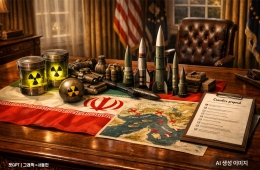
However, even if the two countries return to the negotiating table, it remains uncertain whether they can reach an agreement on the key issue of removing enriched uranium. CNN reported, "The non-negotiable core condition presented by the United States is that Iran must halt all uranium enrichment and ship out more than 400 kilograms of highly enriched uranium from Iran for the United States to recover." The report continued, "During the first round of negotiations, the United States also demanded that Iran suspend uranium enrichment for 20 years in addition to shipping out highly enriched uranium, but Iran refused."
The Wall Street Journal (WSJ) also reported, "President Trump's main goal in the Iran war and the principle of ceasefire negotiations is that Iran must not possess nuclear weapons," adding, "The U.S. proposal to suspend uranium enrichment for 20 years was a significant concession, but Iran has not accepted it."
Hot Picks Today
 "With This Certificate, Even Those in Their 60s...
- Popcorn Container Craze at Theaters Sparks Sell-Out Frenzy, Emerges as New Reven...
- "Bear Destroyed My Rolls-Royce"... US Car Owners Who Claimed $200,000 Insurance ...
- Passed Through Just Before Hormuz Re-closure... 1 Million Barrels of Crude Oil H...
- "Quit Office Job to Earn Over 200 Million Won a Year"… Chinese Woman in Her 30s...
Some analysts believe that Iran is unlikely to transfer its enriched uranium until the economic damage caused by the U.S. counter-blockades becomes more severe. Gregory Brew, Senior Analyst for Iran and Energy at the Eurasia Group, a U.S. think tank, told CNN, "Iran appears to be able to withstand economic pressure for at least another three to four weeks, and only after that will it suffer significant damage," explaining, "Since Iran can hold out to some extent, it is unlikely to accept U.S. demands immediately."
© The Asia Business Daily(www.asiae.co.kr). All rights reserved.



!["They Said It Was 'Delicious' Milk... Is the 'List of Fake Milk Products in Korea' for Real? [Matjal X-File]"](https://cwcontent.asiae.co.kr/asiaresize/307/2023072413274517286_1690172865.jpg)