Korea Launches Its Own 'Genesis Mission'... "Doubling Research Productivity by 2030"
MSIT Announces "K-Moonshot Promotion Strategy"
12 National Missions Selected, Including New Drug Development and Physical AI
"Dedicated PDs Will Be Designated and Granted Strong Authority"
The Ministry of Science and ICT announced a mid- to long-term, pan-national project plan to secure scientific and technological competitiveness in the age of artificial intelligence (AI). The government plans to leverage AI to secure technological leadership, for example by doubling research productivity by 2030. It will also push for a special act to recruit talent to be投入 into the project.

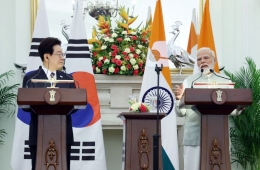
Bae Kyunghun, Deputy Prime Minister for Science and Technology and Minister of Science and ICT, is attending and speaking at the 1st Ministerial Meeting on Science and Technology held on the 24th at the Government Complex Seoul in Jongno-gu, Seoul. 2025.11.24 Photo by Cho Yongjun
View original imageOn the 23rd, the Ministry of Science and ICT held a press briefing at the Government Complex Sejong in Sejong City under the theme of the “Korean-style Genesis Mission K-Moonshot Promotion Strategy” and announced these plans. Yoo Eunsil, Head of the Science and Technology AI Diffusion Team at the Ministry of Science and ICT, explained, “Until now, AI has been a supplementary tool for research, but it is now deeply involved in the entire process from hypothesis formulation and experiment design to data analysis, dramatically improving both the speed of research and development (R&D) and the quality of its content,” adding, “Korea has also prepared a strategy to secure leadership in anticipation of this paradigm shift in science and technology.”
This project aims to significantly enhance research productivity and other outcomes using AI by mobilizing the capabilities of both the government and the private sector, so that Korea does not fall behind major advanced countries. Currently, Korea faces a widening technological gap with the United States and China in AI and scientific fields. In November last year, the United States identified 26 grand challenges, including nuclear fusion and quantum computing, and announced the “Genesis Mission,” under which the federal government and big tech companies jointly lead AI innovation.
Mobilizing national capabilities across companies, universities, and government-funded institutes... all available resources to be deployed
Through the K-Moonshot Project, the Ministry of Science and ICT stated that it will double research productivity by 2030 and resolve 12 national missions across 8 key areas by 2035 using science, technology, and AI. The 12 national missions are new drug development, brain-machine interfaces, nuclear power, nuclear fusion, solar cells, humanoids, physical AI, space, materials, AI scientists, semiconductors, and quantum. To accomplish these missions, the government will marshal not only ministries but also national capabilities spanning companies, universities, and government-funded research institutes.
Head of Team Yoo said, “We will build a ‘National Science AI Integrated Platform’ to bring together national scientific AI resources and industrial capabilities,” adding, “We will promote a system that opens and shares high-quality data held by 23 government-funded research institutes, among others.” She also stated, “Of the advanced graphics processing units (GPUs) purchased by the government, we will secure about 8,000 units exclusively for AI and allocate them strategically.”
The ministry also plans to actively recruit talent to run the K-Moonshot Project. For each mission, the Ministry of Science and ICT will appoint a dedicated project director (PD) and grant them strong authority over the planning and management of project R&D tasks. In addition, it plans to promote the enactment of a special act to ensure a smoothly functioning PD-centered accountability system and to allow for exceptional compensation. The dedicated PDs will be designated at the 5th Ministerial Meeting on Science and Technology to be held next month. Kim Seongsu, Director-General of R&D Policy at the Ministry of Science and ICT, said, “If the PD uses their expertise to design the project, the government will support them, for example by assigning additional personnel,” adding, “It is a structure in which missions are clearly defined and all parties collaborate in a mission-oriented way.”
Hot Picks Today
!["We Can't Hold Out Any Longer": Airlines Reduce Seats, Cut Routes, and Face Bankruptcy Amid Crisis [Global Focus]](https://cwcontent.asiae.co.kr/asiaresize/93/2026042414573239703_1777010253.jpg) "We Can't Hold Out Any Longer": Airlines Reduce...
"We Can't Hold Out Any Longer": Airlines Reduce...
- "You Can Only Have This in Korea": Which National Museum Cafe Menu Is Captivatin...
- "I Just Want to Sleep": Prime Minister Takaichi's Struggles?Frozen Meals, Two Ho...
- Iran Begins Collecting Hormuz 'Transit Fee' in Cash, Not Cryptocurrency
- "This Has Never Happened to Me in Korea"... Gwangjang Market Stall That Charged ...
All available resources, including the budget, will be mobilized to support the project. Director-General Kim explained, “Currently, there are preliminary feasibility study projects, projects being planned in each field, and newly planned projects, and together they will amount to about 500 billion won next year.”
© The Asia Business Daily(www.asiae.co.kr). All rights reserved.