"Principal Employers, Step Forward"... One Month Since "Yellow Envelope Law" Enactment, Strike Tensions Rise in Distribution Industry
Department Store and Duty-Free Shop Sales Staff Urge Headquarters to Enter Negotiations
CU Cargo Workers Also Demand Direct Solutions for Improved Working Conditions
Ambiguity Over 'Employer Status' in Multi-layered Employment Structures
Industry Voices Concern Over Escalating Confusion and Conflict
Labor disputes that began in the distribution industry with demands for negotiations with principal employers are now spreading beyond the cargo sector. Employees responsible for selling brand products at department stores and duty-free shops are also calling for major distribution conglomerates—the headquarters of sales channels—to step up and improve working conditions.
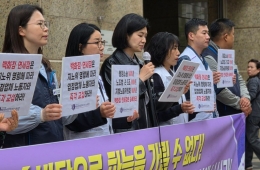
According to the industry on April 25, the Department Store and Duty-Free Shop Sales Service Labor Union, which is under the Korean Confederation of Trade Unions (KCTU) Service Federation and consists of sales service workers at major department stores, duty-free shops, and large shopping malls both online and offline, recently held a press conference in front of the main branch of Lotte Department Store in Sogong-dong, Jung-gu, Seoul to urge principal employers at department stores and duty-free shops to participate in negotiations. The union emphasized, "Principal employers at department stores and duty-free shops wield substantial control and influence over employees of in-store brands, and thus have a responsibility to resolve issues such as protecting emotional laborers, improving facilities, and guaranteeing rest rights through reduced operating hours."

The Department Store and Duty-Free Sales Service Labor Union is holding a press conference urging participation in negotiations with department stores and duty-free shops. Provided by the Department Store and Duty-Free Sales Service Labor Union
View original imagePreviously, on April 21, the Seoul Regional Labor Relations Commission issued a ruling for Lotte Department Store, Hyundai Department Store, and Shilla and Shinsegae duty-free shops, stating that they must enter into collective bargaining with the Department Store and Duty-Free Shop Sales Service Labor Union. The commission ordered corrective action after these companies failed to even post a public notice regarding the union's request for collective bargaining. This development is closely related to the amended Trade Union and Labor Relations Adjustment Act—the so-called "Yellow Envelope Law" (amendments to Articles 2 and 3)—which took effect on March 10. The revised Yellow Envelope Law expands collective bargaining rights to include subcontracted and specially employed workers, focusing overall on strengthening labor rights.
The department stores, duty-free shops, and the labor union remain divided over the issue of "employer status," which determines who is the actual contracting party. Department stores and duty-free shops argue that the brands operating in each store are the employers because they hire the workers and set their working hours and conditions, so the brands should be the negotiating parties. In contrast, the union insists, "Many employees of in-store brands still work according to standards set by the principal employer and in spaces managed by the principal employer," asserting that "all department stores and duty-free shops that have the actual authority to decide those standards must respond to negotiation requests."
Earlier, in October last year, the 14th Administrative Division of the Seoul Administrative Court partially ruled in favor of the Department Store and Duty-Free Shop Sales Service Labor Union in a lawsuit to overturn a retrial decision by the Central Labor Relations Commission regarding unfair labor practices. The court found that department stores and duty-free shops qualify as employers with substantial and specific control over working conditions such as working days and hours for employees of in-store brands. However, the Central Labor Relations Commission appealed the first-instance ruling, so a final decision has yet to be reached.

Members of the Cargo Solidarity Union are holding a rally at the BGF Logistics Jinju Center in Jeongchon-myeon, Jinju, South Gyeongsang Province, demanding the protection of CU logistics workers' rights. Photo by Yonhap News
View original imageHowever, the industry maintains that, as the Regional Labor Relations Commission has issued a corrective order, they will review whether to enter into negotiations after formally receiving the notification. An industry official said, "Our company aims to comply with labor-related laws and foster a mutually beneficial labor-management relationship. Once we receive the decision and official documentation from the commission, we will engage in sincere dialogue as part of the subsequent negotiation process."
The indefinite general strike by the Cargo Solidarity Union under the KCTU, which began on April 7, has also brought the issue of employer status to the forefront. The CU chapter of the Cargo Solidarity Union, representing convenience store logistics workers, demanded that BGF Retail, the principal employer, engage in talks to address transport fee adjustments and improve working conditions. However, BGF Retail contends that logistics-related work is handled by its subsidiary BGF Logistics, so it is not a negotiating party. BGF Logistics operates 25 logistics centers nationwide and directly employs individual cargo drivers at these centers, but the striking cargo workers are not employees of BGF Logistics—they are specially employed workers affiliated with transport companies individually contracted by the logistics centers.
Hot Picks Today
!["Grandma, This Isn't Made by AI, Right?"... Thought It Was Old-Fashioned, But Now I'm Hooked [World is Z Gold]](https://cwcontent.asiae.co.kr/asiaresize/93/2026042114422434550_1776750143.jpg) "Grandma, This Isn't Made by AI, Right?"... Tho...
"Grandma, This Isn't Made by AI, Right?"... Tho...
- Monthly Rentals in Seoul Surpass 70%... Over 80% in Gwanak and Dongdaemun
- "This Has Never Happened to Me in Korea"... Gwangjang Market Stall That Charged ...
- "Seniors Take Over the Disco Festival: 'Only 50 and Above Allowed' [Mwonil Issyu...
- "We Can't Hold Out Any Longer": Airlines Reduce Seats, Cut Routes, and Face Bank...
Another industry representative noted, "Since the criteria for determining employer status remain ambiguous, similar confusion and conflict on the ground can occur at any time," adding, "We are closely monitoring how the situation develops."
© The Asia Business Daily(www.asiae.co.kr). All rights reserved.