#. College student Moon Jungmin (26) has recently become deeply immersed in traveling around temples nationwide. Unable to endure the stress of daily life, she initially escaped to a temple stay, but it has since become a full-fledged hobby. She starts her day with the sound of the temple bell and spends time in silence, putting away her phone. Moon said, "I'm not a Buddhist, but it's the only way I can let go of complicated thoughts."
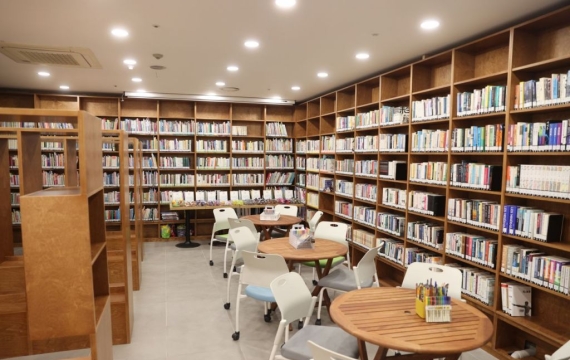
#. College student Kwak (24) is heading to a book cafe overlooking the forest in Gangbuk District, Seoul this weekend, carrying a bag with a single novel instead of a laptop. Kwak confessed, "Preparing for employment, I spent all day watching job postings and my peers' job success stories on social media, and it became suffocating," adding, "I decided to leave everything behind for a while and seek out silence."

Wave meditation is being conducted at Naksansa Temple Stay in Yangyang County, Gangwon Province. Korean Buddhist Cultural Business Group
원본보기 아이콘Recently, 'voluntary isolation'-retreating to temples, rural villages, or deep into the mountains, away from the city lights-has become a new form of rest among college students. Analysts say that young people, feeling helpless due to the severe job crisis and relentless competition, are seeking cost-effective healing in nature.
According to the Korea Buddhist Culture Business Group on April 24, 4 out of 10 (42%) participants in temple stay programs this year belong to the 20s and 30s age group. Reservation rates have increased by about 30% compared to last year. A representative from the Business Group reported, "While there were around 5,000 concurrent users last year, this year over 30,000 people tried to access the site at once, causing the server to crash."
As a result, there are now so-called 'temple ticketing' wars on college campuses, referring to the scramble for reservations. College student Lee (23) lamented, "The temple stay I was waiting for sold out in just 30 seconds, so I couldn't go," adding, "It's said that getting a reservation is harder than getting idol concert tickets or registering for classes."

The search for tranquility is not limited to temples. The act of enjoying complete rest in a quiet place itself is emerging as a 'rest trend.' Book stays, where you surrender your smartphone and read in the forest, or 'chon-cance' (a portmanteau of 'chon,' meaning countryside, and 'vacance,' meaning vacation), where you don work pants and chop firewood, are also gaining popularity.
Rural vacations provide college students with new experiences by allowing them to sweat away their worries through farm work. At night, they can gather in front of the wood stove and enjoy 'bul-myeong' (zoning out while watching a fire), lost in thought. A representative from Local Entertainment Uptown, which runs these programs, said, "A three-day, two-night farm volunteer program, designed with budget-conscious students in mind and priced at 50,000 won, sold out in just three days."
Although the forms may differ, college students consistently cite rest found through isolation as the key benefit. Kim (25), who travels alone for rural vacations, explained, "The sense of liberation that comes from being in an environment where no one knows me is huge. When I put down my phone, I am freed from the pressure to respond to messages immediately." The time spent in isolation, away from real-life worries and fatigue, is consumed as time for recharging.

Analysts say this phenomenon reflects the struggle of college students to briefly break free from the harsh reality of the job market and the relentless cycle of competition. According to the Ministry of Data and Statistics' "March Employment Trends," youth employment (ages 15-29) has declined for 41 consecutive months since November 2022. As of March, youth employment rates were ▲46.3% in 2022 ▲46.2% in 2023 ▲45.9% in 2024 ▲44.5% in 2025, marking a four-year downward trend.
Kwak Geumju, professor of psychology at Seoul National University, analyzed, "Amid the rapid changes brought by the era of artificial intelligence (AI) and the job crisis, the youth are more anxious than ever," adding, "Rather than enjoying high-cost leisure activities like golf in the past, they are seeking 'cost-effective' healing that soothes both mind and body while minimizing spending." Professor Kwak emphasized, "It seems necessary for the government to increase the variety of social activities that college students can participate in," and, "Encouraging young people to engage in social activities is essential to fundamentally address their sense of social helplessness."

-

Reporter Lee Jiye easy@asiae.co.kr
-
Edit Yang Hyejin adoretj@asiae.co.kr
© The Asia Business Daily(www.asiae.co.kr). All rights reserved.


![[Why&Next] Korea Focuses on 'Search', China on 'Action'Why Shopping AI Assistants Differ](https://cwcontent.asiae.co.kr/asiaresize/304/2026042210401035836_1776822010.png)
![[PolPolNews] Lee's Approval Rating Hits Post-Inauguration High Again... Democratic Party 48%, People Power Party 20%](https://cwcontent.asiae.co.kr/asiaresize/304/2026042321495438510_1776948594.jpg)