President Lee Returns with Economic Achievements Including 121 MOUs... Immediately Addresses Domestic Issues
Completion of Back-to-Back State Visits to India and Vietnam
Expanding Cooperation in CEPA, Nuclear Power, and Supply Chains
Deepening Relations with Key Partners of Great Potential: 121 MOUs Signed
Addressing Domestic Issues Including Remarks by Chung Dong-young and Coupang
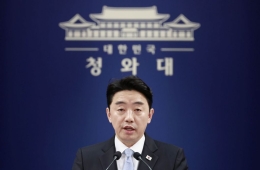
President Lee Jae-myung returned to Korea on the night of the 24th after completing his state visits to India and Vietnam. By visiting India and Vietnam in succession—both countries experiencing rapid growth—he elevated bilateral relations and achieved tangible results, including the signing of government and corporate documents such as memorandums of understanding (MOUs) that comprehensively cover energy, security, nuclear power, critical minerals, infrastructure, and advanced technology. This is being evaluated as the official launch of his "Global South" initiative. After returning to the Blue House, President Lee plans to review the achievements of the six-day, five-night tour and address a host of domestic issues, including controversy over remarks by Unification Minister Chung Dong-young regarding North Korea's nuclear facilities, the Coupang issue, and real estate matters.

President Lee Jae-myung and First Lady Kim Hye-kyung, who returned from state visits to India and Vietnam, are disembarking from Air Force One at Seoul Airport in Seongnam on the 24th. Photo by Yonhap News
View original imageFrom April 19 to 24, President Lee visited New Delhi in India and Hanoi in Vietnam for six days and five nights. The Blue House positioned this trip as the official start of the Lee administration's "Global South" diplomacy. India is a strategic partner with the world's largest population, a massive domestic market, and digital capabilities, while Vietnam has become a key production base and supply chain hub for Korean companies, extending beyond ASEAN.
The Blue House highlighted that the scope of cooperation with both countries was expanded from a traditional focus on trade and investment to include advanced industries, supply chains, nuclear power, infrastructure, digital, defense, and cultural content. A total of 121 government agreements and corporate MOUs were signed or exchanged.
Restarting CEPA Negotiations in India... Dedicated Korea Desk within Indian Prime Minister's Office

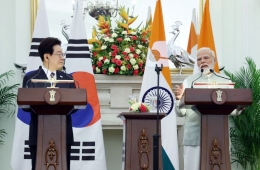
President Lee Jae-myung and Indian Prime Minister Narendra Modi hold a joint press conference at the state guesthouse in New Delhi on the 20th (local time). Photo by Yonhap News Agency
View original imageIn India, the first stop of the tour, the key achievement was the resumption of negotiations to improve the Korea-India Comprehensive Economic Partnership Agreement (CEPA). The two countries adopted a joint declaration to resume CEPA improvement negotiations during the summit talks and agreed to reestablish the institutional framework for expanding trade and investment.
The two countries also agreed to establish an "Industrial Cooperation Committee" to serve as a control tower for industrial cooperation. This is a consultative channel to systematically support Korean companies' entry into India and bilateral industrial cooperation. Other key outcomes included collaboration on port development, digital partnerships, and cooperation in the creative industries. Notably, the Indian side expressed its intention to set up a "dedicated Korea desk" within the Prime Minister's Office, raising expectations that this will provide practical support for resolving difficulties faced by Korean companies and expanding investment.
At the Korea-India Business Forum, President Lee presented three major cooperation blueprints in trade and investment, advanced industries, and culture. Numerous corporate agreements were also exchanged in sectors such as steel, shipbuilding, digital, and energy. The Blue House assessed that this visit provided an opportunity to elevate economic cooperation with India, a country with enormous potential, to a new level.
Cooperation with India has taken on greater significance amid instability in the Middle East and ongoing supply chain realignment. In prior interviews with Indian media and local remarks, President Lee emphasized the importance of safe navigation through the Strait of Hormuz, stable energy supply chains, and cooperation in critical minerals and manufacturing. He envisions India not merely as a consumer market, but as a core pillar of the global production and supply chain, and plans to broaden the scope of cooperation accordingly.
Nuclear Power, Finance, and Supply Chain Cooperation in Vietnam... Strengthening the ASEAN Core

President Lee Jae-myung and General Secretary of the Communist Party of Vietnam and President of the State, Vo Van Thuong, are taking a commemorative photo at the Presidential Palace in Hanoi on the 22nd (local time). Photo by Yonhap News Agency
View original imageDuring the Vietnam visit, key agenda items included cooperation in nuclear power, finance, digital, science and technology, and supply chains. President Lee held a summit with Vo Van Thuong, General Secretary of the Communist Party and State President of Vietnam, and both leaders agreed to develop bilateral relations to a future-oriented and strategic level.
On the occasion of the summit, the two countries exchanged 12 intergovernmental cooperation documents, including a review of the possibilities for nuclear power development and financial cooperation. The documents also included cooperation in digital, scientific and technological innovation, security and safety, pharmaceutical safety, and agri-food and hygiene. The approach is to connect Korea's strengths in nuclear power, infrastructure, and advanced industries with Vietnam's demand for industrial advancement.
Supply chain cooperation was also highlighted as a major achievement. The two countries agreed to strengthen cooperation in critical mineral supply chains and to broaden the foundation for practical collaboration, including the groundbreaking for the Korea-Vietnam Critical Minerals Supply Center. Vietnam is both a production base for Korean companies and a bridgehead for entering the ASEAN market. The Blue House sees cooperation with Vietnam as a key pillar for realizing a comprehensive strategic partnership between Korea and ASEAN.
Economic events with significant business participation were also a major focus. President Lee attended the Korea-Vietnam Business Forum, emphasizing the expansion of cooperation in semiconductors, artificial intelligence (AI), advanced industries, infrastructure, finance, and energy. Major business leaders from both countries discussed concrete cooperation measures to stabilize supply chains, collaborate in advanced industries, and participate in infrastructure development through pre-meetings and the main event.
The state visit to Vietnam also carried symbolic significance as the first such event since the inauguration of Vietnam's new leadership. President Lee met with top Vietnamese leaders, including the general secretary and state president, the prime minister, and the speaker of the National Assembly, establishing top-level communication channels.
Domestic Agenda After Return... Managing the Korea-U.S. Alliance and Livelihood Issues

President Lee Jae-myung, who is on a state visit to Vietnam, is delivering a greeting at a meeting with overseas Koreans held at a hotel in Hanoi on the 22nd (local time). Photo by Yonhap News.
View original imageAfter completing his visits to the two countries, President Lee now faces the tasks of following up on the achievements of the tour and managing domestic issues. Having established the starting point for Global South diplomacy through this tour, he plans to focus on follow-up measures to translate diplomatic successes into economic and livelihood outcomes after his return. Ministries are expected to monitor the implementation of the intergovernmental agreements and corporate MOUs concluded with India and Vietnam to ensure they lead to actual investment, contracts, supply chain stability, and job creation.
Domestically, the controversy over Minister of Unification Chung Dong-young's remarks regarding North Korea's nuclear facilities remains a diplomatic and security issue. While the Blue House clarified that Minister Chung did not leak U.S.-sourced information, there remains the task of bridging perception gaps between Korea and the U.S. and managing sensitive security matters to prevent them from becoming politicized.
The Coupang issue has also emerged as a variable in Korea-U.S. discussions. Given that controversies over platform and distribution regulations and fair trade issues could affect the atmosphere of trade and security talks, the Blue House is expected to focus on managing these matters separately in cooperation with relevant ministries. The basic stance is to advance security negotiations as planned while addressing corporate and trade issues through separate channels.
Responding to the impact of the prolonged Middle East war on people's livelihoods is also expected to be a key task after the president's return. With instability in the supply of energy and petrochemical raw materials such as crude oil and naphtha potentially affecting domestic prices and the broader industry, the government will likely monitor trends in oil prices, exchange rates, and essential goods through the emergency economic response office and adjust its response accordingly.
In particular, as higher fuel and logistics costs and rising costs in the petrochemical, aviation, and shipping industries could be passed on to household and corporate production costs, the government is expected to simultaneously manage oil reserves, secure alternative supply sources, support vulnerable groups, and crack down on hoarding and collusion. The first priority after returning is likely to be minimizing external shocks from Middle East variables and ensuring that the achievements of economic diplomacy during the tour lead to domestic livelihood stability.
The real estate issue is also likely to return to the forefront. President Lee has recently sent direct messages regarding the controversy over financial and tax benefits for multi-homeowners and the long-term holding special deduction, emphasizing his intention to normalize the real estate market. The policy direction is expected to be to protect single-homeowners who actually reside in their properties while reducing benefits for multi-homeownership for non-residential investment or speculative purposes.
On the morning of the last day of his tour, President Lee posted on X (formerly Twitter) regarding the long-term holding special deduction (LTHSD) for real estate capital gains tax, stating, "If we want to protect single-homeownership, it is necessary to reduce capital gains tax based on actual residence periods, but reducing capital gains tax merely because someone invested for a long time without actually living there, especially for high-priced properties, is not a housing protection policy but a policy that encourages real estate speculation."
Hot Picks Today
 "You Can Only Have This in Korea": Which Nation...
- "I Just Want to Sleep": Prime Minister Takaichi's Struggles?Frozen Meals, Two Ho...
- "This Has Never Happened to Me in Korea"... Gwangjang Market Stall That Charged ...
- Trump's $1 Million 'Gold Card' Issued to Only One Despite Claims of $1.9 Billion...
- "Never Hike Alone as a Woman" "Even Two Are at Risk"... Growing Fear of Crime on...
With local elections approaching, internal discipline and message control within the Blue House have also become important tasks. As the focus of state affairs shifts from diplomacy to domestic politics and livelihood issues after the tour, the Blue House is expected to concentrate on managing messages, coordinating among ministries, and reducing policy confusion within the ruling party.
© The Asia Business Daily(www.asiae.co.kr). All rights reserved.