Hyundai Motor Declares "Record High Again This Year"... Fully Prepared for Trump-Related Variables (Comprehensive)
Hyundai Achieves Record Sales for Four Consecutive Years Since 2021
Expansion of Eco-Friendly Vehicle Sales in the U.S. Proves Effective
Scenario-Based Responses Prepared for Trump Administration Policy Variables
Hyundai: "U.S. Tariffs Will Have Limited Impact Compared to Competitors"
Considering Entry into North American Electric Pickup Market Through Collaboration with GM
Hyundai Motor Company achieved sales of 175 trillion KRW last year, setting a new record for the highest sales for the fourth consecutive year. The company has set even higher goals for this year.
In response to growing uncertainties in the U.S. market following the inauguration of the new government, Hyundai plans to prepare scenario-based response strategies for all policy variables and aims to turn the crisis into an opportunity.
On the 23rd, Hyundai announced that its annual sales for 2024 are expected to increase by 7.7% compared to the previous year, reaching 175.2311 trillion KRW. Annual operating profit is projected to decrease by 5.9% year-on-year to 14.2395 trillion KRW. This is the first time Hyundai’s annual sales have surpassed 170 trillion KRW. As a result, Hyundai has set new all-time high sales records for four consecutive years from 2021 through last year. The operating profit margin stood at 8.1%, in line with the guidance provided earlier last year.
Hyundai’s global sales target for this year is approximately 4.17 million units, about 1% higher than the previous year. Lee Seung-jo, Vice President of Hyundai Motor’s Planning and Finance Division, forecasted, "Overall, global industrial demand this year is expected to either slightly increase or remain stagnant."

Hyundai Motor Group Yangjae Headquarters Building. Provided by Hyundai Motor Group
View original imageThe U.S., Eco-Friendly Vehicles, and Exchange Rates Made the Difference
The key drivers behind last year’s sales growth were the U.S. market, hybrid vehicles, and exchange rates. Last year, Hyundai sold 1.191 million units in the North American market (wholesale basis), a 9.9% increase from the previous year. In particular, sales of high value-added models such as SUVs and hybrids increased in the U.S., boosting profitability.
Hyundai’s eco-friendly vehicle sales reached 757,000 units last year, up about 9% year-on-year. Among these, global sales of hybrid electric vehicles (HEV) increased by more than 30% to 497,000 units. Hyundai has set this year’s HEV sales target at 647,000 units, raising it by more than 30% compared to last year.
Operating profit slightly decreased year-on-year due to the exchange rate effect on sales provision liabilities. The year-end exchange rate rose sharply beyond initial expectations, resulting in a negative impact of over 300 billion KRW on the provision liabilities.

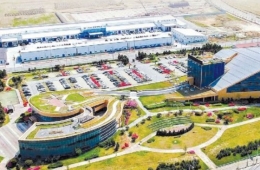
Aerial view of Hyundai Motor Group Meta Plant America. Provided by Hyundai Motor Group
View original imageScenario-Based Countermeasures Prepared for U.S. Policy Variables
During the conference call, Hyundai emphasized that it is meticulously preparing countermeasures for policy variables in the U.S. market. The company has developed scenario-based plans to respond to unexpected policies from the Trump administration, such as the abolition of electric vehicle subsidies stipulated in the U.S. Inflation Reduction Act (IRA) or the imposition of universal tariffs.
Gu Ja-yong, Vice President in charge of Investor Relations, stated, "For the Trump administration to abolish electric vehicle subsidies, congressional approval is required, and that process will not be quick. We expect the subsidies to remain in place at least through this year, with a possibility of ending as early as September."
At the U.S. electric vehicle-dedicated plant Meta Plant America (HMGMA), which began operations last year, Hyundai plans to maintain a flexible production schedule that matches market demand by considering production of hybrids and internal combustion engine vehicles alongside the Ioniq 5 and 9 models.
Regarding the 'universal tariff' card reportedly being considered by the Trump administration, Hyundai is analyzing the potential impacts under various scenarios. Even if universal tariffs are imposed, the company expects the effects to be offset by the strong dollar or to have limited negative impact compared to competitors. Vice President Lee said, "Hyundai’s local production ratio in the U.S. is close to 60%, so the impact of universal tariffs will be limited. We believe the effect on Hyundai will be less than on competitors like Honda or Toyota, which import large volumes from Mexico and Canada."
Hot Picks Today
 Goldman Sachs Raises Forecast to 220%: "KOSPI H...
- Popcorn Container Craze at Theaters Sparks Sell-Out Frenzy, Emerges as New Reven...
- Chairman Choi Jinsik of the Korea Federation of Mid-sized Enterprises: "A Shift ...
- "It Turns Out They Were After My Account" Shocked Reactions... "We're Watching Y...
- "Moms Touch Unruly Woman" Video Spreads... Assaulted Employee and Smashed Regist...
Furthermore, Hyundai revealed plans to enter the North American pickup market by collaborating with GM, with whom it signed a comprehensive cooperation agreement last September, through rebadging electric commercial vehicles. Vice President Lee stated, "Our priority collaboration area is joint procurement, and we are aiming to finalize the rebadging contract for electric commercial vehicles by the first quarter of this year."
© The Asia Business Daily(www.asiae.co.kr). All rights reserved.


!["They Said It Was 'Delicious' Milk... Is the 'List of Fake Milk Products in Korea' for Real? [Matjal X-File]"](https://cwcontent.asiae.co.kr/asiaresize/307/2023072413274517286_1690172865.jpg)