Iran Retaliates After US Shells and Detains Iranian Vessel...Second Round of Talks in Jeopardy (Comprehensive)
US: "Vessel Attempting to Break Maritime Blockade Detained"
Iran Pressures US: "May Not Attend Second Round of Talks"
"Behind-the-Scenes Negotiations Over Nuclear Issue Continue"

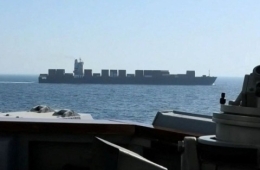
On the 19th (local time), the U.S. Navy guided missile destroyer USS Spruance conducted a seizure operation against the Iranian cargo ship Tuska near the northern Arabian Sea off the coast of Oman. In retaliation for the U.S. seizure of the Iranian vessel, Iran claimed to have struck the U.S. warship with a drone. Reuters/Yonhap News
View original imageAfter the U.S. military fired on an Iranian vessel in the Strait of Hormuz, it has been reported that Iran retaliated with an attack against a U.S. warship. As military tensions between the two countries have risen again, concerns are mounting that the second round of peace talks may not take place. However, both sides are still engaged in behind-the-scenes negotiations over the critical issue of Iran's nuclear program and have not formally declared they will not participate in the talks, drawing global attention to whether the meeting will be held.
U.S.: "Fired on and Seized Iranian Ship"… Iran: "Retaliatory Strike on U.S. Warship"

U.S. Central Command (CENTCOM), which oversees the Middle East, issued a statement on the 19th (local time) saying, "The destroyer USS Spruance intercepted the Tuska, which was heading to Bandar Abbas, Iran, as it was sailing north in the Arabian Sea at 17 knots. Despite issuing repeated warnings to the Tuska's crew over six hours, they did not comply. As a result, several rounds were fired from the ship's guns toward the engine room to disable its propulsion system." The statement continued, "Subsequently, Marines boarded the non-compliant vessel, which is now detained by the U.S. military."
U.S. President Donald Trump also relayed the same details via his social media platform, Truth Social. He stated, "Today, an Iranian cargo ship named 'Tuska,' nearly 900 feet (about 275 meters) long and as heavy as an aircraft carrier, attempted to break through our naval blockade, but failed. The U.S. Navy guided missile destroyer Spruance intercepted Tuska in the Gulf of Oman and issued a legitimate warning to stop, but the Iranian crew did not comply, so our naval warship pierced the engine room to bring it to a halt."
The Iranian side immediately responded, announcing it had carried out a retaliatory strike against the U.S. military. According to Iran's Tasnim News Agency, Iran's Joint Armed Forces Command said in a statement, "The Islamic Revolutionary Guard Corps conducted a drone attack on U.S. Navy warships near the Gulf of Oman. The U.S. violated the cease-fire agreement by firing at an Iranian merchant ship in the Gulf of Oman. There will be even stronger retaliation for this U.S. provocation," the statement warned.
The United States claims that Iran was the first to provoke and violate the cease-fire agreement the previous day. The UK Maritime Trade Operations (UKTMO) reported that on the 18th, two Indian-flagged vessels attempting to transit the Strait of Hormuz were attacked by Iran. President Trump also claimed, "Iran decided to open fire in the Strait of Hormuz yesterday, which is a complete violation of our cease-fire agreement."
Debate is expected under international law over which side broke the mutual cease-fire agreement. Under international law, a 'cease-fire' means that all military actions are suspended during the agreed period. On this, Harlan Ullman, senior fellow at the Atlantic Council, told Al Jazeera, "What the United States did constitutes a declaration of war under international law and is something that should never be undertaken first. Such violations of international law further complicate the already chaotic negotiation process between the United States and Iran," he pointed out.
Trump: "Negotiating Team Arrives on the 20th"… Iran: "Talks Uncertain"

With maritime disputes reigniting, there are growing concerns that the second round of talks between the two countries, scheduled for the 20th, may not take place. President Trump previously announced, "The negotiating team is on its way to Islamabad, Pakistan. They will be there tomorrow evening (the 20th) for negotiations," signaling that the meeting was set to occur.
In connection to this, Iranian media outlets widely reported that Iran's negotiating representative may not attend the second round of talks. The state-run IRNA news agency stated, "Reports that a second round of talks will be held in Islamabad are not true," and "Given the current situation, there is little prospect for substantive negotiations." The report continued, "The United States' excessive, irrational, and unrealistic demands, frequent shifts in position, constant contradictions, the continued naval blockade—which Iran considers a violation of the cease-fire agreement—and threatening rhetoric are all hindering progress in the talks."
There are also concerns that a military operation could be carried out under the guise of the second round of talks. Axios reported, "In Iran, there are suspicions about President Trump's true intentions and worries about the resumption of war. Iranian President Masoud Pezeshkian's expression of distrust toward the United States also reflects this sentiment." Earlier, President Pezeshkian strongly criticized the United States during a phone call with Pakistani Prime Minister Shehbaz Sharif, saying, "The United States has made it clearer than ever that it intends to betray diplomacy by repeating past mistakes."
"Negotiations Continue on the Nuclear Issue… Efforts to Reach a Mediation Plan Underway"

However, as behind-the-scenes negotiations continue over Iran's nuclear program—the key issue in ending hostilities—there are expectations that attempts to negotiate an end to the conflict will persist. Neither side has formally declared their intention not to participate in the talks, so it is possible that the standoff is a strategic move by both parties to strengthen their positions ahead of the second round. Channel 12, an Israeli media outlet, quoted Israeli government officials as saying, "President Trump and Iran ultimately want a solution through negotiations. If an agreement is not reached this week, both sides will extend the cease-fire to buy more time for an accord."
The Wall Street Journal (WSJ), citing local Arab officials, reported, "Iran continues to pursue a large-scale agreement to normalize relations with the United States. Iran, which previously insisted on a five-year suspension of uranium enrichment, has now proposed to the U.S. extending the suspension to 10 years in exchange for allowing the production of low-enriched uranium for 10 years."
Even if the two sides find common ground on the main issues, it is anticipated that a complete peace agreement will take more time. In addition to the nuclear issue, there remain major differences over reopening the Strait of Hormuz and ending Iran's support for armed groups in the Middle East. CNN pointed out, "Even if the U.S. and Iranian delegations hold a second round of talks, there are too many issues to discuss. Many unresolved obstacles remain from previous negotiations. Finding common ground will require resolving issues such as the U.S. blockade of Iranian ports and Iran's blockade of the Strait of Hormuz."
Hot Picks Today
 Goldman Sachs Raises Forecast to 220%: "KOSPI H...
- Popcorn Container Craze at Theaters Sparks Sell-Out Frenzy, Emerges as New Reven...
- "Soaking in the Ganges Will Heal You" Tragedy as 13-Year-Old Boy Dies After 12 H...
- "It Turns Out They Were After My Account" Shocked Reactions... "We're Watching Y...
- "Moms Touch Unruly Woman" Video Spreads... Assaulted Employee and Smashed Regist...
© The Asia Business Daily(www.asiae.co.kr). All rights reserved.



!["They Said It Was 'Delicious' Milk... Is the 'List of Fake Milk Products in Korea' for Real? [Matjal X-File]"](https://cwcontent.asiae.co.kr/asiaresize/307/2023072413274517286_1690172865.jpg)