[US Electric Vehicle Mandate Repeal] "Domestic Car Industry Must Enhance Future Vehicle Competitiveness"
EV Sales to Shrink During Trump Administration
Hyundai and Kia's 36% and 37% EV Conversion Plans Face Setbacks
"Must Strengthen Competitiveness and Face the Challenge Head-on"
"What was bound to happen has happened."
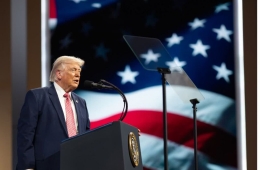
As U.S. President Donald Trump decided to repeal the electric vehicle (EV) mandate, the domestic automotive industry is thrown into turmoil. Hyundai Motor Group, which has been operating an EV factory in the U.S. since last year, will be directly affected.

President Trump revoked the executive order issued by former President Joe Biden to make 50% of all new cars electric on the 20th (local time), which is expected to put a brake on Hyundai Motor and Kia’s plan to convert 36% and 37% of their total sales to EVs within five years. Last year, the EV sales ratio was 5.1% and 6%, respectively.
Hyundai Motor Group is planning massive investments in electrification. Most of the 24 trillion won investment announced this year domestically is ‘all-in’ on EVs. Kia’s Hwaseong ‘EVO (EVO) Plant’ is scheduled for completion in the second half of the year, and Hyundai Motor’s Ulsan EV-only factory will begin operations in the first half of next year.
The local U.S. EV factory is also set for official completion in March. The ‘Hyundai Motor Group Meta Plant America (HMGMA),’ a dedicated EV production plant in Georgia, U.S., which cost a total of $12.6 billion (about 18 trillion won), will start full-scale mass production from the second quarter. In addition, to avoid tariffs, the total annual production capacity of HMGMA, Hyundai Motor’s Alabama plant, and Kia’s Georgia plant will be increased to 1.18 million units, raising the local production ratio in the U.S. to 70%.
However, some analyses suggest that even if subsidies are immediately abolished, the direct impact may not be significant. Earlier this month, the U.S. Environmental Protection Agency (EPA) announced that five models, including Hyundai’s Ioniq 5 and Kia’s EV6, were included for the first time in the Inflation Reduction Act (IRA) subsidy eligibility. Until now, Hyundai Motor Group has utilized a provision that grants a $7,500 tax credit for commercial leases regardless of U.S. production conditions, which helped it rank second in the U.S. EV market last year after Tesla.
![[US Electric Vehicle Mandate Repeal] "Domestic Car Industry Must Enhance Future Vehicle Competitiveness"](http://www.asiae.co.kr/news/img_view.htm?img=2025012209174098429_1737505059.jpg)
Experts advise that although subsidy cuts under the Trump administration are clearly a long-term negative factor, the company should enhance competitiveness and face the challenge head-on.
Kim Juhong, Executive Director of the Korea Automobile Mobility Industry Association, said, "Since October last year, Hyundai has been operating an EV-only factory in Georgia, U.S., and there are concerns about profitability dropping significantly," but added, "Since subsidies also apply to hybrids, it is necessary to flexibly develop models and advance production systems to reduce costs and respond accordingly."
Hot Picks Today
!["Stock Set to Double: This Company Smiles Every Time a Data Center Is Built [Click e-Stock]"](https://cwcontent.asiae.co.kr/asiaresize/93/2026050416112750184_1777878687.jpg) "Stock Set to Double: This Company Smiles Every...
"Stock Set to Double: This Company Smiles Every...
- "Is Yours Just Gathering Dust at Home? Millennials & Gen Z Rediscover Digicams O...
- Trump: "Possible Agreement Before China Visit... Enriched Uranium to Be Sent to ...
- "Continuous Groundwater Pumping Causes Mexico City to Sink 24cm Annually... 'Gia...
- “She Shouted, ‘The Rope Isn’t Tied!’... Chinese Woman Falls from 168m Cliff ...
Lee Hanggu, President of the Korea Automotive Technology Institute, said, "Rather than focusing on EV subsidies, we need to cultivate competitiveness in future vehicles such as autonomous driving with a long-term perspective."
© The Asia Business Daily(www.asiae.co.kr). All rights reserved.