[New York Stock Market] Deal Nears... S&P 500, Nasdaq Hit New Highs Again
Trump: "Agreement Possible Before Visit to China"
Brent Crude Plunges Over 7%
AMD Stock Surges on Strong Earnings
Private Sector Employment Posts Largest Gain Since January Last Year
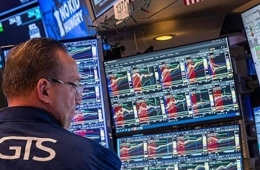
On May 6 (local time), news that the United States and Iran are discussing the signing of a memorandum of understanding (MOU) on ending the war sent all three major U.S. stock indexes surging to close sharply higher. Buoyed by expectations for the end of the war, strong corporate earnings, and robust employment data, both the S&P 500 and the Nasdaq indexes set record highs for the second consecutive trading day.
At the New York Stock Exchange (NYSE), the Dow Jones Industrial Average closed at 49,910.59, up 612.34 points (1.24%) from the previous session. The S&P 500, focused on large-cap stocks, rose 105.90 points (1.46%) to finish at 7,365.12, while the tech-heavy Nasdaq index jumped 2.03% to close at 25,838.943.

The driving force behind the market on this day was optimism over a potential end to the war. According to Axios, reports that the U.S. and Iran are discussing a one-page memorandum of understanding (MOU) regarding the end of the conflict lifted the indexes. The MOU is said to include a temporary halt to Iran's uranium enrichment, the lifting of U.S. sanctions against Iran, a gradual lifting of Iran's blockade of the Strait of Hormuz, and the U.S. phased removal of its maritime blockade against Iran.
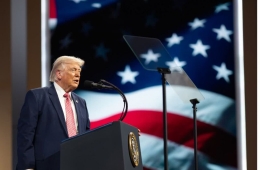
U.S. President Donald Trump also told reporters at the White House, "Iran must not, and will not, have nuclear weapons," adding, "They have agreed to this, among other things."
Earlier, in a PBS interview, President Trump stated that the agreement would include shipping Iran's stockpile of highly enriched uranium to the U.S. and suspending operations at Iran's underground nuclear facilities. He added that an agreement could be reached before the U.S.-China summit.
Amid expectations that the war will soon end, traders reduced their positions, causing oil prices to plummet. On the New York Mercantile Exchange, West Texas Intermediate (WTI) crude for June delivery was down 6.92% from the previous session, trading at $95.18. On the ICE Futures Exchange, Brent crude for July delivery plunged 7.71% to $101.43.
Bill Nosky, Chief Investment Officer at US Bank Asset Management Group, analyzed, "If hostilities ease or cease completely and the Strait of Hormuz is reopened, regions that have been economically most vulnerable and hardest hit, like Southeast Asia and Europe, could avoid further hardship. This would lay the groundwork for a sharp rebound in the stock market."
Corporate earnings announcements also served as a catalyst. Semiconductor company AMD reported first-quarter revenue and net profit that exceeded market expectations, and with a positive outlook for the second quarter, its share price soared 17%.
Most large-cap stocks finished higher. Nvidia surged 6.01%, Apple rose 1.11%, Microsoft gained 0.54%, Amazon increased 0.56%, TSMC advanced 6.45%, Alphabet climbed 2.68%, Meta was up 1.26%, and Tesla rose 2.19%.
Employment data released that day also drew market attention. U.S. employment data provider Automatic Data Processing (ADP) reported that private sector employment in the U.S. increased by 109,000 in April compared to the previous month. This was the largest increase since January 2025 and exceeded the Dow Jones expert consensus forecast of 84,000.
Remarks from Federal Reserve Board members were also released. Austan Goolsbee, President of the Federal Reserve Bank of Chicago, said during a panel discussion at the Milken Institute Global Conference in Los Angeles, "We must continue to monitor forecasts and expectations for the coming surge in productivity," adding, "The greater the hype, the more we may need to raise interest rates to prevent the economy from overheating."
Hot Picks Today
!["Stock Set to Double: This Company Smiles Every Time a Data Center Is Built [Click e-Stock]"](https://cwcontent.asiae.co.kr/asiaresize/93/2026050416112750184_1777878687.jpg) "Stock Set to Double: This Company Smiles Every...
"Stock Set to Double: This Company Smiles Every...
- "Is Yours Just Gathering Dust at Home? Millennials & Gen Z Rediscover Digicams O...
- "SK hynix GDRs Trade at a Premium...Global Demand Set to Surge"[Click e-Stock]
- "High-Net-Worth Investors Managing 10 Trillion Won: 'Gangnam Wealthy Also Feel F...
- “She Shouted, ‘The Rope Isn’t Tied!’... Chinese Woman Falls from 168m Cliff ...
Alberto Musalem, President of the Federal Reserve Bank of St. Louis, attended the Mississippi Bankers Association's annual convention and said, "Inflation is significantly above our 2% target," adding, "There are risks on both the employment and inflation fronts, but as I see it, the risks have shifted more towards inflation than employment."
© The Asia Business Daily(www.asiae.co.kr). All rights reserved.