International Oil Prices Plunge Over 7% on Hopes for US-Iran Deal...Largest Drop Since Mid-April
Largest Drop Since April 17
Brent Down 7.83%, WTI Down 7.03%
"Even if Hormuz Reopens, Normalization Could Take Months"
On May 6 (local time), international oil prices plunged more than 7% on expectations that the United States and Iran were nearing a peace agreement. This marks the largest drop since the middle of last month.

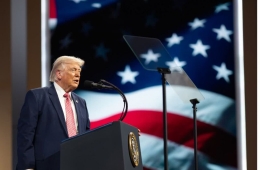
U.S. President Donald Trump is speaking at the White House on the 6th (local time). Photo by AP
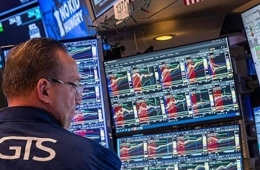
View original imageOn this day, July Brent crude futures, the global benchmark, closed at $101.27 per barrel on the ICE Futures Exchange, down 7.83% from the previous session. June West Texas Intermediate (WTI) futures closed at $95.08 per barrel, a 7.03% decline from the previous day. These drops are the steepest since the middle of last month. Brent and WTI both recorded their lowest levels since April 21 and April 24, respectively. In terms of the scale of the decline, it was the largest since April 17 for both benchmarks.
This sharp decline is interpreted as being driven by expectations of an end to the war between the United States and Iran. The Guardian pointed out that growing hope for a peace agreement between the two countries has led the market to reflect the possibility of the reopening of the Strait of Hormuz.
The political media outlet Axios reported that the two countries are discussing the signing of a Memorandum of Understanding (MOU) to end the war. The MOU reportedly includes a temporary moratorium on Iran’s nuclear enrichment, the lifting of some U.S. sanctions on Iran and the release of a portion of Iran's frozen assets, a gradual lifting of restrictions on passage through the Strait of Hormuz by Iran, and a gradual easing of the U.S. maritime blockade against Iran. The Iranian Revolutionary Guard Corps (IRGC) Navy also stated that “the threat from invading forces has been eliminated,” assuring that safe and stable passage through the Strait of Hormuz will be guaranteed, which further reassured the market.
However, it remains uncertain whether expectations for a peace agreement will materialize immediately. The spokesperson for the Iranian parliament’s National Security and Foreign Policy Committee refuted reports that the U.S. and Iran are close to an MOU to end the war, stating, “This is merely a wish of the United States, not reality.” The Iranian Foreign Ministry also said it was reviewing the U.S. proposal. Iran is expected to communicate its position to Pakistan, the mediator, in the near future.
U.S. President Donald Trump stated in an interview with PBS that there is a possibility an agreement could be reached before his visit to China on the 14th-15th. The Iran war has been cited as a major variable in bilateral relations. However, President Trump also added a warning to Iran, saying that if an agreement is not reached, the U.S. would resume attacks.
Hot Picks Today
!["Stock Set to Double: This Company Smiles Every Time a Data Center Is Built [Click e-Stock]"](https://cwcontent.asiae.co.kr/asiaresize/93/2026050416112750184_1777878687.jpg) "Stock Set to Double: This Company Smiles Every...
"Stock Set to Double: This Company Smiles Every...
- "Is Yours Just Gathering Dust at Home? Millennials & Gen Z Rediscover Digicams O...
- "SK hynix GDRs Trade at a Premium...Global Demand Set to Surge"[Click e-Stock]
- "High-Net-Worth Investors Managing 10 Trillion Won: 'Gangnam Wealthy Also Feel F...
- “She Shouted, ‘The Rope Isn’t Tied!’... Chinese Woman Falls from 168m Cliff ...
David Morrison, Senior Market Analyst at Trade Nation, commented, “Investors are pricing in a ‘peace premium,’ which has triggered increased appetite for risk assets.” He added, “However, even if the Strait reopens, it could take several months for shipping and trade flows to return to normal.” He also noted, “Although crude inventories are not dangerously low overall, the uneven regional distribution and the reduction of buffer stocks are heightening concerns about supply shortages in some areas.”
© The Asia Business Daily(www.asiae.co.kr). All rights reserved.