Foreigners Selling Domestic Stocks for Four Consecutive Months... Net Outflow Expected to Widen Due to Gyeom Incident
International Finance and Foreign Exchange Market Trends Since November
Political Uncertainty Expansion Likely to Increase Future Net Outflows
Won-Dollar Exchange Rate Rises Sharply This Month Due to Martial Law Incident
Concerns about the growth potential of domestic semiconductor companies and global geopolitical risks led to a continuous net outflow of foreign investment funds from domestic stocks for four consecutive months last month. Considering that the figures for last month do not reflect the martial law incident, the scale of net outflows of foreign investment funds is expected to further expand in the future.

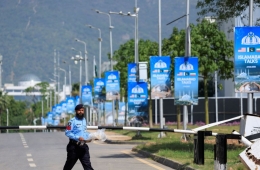
On the 12th, citizens at the Seoul Station waiting room are watching the urgent statement announcement regarding President Yoon Seok-yeol's declaration of martial law. Photo by Kang Jin-hyung
View original imageAccording to the 'International Finance and Foreign Exchange Market Trends since November' announced by the Bank of Korea on the 12th, foreign investment funds in domestic stocks recorded a net outflow of $2.95 billion in November. The scale of net outflows decreased compared to the previous month (-$4.17 billion).
Based on the KRW-USD exchange rate at the end of last month (1,394.7 won), this amounts to approximately 4.11 trillion won. Foreign investment funds in domestic stocks have been in net outflow for four consecutive months since August (-$1.85 billion).
Foreign investment funds in bonds recorded a net inflow of $810 million. This is a significant decrease compared to the previous month ($4.05 billion). Bond investment funds have continued a net inflow trend for eight consecutive months since April.
A Bank of Korea official explained, "Stock funds experienced net outflows due to concerns about the growth potential of domestic semiconductor companies and global geopolitical risks," adding, "Bond funds saw a decrease in net inflow scale due to a slowdown in foreign investment ahead of the year-end and a reduction in short-term arbitrage incentives."
Including both stocks and bonds, foreign investment funds in domestic securities have continued net outflows for three consecutive months. With persistent net outflows in stock funds and a decrease in net inflows in bond funds, the scale of net outflows expanded to $2.14 billion last month, compared to -$120 million the previous month.
Amid increased political uncertainty in the country following the martial law incident, the scale of net outflows of foreign securities investment funds is expected to further expand this month. A Bank of Korea official stated, "The net outflow scale in November does not reflect the martial law incident on December 3," and added, "If the impeachment political situation prolongs, it could negatively impact foreign investment."
Expansion of Political Uncertainty... KRW-USD Exchange Rate Rises by 32.2 Won Compared to End of November
The KRW-USD exchange rate rose significantly this month. The exchange rate, which was 1,379.9 won at the end of October, increased by 14.8 won to 1,394.7 won at the end of November. As of the 10th of this month, it rose sharply to 1,426.9 won, an increase of 32.2 won compared to the end of November.
The Bank of Korea explained that the exchange rate rose substantially due to a combination of strong U.S. economic indicators, the U.S. presidential election results (Red Sweep) leading to a stronger dollar, and domestic political uncertainty.
The daily volatility of the KRW-USD exchange rate slightly decreased compared to the previous month. The daily fluctuation in November was 4.7 won, down from 4.9 won in October. The volatility rate was 0.34%, also lower than the previous month.
The credit default swap (CDS) premium on South Korean government bonds (based on the 5-year Foreign Exchange Stabilization Fund bonds) averaged 34 basis points (1bp = 0.01 percentage points) last month, up from 32 basis points the previous month. The Bank of Korea assessed that external foreign currency borrowing conditions remained generally stable in November.
Hot Picks Today
 Applied Just for Skin Soothing...Study Finds It...
- "Only the Top 1% Winning Big in Stocks Smile... '300 Million Won Splurges' or '1...
- "Paying More Than the Listed Price?"... Academies Caught in the Act of Illicit T...
- "If You Pay, I'll Close the Case"... Former Korea Customs SJPO Who Took 145 Mill...
- "Please Launch It in Korea!" After All the Hype... This Coffee Finally Arrives i...
A CDS is a financial derivative product that acts as insurance to compensate for losses if the issuing country or company defaults. When the economic risk of the country increases, the premium generally rises as well.
© The Asia Business Daily(www.asiae.co.kr). All rights reserved.





![Is This a Boom or a Recession? Queues for Both Luxury and Bargain Goods [K-Shaped Consumption Era]](https://cwcontent.asiae.co.kr/asiaresize/307/2026042114133834494_1776748418.png)