[Issue Interview] 'A Second Life on Campus'... How to Revive Both Regional Universities and the Elderly
Professor Yuseon Jong, Department of Real Estate Studies, Konkuk University
"Japan's Rikkyo University operates a separate admission quota specifically for elderly students. For them, degree programs are shortened, and tuition fees are reduced. This provides learning opportunities for elderly people who either did not receive university education when they were younger or wish to study new fields after retirement. This serves as a reference precedent in the domestic situation where there is even a saying that 'local universities close down in the order that cherry blossoms bloom.'
As the school-age population decreases due to population decline, the number of universities closing is increasing. Amid universities seeking new roles in the aging era, the introduction of University Based Retirement Communities (UBRC) is being actively promoted domestically. On the 6th, at a research lab in Konkuk University, we met Professor Yoo Seon-jong of Konkuk University's Department of Real Estate, an expert who has studied elderly housing policies since his study abroad in Japan in the 1990s and is currently recognized as an expert in the senior housing field, including undertaking government-related research projects.
Professor Yoo explained, "Under the current system, university-owned assets cannot be sold or repurposed without approval from the Ministry of Education. UBRC, which creates elderly retirement villages by utilizing idle facilities of local universities, will be a new alternative for both local universities struggling with declining school-age populations and elderly people concerned about quality of life after retirement. It is necessary to actively promote this at the government level."

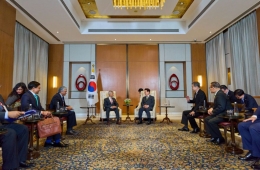
On December 6th, Professor Yoo Seon-jong of the Department of Real Estate at Konkuk University was interviewed by Asia Economy. Photo by Park Yoo-jin
View original image- You started researching elderly housing since your study abroad in Japan.
▲ When I went to study in Japan in 1994, I initially intended to research the reconstruction market. However, observing the rapid aging in Japan, I thought Korea would progress even faster. While writing my doctoral dissertation on housing pensions (reverse mortgage), I also worked on a project for Japan's Ministry of Health and Welfare. During that process, I discovered that elderly people spend more than half of their pension income on housing costs, which naturally led me to start researching elderly housing.
In the summer of 2007, I purchased a transportation pass in Japan and traveled nationwide from Hokkaido, visiting elderly housing facilities. I carefully examined operation manuals, cost structures, and so on. Ten years later, in 2017, during my sabbatical year, I toured Japan again to observe changes. Japan has about 20 types of elderly housing, and this field research was very helpful in understanding their characteristics and differences.
- What is the specific concept and advantages of UBRC?
▲ It is about creating elderly retirement villages by utilizing idle facilities and personnel of local universities. Due to declining student numbers, local universities have surplus facilities and staff, which can be newly utilized. Elderly people can mentor students and attend lectures as part of lifelong education. Universities secure new revenue sources, and elderly people gain an environment that can extend their healthy life expectancy.
- How is funding arranged?
▲ It is quite feasible by combining funds related to regional vitality town creation from the Ministry of Land, Infrastructure and Transport, the local extinction response fund from the Ministry of the Interior and Safety, and university support from the Ministry of Education. The Ministry of the Interior and Safety holds over 1 trillion won in the local extinction response fund. This model can simultaneously achieve two goals: solving local university problems and revitalizing regions.
- Aren't there many people who want to live at home until they die?
▲ In the past, people passed away within a month or two after their health deteriorated. But now, due to advances in medical technology, bedridden elderly live several more years. Healthy life expectancy usually ends around 70 to 75 years old, but people live long until average life expectancy afterward. Therefore, it is important to move to facilities that can extend healthy life expectancy while still healthy. The current home is a good space when healthy but becomes a dangerous space once healthy life expectancy is lost.
- What institutional improvements are needed to activate UBRC?
▲ Currently, it is difficult to utilize idle university assets without approval from the Ministry of Education. Sales or repurposing are not possible. Therefore, the Ministry of Education should policy-wise promote the establishment of UBRC and conduct pilot projects with two or three universities first to verify effectiveness. Dongmyung University, Chosun University, and Wonkwang University are preparing, but so far it has started more from a sense of crisis than voluntarily.
- How can cost issues be resolved?
▲ Currently, most elderly people in Korea are sitting on real estate assets that are not liquidated. When converting housing costs to monthly rent and adding food and housekeeping costs, it amounts to about 3 to 4 million won. Based on occupational pensions, this is a level that couples can sufficiently afford. Especially in local areas, it is possible at even lower costs. It should be seen as shifting the costs spent on labor at home to facilities.
- What are your future research plans?
▲ During the remainder of my professorial career, I want to help the elderly housing market in Korea properly establish itself. I will continue not only theoretical research but also practical case studies. I am currently preparing a book summarizing Japanese elderly housing cases, scheduled for publication in the first quarter of next year. It will be a professional book introducing UBRC and CCRC (Continuing Care Retirement Communities).
- I heard Japan has a well-developed elderly housing information disclosure system.
▲ Japan has a system called the 'Important Matters Explanation Document.' It discloses all information such as the facility's legal status, operating entity, number of staff, number of residents, residents' health status, number of residents by length of stay, rent, and deposit. This detailed document, spanning 10 to 30 pages, allows one to accurately understand the operational status without visiting the facility. Korea also needs to introduce such an information disclosure system.
- What are the characteristics of elderly housing in Japan?
▲ Japan has well-established tiered facilities such as independent living, assist living, and nursing homes. Especially, 'assist living,' which Korea does not have, is important; it is an intermediate stage between full independence and nursing care. From the operator's perspective, it is the most profitable. Although the space is smaller than independent living, premium services can generate 1.5 to 2 times the income.
- Is the introduction of assist living necessary?
▲ It is absolutely necessary. Currently, Korea only has elderly welfare housing for healthy elderly and nursing facilities for bedridden elderly. There is no intermediate stage, so if health suddenly deteriorates, one must go directly to a nursing home. With assist living, elderly can move stepwise according to health status and sometimes return to independent living if health improves.
Hot Picks Today
 Goldman Sachs Raises Forecast to 220%: "KOSPI H...
- Popcorn Container Craze at Theaters Sparks Sell-Out Frenzy, Emerges as New Reven...
- "Soaking in the Ganges Will Heal You" Tragedy as 13-Year-Old Boy Dies After 12 H...
- "It Turns Out They Were After My Account" Shocked Reactions... "We're Watching Y...
- "Moms Touch Unruly Woman" Video Spreads... Assaulted Employee and Smashed Regist...
- What is the desirable direction for future elderly housing policy in Korea?
▲ Elderly housing should be a platform that extends healthy life expectancy, not just a simple living space. Various housing models such as UBRC, Silver Stay, and assist living should be developed, and consumer choice should be guaranteed through information disclosure. Also, integrated care systems combining medical and care services must be established. Given the rapid aging speed, policies must be implemented swiftly.
© The Asia Business Daily(www.asiae.co.kr). All rights reserved.



!["They Said It Was 'Delicious' Milk... Is the 'List of Fake Milk Products in Korea' for Real? [Matjal X-File]"](https://cwcontent.asiae.co.kr/asiaresize/307/2023072413274517286_1690172865.jpg)