Opposition Party Unilaterally Passes 'Bangmunjin Act'... Last Filibuster Begins on 'Broadcasting 4 Acts'
Passage of the Visitjin Act in the Plenary Session on the Morning of the 29th
All Four Broadcasting Laws Expected to be Processed by the 30th
Unlimited Debate Likely to Exceed 100 Hours
The third bill among the 'Broadcasting Four Acts' promoted by the Democratic Party of Korea, the amendment to the 'Broadcasting Culture Promotion Act (Bangmunjin Act),' passed the plenary session on the morning of the 29th solely by the opposition party. Speaker Woo Won-sik immediately tabled the last bill of the Broadcasting Four Acts, the 'Educational Broadcasting System Act (EBS Act),' after the passage of the Bangmunjin Act amendment.
On the same day, the Democratic Party forcibly ended the filibuster (unlimited debate) by the People Power Party, which began shortly after the Bangmunjin Act was tabled in the early hours of the 28th, after 30 hours and 55 minutes, and proceeded to vote on and pass the bill. The Bangmunjin Act was passed with 187 votes in favor out of 187 members present. Ruling party lawmakers protested the forced passage of the bill by not participating in the vote and leaving the chamber.
The filibuster, which has continued for five days until this day, is expected to end after all the Broadcasting Four Acts are processed on the 30th. The filibuster, which began on the 25th, had lasted about 85 hours until the morning of this day. If the filibuster continues until the 30th, the debate time will exceed 100 hours, marking the second-longest filibuster in history. The longest filibuster in history was 192 hours and 25 minutes, conducted by the Democratic Party in 2016 opposing the 'Anti-Terrorism Act.'

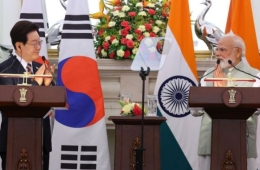
On the 29th, as the Broadcasting Culture Promotion Act (Bangmunjin Act), one of the 'Four Broadcasting Laws,' was passed in the National Assembly plenary session, opposition party lawmakers applauded. Photo by Hyunmin Kim kimhyun81@
View original imageThe first bill among the Broadcasting Four Acts, the 'Act on the Establishment and Operation of the Korea Communications Commission (KCC Act)' was passed solely by the opposition party on the afternoon of the 26th. The second bill, the amendment to the Broadcasting Act, which restructures the governance of the public broadcaster KBS, passed in the early hours of the 28th. The People Power Party conducted a filibuster for 24 hours and 7 minutes against the first KCC Act and 30 hours and 46 minutes against the Broadcasting Act.
Speaker Woo plans to table the fourth bill, the EBS Act, to complete all the Broadcasting Four Acts. The People Power Party defines the Broadcasting Four Acts as the Democratic Party's 'broadcasting control laws' aimed at permanently dominating public broadcasting and plans to respond with filibusters. The Broadcasting Four Acts mainly increase the number of public broadcasting directors from the current 9 to 11 to 21 and grant the right to recommend directors to related professional organizations and others. The core is to expand the director recommendation rights of public broadcasters such as KBS, MBC, and EBS, where the KCC's authority has been strong, to viewers and related institutions or organizations. Additionally, the president of public broadcasters will be recommended by a National Recommendation Committee, which will propose multiple candidates.
Hot Picks Today
 "Six Months After 'Mom's Touch Troublesome Woma...
- Popcorn Container Craze at Theaters Sparks Sell-Out Frenzy, Emerges as New Reven...
- "With This Certificate, Even Those in Their 60s Can Get Hired and Earn 3.69 Mill...
- When His Father Suddenly Collapsed Before His Eyes... 13-Year-Old Son Preserves ...
- Female Game Caster Makes Bold Move After Criticism Over "Short Skirt" on Broadca...
However, there are concerns that fatigue is accumulating as the confrontation between the ruling and opposition parties over the contentious bills is prolonged. This is because the political deadlock phase, which proceeds in the sequence of bill tabling → filibuster → opposition party sole passage → presidential request for reconsideration (veto) → re-vote → bill abandonment, is being repeated.
© The Asia Business Daily(www.asiae.co.kr). All rights reserved.



!["They Said It Was 'Delicious' Milk... Is the 'List of Fake Milk Products in Korea' for Real? [Matjal X-File]"](https://cwcontent.asiae.co.kr/asiaresize/307/2023072413274517286_1690172865.jpg)