Jeong In-gyo Visits Renault Busan Plant, "Expecting Investment in Electric Vehicle Production Facilities Following HEV"
Jung In-kyo, Head of the Trade Negotiation Headquarters at the Ministry of Trade, Industry and Energy, visited export and foreign investment sites that led economic growth in the first half of the year, embarking on a full-scale effort to achieve this year's export target of $700 billion and foreign investment of $35 billion.
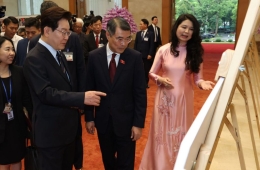
The Ministry of Trade, Industry and Energy announced that Head Jung will visit Renault Korea's Busan plant and Busan New Port consecutively on the 12th.
Since entering Korea in 2000, Renault Korea has steadily contributed to exports (a cumulative total of 1.07 million units) and regional job creation (more than 50,000 people including partner companies). It is currently investing a total of 450 billion KRW (foreign investment of 102.5 billion KRW) to convert the internal combustion vehicle production facilities at the Busan plant into eco-friendly hybrid new car production facilities. Through this, the Ministry expects that Renault Korea’s Busan plant will not only maintain existing employment but also create more than 200 new jobs and contribute to revitalizing the local economy by expanding parts procurement from partner companies.

Head Jung said, "Following the hybrid vehicle investment, I hope that the electric vehicle investment plan will be finalized soon, and the government will do its best to create a better investment environment." He also urged, "Please make efforts to procure key parts such as batteries and motors from Korean companies when producing electric vehicles in the future."
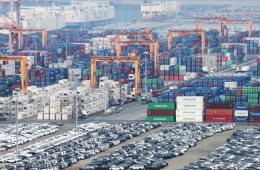
Head Jung will visit Busan New Port, which serves as the forward base for export-import logistics, to inspect maritime logistics risks. Busan Port is the largest export-import port in Korea, handling 63% of the country's total export-import container volume (as of 2022).
Based on the recognition that "export expansion leads to economic growth and recovery of people’s livelihoods," the government has set and supported a challenging goal of a record-high $700 billion in exports this year. Exports increased by 9.1% in the first half of this year compared to the previous year, and the trade surplus reached $23.1 billion, the largest first-half surplus since 2018 ($31.1 billion), driving economic growth. The Ministry of Trade, Industry and Energy forecasts that exports will continue to perform well in the second half, centered on IT items such as semiconductors.
However, the recent rise in maritime freight rates has emerged as a key risk to our exports. Regarding this, Head Jung stated, "The impact of rising maritime freight rates on exports has been limited so far, but since the possibility of continued rate increases is high, proactive response and thorough management are required at this time." He emphasized, "The government has been proactively implementing contingency plans such as easing logistics cost burdens and expanding shipping capacity. If rates rise further and enter stage 3 (currently at stage 2), a joint export emergency response team involving related ministries will be activated to promptly prepare additional logistics support measures."
Hot Picks Today
 Thailand and India Surpass 50%, but Korea Only ...
- "Why Is My Chanel Wallet on Danggeun?"...High School Students Steal Luxury Goods...
- "Why Are They Doing This?" Bizarre 'Streetlight Challenge' Involving Leg-Wrappin...
- "Doctors Never Eat This": Foods Warned Against by Asan Medical Center Professor
- Chilling Timing "Did They Know Again?"... $640 Million Suspicious Bet Just 15 Mi...
Head Jung will also visit the Korea Maritime Institute to review trends in discussions on new trade norms such as the World Trade Organization (WTO) Fisheries Subsidies Agreement, trends in non-tariff barriers on seafood products, and export expansion strategies. At this meeting, he plans to request the establishment of a close cooperation system among the public, private, and research sectors to actively respond to trade issues in the maritime and fisheries fields.
© The Asia Business Daily(www.asiae.co.kr). All rights reserved.