[The Editors' Verdict] The Endless Summer Battle of the Semi-Basement
![[The Editors' Verdict] The Endless Summer Battle of the Semi-Basement](http://www.asiae.co.kr/news/img_view.htm?img=2023060707451054456_1686091510.jpg)
"Damp air presses against the tip of my nose. The falling rain runs down the smeared walls. When moisture seeps through the worn-out floor mats, I grab a mop. Wiping and wringing take up the whole day. Before falling asleep, my only wish is for the rain to stop."
This is part of a story shared by an acquaintance about living in a semi-basement room. Every summer, 200,000 households in Seoul face a battle against the rain. Still, this is somewhat fortunate. The real fear is that, like the house of Ki-taek in the movie Parasite (2019), the basement could fill completely with water. The scene where Ki-taek’s daughter clings to the toilet, vomiting in a bathroom flooded up to her waist, might be amusing or intriguing to some. However, for semi-basement residents, it is pure terror.
In a semi-basement, it’s not easy to open windows to get rid of the damp smell?whether it’s the scent of wet cement or mold spreading in every corner. It’s scary enough that rain seeps in, but it’s even more uncomfortable when people’s eyes fixate on the few belongings inside.
Because of this, living in a semi-basement makes one sensitive to water. Even hearing water cleaning upstairs causes a startle. Flooding is inevitable in semi-basements. Water used for cleaning upstairs, along with dust and trash from each floor, flows down the stairs and gathers in front of the semi-basement entrance. If drainage works, it’s fortunate, but most semi-basements are located in old houses. Water pooling over clogged drains doesn’t dry and instead rots.
Nationwide, about 327,000 households (according to the 2020 Population Census) enter this annual battle with water every summer. Assuming four people per household, over one million people are involved.
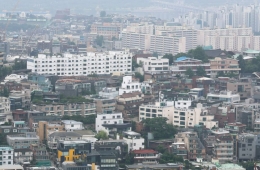
Every year, the battle becomes more unfavorable. Aging is a hidden enemy eroding the residential function of semi-basements. According to a survey by Seoul City from 2022 to 2023, there are 237,619 semi-basement households. Over 80% of these were built before 1995. People started living in basement floors, which were not originally intended as living spaces, from 1976. Basements installed in the 1960s for air-raid shelters were opened up for habitation. As the population concentrated in Seoul, people were allowed to live underground. The proportion of buildings with basements increased from only 7% before 1976 to 91% in the 1980s and 95% in the 1990s. This led to the spread of old semi-basements throughout Seoul.
The weather has become harsher. More rain falls in shorter periods. According to the Korea Meteorological Administration’s climate change scenario (SSP), the annual rainfall in South Korea between 2041 and 2060 is expected to increase by 6?7% compared to now, but the number of rainy days will decrease by 8?11%. The KMA anticipates that the average rainfall intensity will increase by 16?20%. The probability of sudden, overwhelming floods hitting semi-basements without warning has thus increased.
This battle must end before it’s too late. Homeowners who should eliminate semi-basements are not cooperative. Removing semi-basements through rebuilding or remodeling would mean losing at least three rows of housing units. Some of them even oppose installing water barriers on semi-basement windows, fearing the stigma of ‘flooded housing’ could affect property values.
Hot Picks Today
 Chilling Timing "Did They Know Again?"... $640 ...
- Thailand and India Surpass 50%, but Korea Only at 37%... Falling Behind in the A...
- "Why Is My Chanel Wallet on Danggeun?"...High School Students Steal Luxury Goods...
- "Woke Up to a Strange Smell"...Both Feet Placed on KTX Front Armrest
- "I Can't Believe They're Real": Cockroaches Squirm Inside Transparent Jacket in ...
The government’s promise to phase out semi-basements must be kept. Through support from the government and Seoul City, only about 5,000 households have escaped semi-basements and moved into rental housing over the past two years. That’s only about 2.5% of the 200,000 semi-basement households. If purchase costs are an issue, at least deposits or monthly rents for semi-basement tenants should be supported. However, even this is said to lack feasibility. Realistic support on either front is necessary to end the war against semi-basements.
© The Asia Business Daily(www.asiae.co.kr). All rights reserved.