How Long Will the Current Account Surplus Led by Semiconductors Continue?
Current Account Surplus Continues for 10 Consecutive Months
Surplus Trend Expected to Last for a Significant Period Due to Semiconductor Export Boom

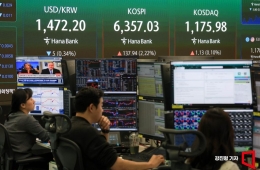
As the semiconductor market recovers, South Korea's current account balance continued its surplus streak for the 10th consecutive month in February. With the global IT (information and communication) industry improving, semiconductor demand is expected to keep rising, leading to a continued surplus in the current account balance.
According to the preliminary balance of payments statistics released by the Bank of Korea on the 5th, South Korea's current account surplus in February reached $6.86 billion. This surplus increased compared to the $3.05 billion recorded in the previous month. The current account surplus has been sustained for 10 consecutive months since May last year. The surplus amount was also the third highest ever recorded for February.
The current account surplus was driven by exports. February exports amounted to $52.16 billion, approximately 3% higher than the same period last year. By item, semiconductor exports surged 63% year-on-year, leading the overall export improvement.
This semiconductor market improvement is also reflected in Samsung Electronics' earnings announced the previous day. Samsung Electronics reported that its consolidated operating profit for the first quarter of this year was preliminarily estimated at 6.6 trillion won, a 931.25% increase compared to the same period last year. This amount even exceeds Samsung Electronics' full-year operating profit of 6.57 trillion won last year.

Sales reached 71 trillion won, an 11.37% increase compared to the same period last year. This earnings result was an earnings surprise exceeding securities firms' forecasts by more than 20%, with semiconductors credited as the driving force. Although segment-specific results were not disclosed that day, the securities industry expects Samsung Electronics' Device Solutions (DS) division, responsible for the semiconductor business, to have posted an operating profit between 700 billion and 1 trillion won, turning profitable for the first time in five quarters since Q4 2022.
Song Jae-chang, head of the Bank of Korea's Financial Statistics Department, said, "Semiconductors have continuously driven the current account surplus," adding, "With increasing demand for AI (artificial intelligence) and data centers, improvements continue in semiconductor front industries such as servers, mobile devices, and PCs."
The semiconductor market upswing is expected to continue for some time. According to Taiwanese market research firm TrendForce, DRAM ASP in Q1 rose up to 20% compared to the previous quarter and is expected to increase by 3-8% in Q2. NAND prices also rose 23-28% in Q1 and are forecasted to increase by 13-18% in Q2.
The rising demand for HBM (High Bandwidth Memory), used in AI semiconductors, is also expected to help improve semiconductor exports. Thanks to the expansion of generative AI services, shipments of Graphics Processing Units (GPUs) and Neural Processing Units (NPUs) have surged, and the HBM market is projected to experience rapid growth until 2026.

On the morning of the 5th, the 2024 February Balance of Payments (provisional) briefing was held at the Bank of Korea in Jung-gu, Seoul. From the left in the photo: Kim Tae-ho, Manager of the International Balance of Payments Team at the Bank of Korea; Song Jae-chang, Head of the Financial Statistics Department; Moon Hye-jung, Head of the International Balance of Payments Team; Ahn Yong-bi, Manager of the International Balance of Payments Team. Photo by Bank of Korea
View original imageFebruary imports amounted to $45.55 billion, down 12.2% year-on-year. The decline in energy prices led to a continued decrease centered on raw materials. Raw material imports in February fell 19.1% compared to the previous year. Imports of major items mostly decreased: gas by -48.6%, chemical products by -23.2%, coal by -17.5%, and petroleum products by -15.1%. Capital goods imports, mainly information and communication devices (-31.4%), also decreased by 5.3%, and consumer goods imports shrank by 6.6%, including passenger cars (-19.7%) and grains (-17.2%).
With exports rising and imports falling, the February goods balance surplus reached $6.61 billion, successfully turning to a surplus compared to the previous year. The surplus also expanded compared to the $4.24 billion recorded in the previous month. Due to export improvements, the current account surplus is expected to continue for the time being. Song said, "We expect the current account surplus to continue for the time being due to the semiconductor market improvement."
Hot Picks Today
![[Exclusive] Latest Cancer Treatment Costs Rise by 40 Million Won... War Disrupts Raw Material Supply, Domestic Production Stalled Without Budget](https://cwcontent.asiae.co.kr/asiaresize/93/2026042109055833701_1776729958.jpg) [Exclusive] Latest Cancer Treatment Costs Rise ...
[Exclusive] Latest Cancer Treatment Costs Rise ...
- As Oil Prices Soar and Criticism Mounts, Trump Announces "Special Measures"...In...
- [Breaking] Police Request Arrest Warrant for Bang Si-hyuk on Charges of Fraudule...
- Female Game Caster Makes Bold Move After Criticism Over "Short Skirt" on Broadca...
- Couple Secretly Making Love on Mountain Summit... Broadcast Live on the Internet
However, rising international oil prices are expected to increase raw material import costs, negatively affecting the current account surplus. Song predicted, "International oil prices have recently been on the rise, and although with a time lag, this will also impact crude oil import prices."
© The Asia Business Daily(www.asiae.co.kr). All rights reserved.


!["They Said It Was 'Delicious' Milk... Is the 'List of Fake Milk Products in Korea' for Real? [Matjal X-File]"](https://cwcontent.asiae.co.kr/asiaresize/307/2023072413274517286_1690172865.jpg)