[YeitSuda] People Unhappy with the Success of 'Seoul's Spring'
"Please, do not come to watch the movie. It is really too exhausting."

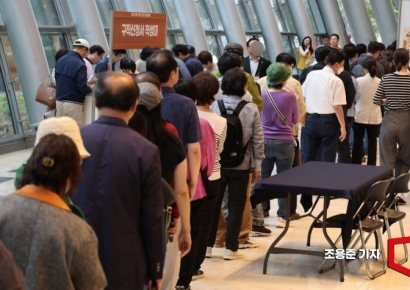
On the 44th anniversary of the December 12 military coup, the film "Spring in Seoul," which is based on the December 12 military coup, is being screened at a movie theater in Seoul on the 12th. Photo by Jinhyung Kang aymsdream@
View original imageAs the movie 'Seoul's Spring' surpassed 7 million cumulative weekend viewers in its third week since release, a plea from a theater employee has become a hot topic. A person presumed to be working at a movie theater, referred to as A, explained on an anonymous community for office workers, "Recently, 'Seoul's Spring' has been a huge hit, and an enormous number of viewers are coming in, but there are no staff, the screening rooms are dirty, and if you ordered at the concession stand, you must have waited a long time because there are no employees."
A continued, "The workforce has been reduced by more than half compared to last year, so only one or two people are barely managing to handle every sold-out screening at the same time. In the past, when business was good, labor costs increased, so we hired part-timers, and when company sales grew, treatment improved, which made me happy. But now, even if business is good, since only I am struggling, I wish the audience wouldn't come."
The theater industry faced a crisis of collapse due to the prolonged COVID-19 pandemic, and in 2020, large-scale personnel reductions such as voluntary retirement and unpaid leave were implemented to reduce fixed costs. Fixed costs such as theater rent, maintenance fees, and labor costs have increased every year, but sales plummeted due to COVID-19, leading to a surge in theater closures. Eventually, the three major multiplex chains announced ticket price increases three times to improve profitability.
Since last year, as quarantine measures eased and Hollywood blockbusters were released, theaters seemed to regain vitality. However, the reduced on-site workforce has not been replenished to pre-COVID levels, leading to safety accidents in various theaters and expanding controversy. In June last year, a fire alarm went off during a movie screening, causing all viewers to evacuate and fire trucks to respond. Fortunately, it was a false alarm caused by a malfunction. Around the same time, a fire broke out on the rooftop of another theater building, prompting evacuation of viewers. It was revealed that the person guiding the evacuation was a police officer, not a theater employee, leading to criticism of inadequate safety response.
According to the CJ CGV audit report, the total number of part-time workers at CJ CGV in the first quarter of 2022 was 2,102, a 62.8% decrease compared to the end of 2019 before COVID-19. In particular, the number of fixed-term part-time workers was 329, showing an 83.7% reduction compared to pre-COVID-19. The number of fixed-term part-time workers, which was 2,010 at the end of 2019, drastically shrank to less than 200 in 2020, and as of the end of 2021, it remains at about one-quarter of the pre-COVID-19 level.
Lotte Cinema headquarters recently sent a notice to Lotte Cultureworks’ nationwide directly operated theaters to reduce staff and maintain working hours at about 50% compared to October this year. Since the 29th of last month, voluntary retirement has been accepted for employees with more than three years of service. Megabox Joongang is also reportedly considering voluntary retirement recently. This is analyzed as a move to normalize operations through cost reduction such as restructuring, as performance has not easily recovered despite the endemic situation.
Among the workers drastically reduced during the process of cutting on-site staff due to poor performance, the majority are short-term contract fixed-term part-time workers. Regular employees are also overwhelmed with excessive workloads, and for them, the success of 'Seoul's Spring' is nothing but an unwelcome celebration at someone else's house. To address the unsanitary viewing environment and safety issues relative to the increased ticket prices, urgent workforce replenishment and infrastructure development in the theater industry are needed.
Hot Picks Today
 "With This Certificate, Even Those in Their 60s...
- Popcorn Container Craze at Theaters Sparks Sell-Out Frenzy, Emerges as New Reven...
- When His Father Suddenly Collapsed Before His Eyes... 13-Year-Old Son Preserves ...
- Female Game Caster Makes Bold Move After Criticism Over "Short Skirt" on Broadca...
- "Quit Office Job to Earn Over 200 Million Won a Year"… Chinese Woman in Her 30s...
© The Asia Business Daily(www.asiae.co.kr). All rights reserved.



!["They Said It Was 'Delicious' Milk... Is the 'List of Fake Milk Products in Korea' for Real? [Matjal X-File]"](https://cwcontent.asiae.co.kr/asiaresize/307/2023072413274517286_1690172865.jpg)