"China, Same Criminals as North Korea"... US Congress Pressures on Defector Issues
2,000 North Korean Defectors in Chinese Detention Centers... Risk of Repatriation
US Congress CECC Discusses Human Rights Issues of Defectors in China
"Ignoring Harsh Punishment upon Repatriation... China is Just Like Kim Jong-un"
Concerns have been raised in the U.S. Congress that thousands of North Korean defectors could be forcibly repatriated once the COVID-19 lockdown ends and the North Korea-China border reopens. Following warnings from the United Nations Committee on the Elimination of Discrimination against Women (CEDAW) that China has become a "final destination for human trafficking of North Korean women," international pressure on China is intensifying.
According to North Korean human rights organizations on the 14th, the Congressional-Executive Commission on China (CECC), a bipartisan body under the U.S. Congress, held a hearing yesterday on the topic of the "Risk of Forced Repatriation of North Korean Defectors in China." Korean experts appeared as "expert witnesses" at the hearing, including Shin Hee-seok, former legal analyst at the Transitional Justice Working Group (TJWG); Song Hanna, international cooperation director at the North Korea Human Rights Database Center (NKDB); and Lee Jung-hoon, dean of the Graduate School of International Studies at Yonsei University.
![Our expert witnesses from the Korean side attending the hearing of the Legislative and Executive Branch China Committee. From the left, Shin Hee-seok, Legal Analyst of the Transitional Justice Working Group (TJWG), and Song Hanna, International Cooperation Director of the North Korea Human Rights Database Center (NKDB) <br>[Photo by Yonhap News]](http://www.asiae.co.kr/news/img_view.htm?img=2023061410491063213_1686707349.jpg)
Our expert witnesses from the Korean side attending the hearing of the Legislative and Executive Branch China Committee. From the left, Shin Hee-seok, Legal Analyst of the Transitional Justice Working Group (TJWG), and Song Hanna, International Cooperation Director of the North Korea Human Rights Database Center (NKDB)
[Photo by Yonhap News]
Since North Korea closed its borders in January 2020 due to the spread of COVID-19, it is estimated that around 2,000 North Korean defectors have been detained in facilities within China. Director Song Hanna cited this figure and revealed satellite images suggesting the expansion of detention facilities for defectors by Chinese public security authorities.
Photos taken in October last year showed that compared to September 2019, the roofs of existing buildings had been replaced, indicating repairs and renovations, and several new buildings had been constructed. Director Song stated, "Through interviews with former Chinese officials and those who have experienced detention, as well as field investigations, we confirmed the locations of six major detention facilities operated by the Chinese Public Security Border Defense Corps (PSBDC) along the North Korean border." She specifically pointed out a detention facility in Helong City, China, adjacent to Musan County in North Korea, noting, "Satellite images show new fences and additional facility construction around the watchtowers."
She warned, "If North Korea reopens its border with China, China will deport defectors back to North Korea. If large-scale repatriations begin, a humanitarian crisis is expected." She further expressed concern, stating, "Survivors have detailed torture including beatings, electric shocks, and sexual assault," and "They suffer forced labor and are compelled to work under harsh conditions without pay or basic rights."
Additionally, Chinese authorities have introduced surveillance technologies such as facial recognition to crack down on defectors, which has increased risks and caused broker fees for defectors to rise significantly over the past three years. Director Song noted, "Broker fees have increased from 20 million won per person before COVID-19 to 50 million won earlier this year," adding, "There have even been cases where brokers refused offers of up to 100 million won due to security concerns."
From the UN to the U.S.... Human Rights Violations of 'North Korean Defectors in China' Publicized
![Satellite Image of North Korean Defectors Detention Facility by Chinese Public Security [Photo by North Korea Human Rights Information Center]](http://www.asiae.co.kr/news/img_view.htm?img=2023061410490163211_1686707340.jpg)
Satellite Image of North Korean Defectors Detention Facility by Chinese Public Security [Photo by North Korea Human Rights Information Center]
View original imagePrior to the hearing, at the end of last month, the United Nations Committee on the Elimination of Discrimination against Women strongly criticized human rights abuses against North Korean women defectors in China. Following the international organization, the U.S. is also increasing pressure on China. The background to the initial publicization of issues such as human trafficking, forced marriage, and sexual assault faced by North Korean women defectors in China at the UN was reports from Korean human rights organizations. It is assessed that the presence of Korean witnesses at the U.S. congressional hearing is not unrelated to this.
Shin Hee-seok, legal analyst at the Transitional Justice Working Group, defined North Korea as having diverted scarce resources not only to developing weapons of mass destruction but also to building a kind of security barrier at its borders, calling it a "Juche wall" designed to permanently imprison its own citizens (North Korean residents). He pointed out, "Some ethnic Korean pastors who helped defectors have been assassinated by the North Korean side, but China also turns a blind eye to this," adding, "It is widely known that to preserve the 'purity' of the Korean people, pregnant North Korean women defectors and their babies have been exposed to abortion and infanticide."
Shin urged the international community to act before a real crisis arises from large-scale forced repatriations when the border reopens. Specifically, he called for demands that the Chinese government disclose data such as the number of North Korean detainees facing deportation to North Korea, the number of North Koreans issued residence permits, the number of children born to North Korean women and Chinese husbands, and the existence and data related to refugee application procedures for North Koreans. He also proposed considering strengthening sanctions targeting Chinese individuals or organizations complicit in human rights abuses against North Koreans.
Lee Jung-hoon, former ambassador for international cooperation on North Korean human rights and dean of Yonsei University's Graduate School of International Studies, pointed to the "Moon Jae-in administration" as the reason for the lack of progress on North Korean human rights issues during the hearing. He criticized, "The Moon Jae-in administration pursued a delusional peace policy that ignored North Korean human rights issues over the past five years," and also directly criticized, "The Trump administration's attempts to court Kim Jong-un were also wrong." Furthermore, citing the case where South Africa was suspended by the UN for its apartheid policies, he strongly demanded, "The UN should take the same level of measures against North Korea."
"China Threw Defectors Who Escaped Kim Jong-un into the 'Meat Grinder'"
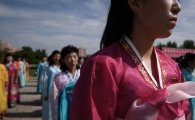
![In September 2018, North Korean women dressed in hanbok participated in the "International March for Peace, Prosperity, and Reunification of Korea" held on the outskirts of Pyongyang. [Image source=AFP·Getty image]](http://www.asiae.co.kr/news/img_view.htm?img=2023041313091987754_1681358958.jpeg)
In September 2018, North Korean women dressed in hanbok participated in the "International March for Peace, Prosperity, and Reunification of Korea" held on the outskirts of Pyongyang. [Image source=AFP·Getty image]
View original imageThe hearing was evaluated as having formed a certain consensus on the humanitarian crisis faced by North Korean defectors in China. With pressure coming from both the UN and the U.S., the policy of "forced repatriation of defectors" is expected to become a burden for the Chinese government.
CECC Chairman, Republican Congressman Chris Smith, pointed out, "It is estimated that 80% of North Korean women defectors are victims of human trafficking and exploited in the sex industry," adding, "The illegal profits generated by North Korea-China criminal organizations from this amount to $105 million annually (approximately 134 billion won)." He noted that while the annual report has addressed the issue of North Korean defectors in China, there is a possibility of producing a separate report focusing solely on this issue in this year's annual report. Since its establishment in 2000, the CECC has submitted annual reports on human rights and rule of law issues in China to Congress.
Republican Congressman Jack Nunn also expressed concern, saying, "Under Kim Jong-un's rule, North Korean residents are killed, starved, or die from labor every year," estimating the annual death toll to be between 300,000 and 800,000. He continued, "Defectors have escaped from the most oppressive regime on earth but are thrown back into the 'meat grinder' by the Chinese government," criticizing, "China shares the same responsibility as North Korea, and both are the same kind of human rights violators." He further called for strict measures to hold China accountable for its inhumane actions and Kim Jong-un for human rights abuses.
Related Articles
 "Abduction and Sexual Assault Immediately After Crossing the Border: The Harsh Reality of North Korean Defectors in China"
Meanwhile, there are observations that the flow of defections may become active again, as news emerged recently that the wife and son of an employee of the trade representative office at the North Korean embassy in Vladivostok, Russia, escaped. It is anticipated that if North Korea reopens its borders and resumes human exchanges soon, diplomats and others reluctant to return to their home country will attempt to defect. A presidential office official stated yesterday, "About 13 months have passed since the launch of the Yoon Suk-yeol administration, and the number of defectors has surged significantly compared to the previous five years, regardless of rank or position."
© The Asia Business Daily(www.asiae.co.kr). All rights reserved.







