Post-Chuseok US-China Diplomatic Battle on the Korean Peninsula, Expectations for North Korea Nuclear and IRA Solutions
Harris, US President, to Meet President Yoon on 29th
Electric Vehicle Subsidy Resolution Remains Uncertain
[Asia Economy Reporter Yoo In-ho] After the Chuseok holiday, top officials from the United States and China will consecutively visit South Korea.
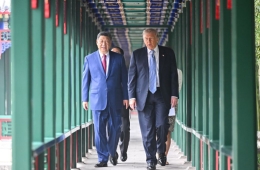
Amid intensifying political, economic, and security hegemonic competition between the U.S. and China, attention is focused on whether this series of high-level U.S.-China diplomatic engagements on the Korean Peninsula will serve as an opportunity to find solutions to issues such as North Korea's denuclearization and the U.S. Inflation Reduction Act (IRA) discrimination problem.
![[Image source=Yonhap News]](http://www.asiae.co.kr/news/img_view.htm?img=2022021920535750679_1645271637.jpg)
The Presidential Office officially confirmed on the 8th that U.S. Vice President Kamala Harris will visit South Korea.
Vice President Harris is scheduled to visit on the 29th and meet with President Yoon Suk-yeol to discuss ways to strengthen the Korea-U.S. alliance. During this meeting, they plan to exchange views on mutual interests including North Korea issues, economic security, and major regional and international affairs.
Prior to this, from the 15th to the 17th, Li Zhanshu, the third-ranking official in the Chinese Communist Party and Chairman of the Standing Committee of the National People's Congress, will visit South Korea for three days.
It is unusual for high-ranking officials from the U.S. and China to visit South Korea in quick succession within less than a month. This has led to interpretations that South Korea is strengthening its alliance with the U.S. while facing intensified Chinese containment.
Because of this, evaluations suggest that South Korea will be put to the test as either a geopolitical risk or opportunity amid the escalating U.S.-China hegemonic competition.
For now, the government and diplomatic circles in South Korea are hopeful that this will create an opportunity to resolve economic security crises such as discrimination under the Inflation Reduction Act and supply chain restructuring.
Above all, the strong Korea-U.S. alliance is expected to gain momentum through Vice President Harris's visit, particularly regarding the Inflation Reduction Act discrimination issue, which has recently been pointed out as a factor causing friction.
President Yoon and the South Korean government are expected to convey to Vice President Harris their concerns about Korean-made electric vehicles not receiving subsidies in the U.S. market due to the implementation of the Inflation Reduction Act, along with the need for legislative amendments.
Trade Negotiations Director Ahn Deok-geun recently met with Katherine Tai, U.S. Trade Representative (USTR), in Washington D.C. Vice President Harris is also expected to exchange views with President Yoon on the IRA. Given that the U.S. administration and Congress have recognized South Korea's concerns as significant, the weight of this discussion is expected to be considerable.
However, it remains uncertain whether any meaningful answers, including immediate legislative amendments or the possibility of amendments after the U.S. midterm elections in November, will be obtained during this visit.
The Korea-U.S. alliance is also likely to discuss North Korea's nuclear issues, including the Yoon administration's North Korea roadmap, the "Bold Initiative."
If the Korea-U.S. leaders meet at the United Nations General Assembly in mid-September to discuss North Korea sanctions or, conversely, North Korea economic cooperation programs, further communication on these matters could take place during Vice President Harris's visit.
Li Zhanshu's visit earlier than this is largely a reciprocal visit following Park Byeong-seok's trip to China in February. The Chairman of the Standing Committee of the National People's Congress corresponds to the Speaker of the National Assembly in South Korea.
Diplomatic circles view Li's visit as a move to counter the U.S.
This may have been considered in light of last month's visit by Nancy Pelosi, the third-ranking official in the U.S. protocol order and Speaker of the House of Representatives. If Li visits South Korea, he may also pay a courtesy call on President Yoon.
It is naturally expected that the possibility of holding a summit with Chinese President Xi Jinping could be raised.
Professor Park Won-gon of Ewha Womans University said, "The intention behind Vice President Harris's visit includes the U.S.'s calculation in response to Li Zhanshu's movements," adding, "China will also show its determination to prevent South Korea from actively cooperating with the U.S.'s 'China containment' strategy."
Hot Picks Today
!["Heading for 2 Million Won": The Company the Securities Industry Says Not to Doubt [Weekend Money]](https://cwcontent.asiae.co.kr/asiaresize/93/2025050713592847164_1746593968.jpg) "Heading for 2 Million Won": The Company the Securities Industry Says Not to Doubt [Weekend Money]
"Heading for 2 Million Won": The Company the Securities Industry Says Not to Doubt [Weekend Money]
- Jay Y. Lee Bows His Head: "I Will Take All the Blame"... Apologizes for Samsung Labor-Management Conflict
- "Do We Need to Panic Buy Again?" War Drives 30% Price Surge... Even the Bedroom Feels the Impact
- "Anyone Who Visited the Room Salon, Come Forward"… Gangnam Police Station Launches Full Staff Investigation After New Scandal
- "Stop Tying Others' Hands"... China Criticizes U.S. Containment Policy
© The Asia Business Daily(www.asiae.co.kr). All rights reserved.