Minimum Wage Public Committee Formation Complete... Labor Sector Still Insists on "10,000 Won"
Labor "Currently Lowest in OECD" vs. Employers "Moon Government's Raise Rate Highest in Asia"
Disagreement from the Start of Negotiations... Concerns of Labor-Management Conflict Even After Appointment of Public Interest Commissioners

The first plenary meeting of the Minimum Wage Commission on April 20 last month. (Image source=Yonhap News)
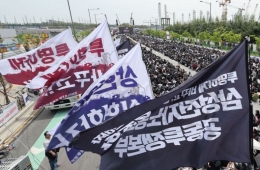
View original image[Sejong=Asia Economy Reporter Moon Chaeseok] With the decision made on whether to retain the 30 members of the Minimum Wage Commission, including the 9 public interest members who hold the key to deliberations next year, labor groups are intensifying pressure to raise the minimum wage to 10,000 won, the Moon Jae-in administration's national goal. They insist that regardless of whether the public interest members are replaced, reaching 10,000 won must be achieved. To reach 10,000 won, a 14.7% increase from this year's 8,720 won is required.
The Ministry of Employment and Labor appointed 25 out of 27 Minimum Wage Commission members on the 11th and released the list. Excluding the 3 special members appointed by the government, the 27 members consist of 9 worker representatives, 9 employer representatives, and 9 government-recommended public interest members. The public interest members exert decisive influence in decision-making. Among them, except for public interest member Yang Jeong-yeol (standing member, Ministry of Employment and Labor director) and worker representative Kim Man-jae (chairman of the Korean Metal Workers' Union), the terms of 25 members were set to expire on the 13th. Among the public interest members, only Yoon Ja-young was replaced by Lee Soo-yeon (research professor at Kyungnam University Far East Research Institute). One worker representative and three employer representatives were replaced, while the rest were retained. Before the list was made public on the 10th, the Korean Confederation of Trade Unions (KCTU) pressured the 9 public interest members to resign by sending protest text message campaigns and holding demonstrations. This was because they viewed the current public interest members as having approved historically low wage increases during the 2019-2020 deliberations, with increase rates of 2.9% and 1.5%, respectively.
Although the labor groups failed to force the resignation of several public interest members, they are raising their voices insisting that the minimum wage must be raised to 10,000 won next year. They argue that after two consecutive years of historically low increases, a third consecutive year is unacceptable. However, this stance has been criticized for insufficiently considering the difficulties companies face in raising labor costs due to the aftermath of the COVID-19 pandemic. Since the end of the Park Geun-hye administration, achieving 10,000 won requires a 39.7% increase from 6,030 won, so concerns have arisen that the Moon administration's national goal would be difficult to achieve even before the COVID-19 crisis.
Hot Picks Today
 "Buy on Black Monday"... Japan's Nomura Forecasts 590,000 for Samsung, 4 Million for SK hynix
- "Plunged During the War, Now Surging Again"... The Real Reason Behind the 6% One-Day Silver Market Rally [Weekend Money]
- [Good Morning Market] Tech Stocks Plunge on New York Exchange... KOSPI Expected to See Volatile Session
- "Samsung and Hynix Were Once for the Underachievers"... Hyundai Motor Employee's Lament
- "That? It's Already Stashed" Nightlife Scene Crosses the Line [ChwiYak Nation] ③
Therefore, it is expected that fierce debates between labor and management will occur during the minimum wage negotiation process next year, which will take shape around July. From the first plenary meeting on the 20th of last month, both sides showed significant differences in opinion. There is also a large gap in their recognition of the current minimum wage level and future policy direction. Labor groups claim "the current level is too low," while management argues "the Moon administration's increase rate is too steep." On the 11th, the KCTU announced that among the 37 member countries of the Organisation for Economic Co-operation and Development (OECD), South Korea's minimum wage is the lowest, while on the same day, the Federation of Korean Industries (FKI) analyzed statistics from the International Labour Organization (ILO) and others, reporting that South Korea's average annual minimum wage increase rate from 2016 to 2020 was 9.2%, ranking first among 18 Asian countries.
© The Asia Business Daily(www.asiae.co.kr). All rights reserved.