Seeking Solutions for High-Concentration Ultrafine Dust in Northeast Asia... Call for Project Proposals

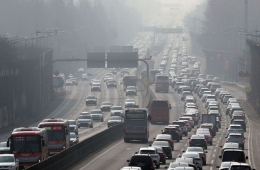
Due to the influence of yellow dust, the cityscape viewed from Inwangsan Mountain in Seoul appeared hazy on the 12th, when fine dust levels were forecasted to be poor. The Korea Meteorological Administration stated, "Fine dust is expected to be at a 'poor' level in the metropolitan area and 'moderate' in other regions." They added, "However, in the afternoon, the metropolitan area is expected to temporarily reach a 'very poor' level, and other regions are expected to temporarily reach a 'poor' level." Photo by Kim Hyun-min kimhyun81@
View original image[Asia Economy Reporter Hwang Junho] Efforts to identify the causes of high-concentration fine dust in Northeast Asia, including South Korea, and to find improvement measures are set to begin in earnest. The Ministry of Science and ICT will open a call for new projects under the 'Northeast Asia-Regional' linked fine dust response technology development initiative from the 5th of this month until July 4th.
This research project aims to develop a fine dust management system by comprehensively considering the sources of fine dust generation such as energy and weather in the Northeast Asia region, and to conduct studies to suppress regional fine dust. A total of 45 billion KRW will be invested this year, with a total of 45.8 billion KRW allocated through 2024.
Specifically, the Northeast Asia project will conduct scientific research to clarify the characteristics and formation processes of high-concentration fine dust. The formation process investigation will utilize the Cheollian Satellite 2B, launched in February. Additionally, research to improve the accuracy of fine dust forecasting, analysis of changes in fine dust emissions in Northeast Asia, and studies to establish emission reduction scenarios for South Korea will be conducted. Research will also include identifying regional characteristics of high-concentration fine dust phenomena and demonstrating customized reduction measures.
The Ministry of Science and ICT selected Dr. Bae Gwinaam, a principal researcher at the Korea Institute of Science and Technology (KIST), as the project leader to oversee this initiative on June 2nd.
The government will provide detailed explanations of the main research goals and the research topic guide at a project briefing session on the 14th. The research topic guide can be accessed on the websites of the Ministry of Science and ICT and the National Research Foundation of Korea.
Hot Picks Today
!["Rather Than Endure a 1.5 Million KRW Stipend, I'd Rather Earn 500 Million in the U.S." Top Talent from SNU and KAIST Are Leaving [Scientists Are Disappearing] ①](https://cwcontent.asiae.co.kr/asiaresize/93/2026051914165468840_1779167814.png) "Rather Than Endure a 1.5 Million KRW Stipend, I'd Rather Earn 500 Million in the U.S." Top Talent from SNU and KAIST Are Leaving [Scientists Are Disappearing] ①
"Rather Than Endure a 1.5 Million KRW Stipend, I'd Rather Earn 500 Million in the U.S." Top Talent from SNU and KAIST Are Leaving [Scientists Are Disappearing] ①
- "No Cure Available, Spread Accelerates... Already 105 Dead, American Infected"
- "Teacher, What Is This?"... Norwegian 6-Year-Old Discovers 1,300-Year-Old Sword During Outdoor Class
- "Reporters Who First Revealed Jo Jinwoong's Juvenile Offense History Cleared of Juvenile Act Violation"
- Instead of a National Assembly Profile, Now a 'Carpenter'... Ryu Hojung Says "I Couldn't Do a Body Profile Shoot Twice"
Ko Seogon, Director of Basic and Fundamental Research Policy, stated, "This Northeast Asia project aligns with the 'Ministry of Science and ICT Fine Dust R&D Promotion Strategy' established in June, and we hope many researchers will apply to contribute to identifying fine dust causes and advancing forecasting capabilities."
© The Asia Business Daily(www.asiae.co.kr). All rights reserved.