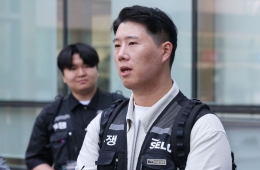
There Is a College Student Team That Pinpoints and Solves Real-World Problems
Dongmyeong University Extracurricular Living Lab 150 Participants Donate Talent Until Year-End... 3rd Year This Year
Hand Hygiene, Kickboard Safety, Kindergarten Rooftop Utilization... Identifying and Solving Problems Directly

[Asia Economy Yeongnam Reporting Headquarters Reporter Kim Yong-woo] “What about the dormitory bedding? How should we utilize the kindergarten rooftop? Should we just leave the kickboards as they are?”
“Rather than struggling with various real-life concerns, we will solve them ourselves.”
About 150 students from Dongmyung University formed 25 living lab teams, each reflecting their department’s characteristics. Their determination is to go beyond the campus and directly tackle problems that can be addressed by engaging with local realities. They decided to cover all areas encountered in daily life, including tourism, education, environment, health, safety, and welfare.
The living lab teams began their activities in this way. This unique convergence activity goes beyond classroom lessons and campus boundaries, with students actively exploring the field on foot to identify problems and find solutions themselves.
Dongmyung University, now in its third year of operation, is seeing “considerable enjoyment” as students gain experience and contribute to the local community.
This year, 151 students belonging to 25 living lab teams from various departments such as Industrial Design, Interior Architecture, Business Administration, Tourism Management, Mechatronics Engineering, Nursing, Social Welfare, Counseling Psychology, Sports Rehabilitation, Speech Therapy and Audiology, Military Science, and Media Communication are actively working in the field.

These are non-credit extracurricular activities and community talent donation projects running for seven months from early June to the end of the year.
Team members address all current issues, including education on the importance of hand hygiene to prevent infectious diseases (Nursing), infection prevention in indoor fitness centers (Sports Rehabilitation), and safety education related to shared electric kickboards (Social Welfare).
They also extend their reach to expert fields such as creating a new-concept playground utilizing kindergarten rooftops (Interior Architecture), evaluating speech errors in daycare children and preparing teacher guidance plans, developing dyslexia guidebooks for welfare centers and local children’s centers, teaching Korean to adolescents with developmental disabilities, preparing disability- and daily routine-specific educational guidelines for kindergarten and daycare teachers, and providing evaluation, treatment, and prevention education for voice problems of daycare and kindergarten teachers.
There are activities for seniors as well. These include replacing and cleaning dormitory bedding using local seniors, volunteering for senior hearing services at elderly welfare centers, free language cognitive evaluation and education for seniors through senior centers, breast self-examination, and research on support activities for socially disadvantaged and marginalized youth.
The Military Science team also came up with innovative ideas. They are preparing plans for the preservation and utilization of combat heritage sites in the Busan area. They are also actively working on support activity plans for socially disadvantaged and marginalized youth.
The Speech Therapy and Audiology department has an impressive 10 teams with 58 participants involved.
Park Soo-young, Director of the Dongmyung University Community Collaboration Center, said, “The unique socially participatory differentiated project ‘Dongmyung University Living Lab’ clearly defines problems, generates field-centered solution ideas, verifies them in various ways, and reaches solutions with expert mentoring.”
Hot Picks Today
!["Heading for 2 Million Won": The Company the Securities Industry Says Not to Doubt [Weekend Money]](https://cwcontent.asiae.co.kr/asiaresize/93/2025050713592847164_1746593968.jpg) "Heading for 2 Million Won": The Company the Securities Industry Says Not to Doubt [Weekend Money]
"Heading for 2 Million Won": The Company the Securities Industry Says Not to Doubt [Weekend Money]
- Did Samsung and SK hynix Rise Too Much?... Foreign Assets Grow Despite Selling [Weekend Money]
- "Anyone Who Visited the Room Salon, Come Forward"… Gangnam Police Station Launches Full Staff Investigation After New Scandal
- "Drink Three Cups of Coffee and Stay Up All Night Before the Test"... Manual of Insurance Planner Who Collected 1 Billion Won in Payouts
- "Wearing a Leather Jacket in 30-Degree Heat, Jensen Huang Enjoys Street Food as Beijing's 'Mukbang Star': 'It's Delicious'"
He added, “We will continue to develop products and services for problem-solving and provide follow-up support, and we plan to promote entry into social economy enterprises such as cooperatives, village enterprises, and social enterprises.”
© The Asia Business Daily(www.asiae.co.kr). All rights reserved.