This Year's Goseong Wildfire Damage Significantly Reduced Through Collaboration with Related Agencies

Park Jong-ho, the Commissioner of the Korea Forest Service, recently inspected the wildfire prevention response situation with the center officials at the Gangneung East Coast Wildfire Prevention Center in Gangwon Province. Photo by Korea Forest Service
View original image[Asia Economy (Daejeon) Reporter Jeong Il-woong] This year, a forest fire occurred again in Goseong, Gangwon Province after one year, but the scale of the damage was significantly reduced compared to last year. It is evaluated that active cooperation among related agencies responding to forest fires prevented the spread of the fire and reduced the damage.
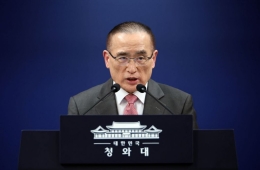
On the 12th, Park Jong-ho, the head of the Korea Forest Service, held a briefing at the Government Complex Daejeon and analyzed and announced the success factors in extinguishing this year's Goseong forest fire.
According to the Korea Forest Service, forest fires occurred in Goseong in April last year and this month. These fires share many similarities in terms of timing, location, and causes. Representative points include the occurrence of forest fires in the evening hours when helicopter deployment was difficult in the spring season around Toseong-myeon, Goseong-gun, Gangwon Province, and the ignition starting from the foot of the mountain spreading into a large-scale forest fire.
For example, last year's Goseong forest fire started around 7 p.m. on April 4 in the Wonam-ri area of Toseong-myeon, Goseong-gun, Gangwon Province, caused by a spark from an electric wire inside a switch. This year's Goseong forest fire is estimated to have started around 8:10 p.m. on the 1st when embers from a house fire spread to the hills around Dowon-ri, Toseong-myeon, Goseong-gun. This can be seen as a clue to a large-scale forest fire caused by human error in spring.
However, there is a clear difference in the scale of damage and extinguishing time. Last year's Goseong forest fire caused 2 deaths, destroyed 1,267 hectares of forest, 518 houses, and 260 warehouses, and was extinguished after a maximum of about 45 hours (13 hours in Goseong and Sokcho, 17 hours 18 minutes in Gangneung and Donghae, 45 hours 15 minutes in Inje). During this process, 1,196 people were displaced.

A member of the Aerial Firefighting Team from the Korea Forest Service's Forest Aviation Headquarters is conducting overnight firefighting operations at the recently occurred Goseong wildfire site. Photo by Korea Forest Service
View original imageOn the other hand, this year's Goseong forest fire damage was limited to 85 hectares of forest and 6 buildings destroyed. No deaths occurred due to the fire, and only 2 people were displaced, showing a marked difference from the damage situation during last year's fire. The extinguishing was completed 11 hours and 50 minutes after the fire started, which was confirmed to be between about 2 hours and 34 hours faster than last year's extinguishing time.
The Korea Forest Service cites the following as success factors for the relatively low damage in this year's Goseong forest fire: ▲strengthened inter-ministerial cooperation ▲the active role of the Forest Fire Disaster Special Suppression Team and aerial firefighting teams ▲establishment of a forest fire prevention and suppression system incorporating smart technology ▲formulation of aerial and ground three-dimensional suppression operations ▲efficient mobilization and deployment of ground suppression personnel ▲efficient promotion of mop-up operations ▲transition of firefighters to national employees and regularization of the Forest Fire Disaster Special Suppression Team.
In particular, the Korea Forest Service prides itself on inter-ministerial cooperation playing the biggest role in minimizing casualties and property damage from the Goseong forest fire. Cooperation was swiftly carried out by the Ministry of the Interior and Safety (the disaster safety control agency) ordering local governments to send disaster text messages while conducting disaster broadcasts on site to help nearby residents evacuate preemptively; the Korea Forest Service, the main agency for forest fire suppression, establishing aerial and ground suppression strategies on site and leading the firefighting; and the National Fire Agency and military units supporting firefighting around residential areas and mop-up operations.
Earlier, from this year, the Korea Forest Service and the National Fire Agency strengthened their cooperation by implementing exchange shifts between the Korea Forest Service Central Forest Disaster Situation Room and the National Fire Agency 119 Situation Room during normal times.

On the night of the 1st, after completing overnight wildfire suppression efforts at the wildfire site in Goseong, Gangwon Province, the faces and masks of the Korea Forest Service wildfire suppression team members who came down the mountain are scorched. Photo by Korea Forest Service
View original imageAdditionally, the active role of firefighting personnel such as the Forest Fire Disaster Special Suppression Team and aerial firefighting teams deployed on the front lines of the fire scene stands out as a hidden key to the successful response to this year's Goseong forest fire. The main fire was extinguished within 2 hours and 30 minutes by forest fire suppression helicopters deployed at sunrise the day after the fire started. Above all, the Korea Forest Service emphasizes that behind the rapid main fire suppression was the dedication of firefighting personnel who fought through the night on site.
In fact, a total of 456 members of the Forest Fire Disaster Special Suppression Team and aerial firefighting teams were deployed at night when the wind had calmed and extinguished about 60% of the fire before forest helicopters began suppression. Their performance stands out in other forest fire scenes as well. In this regard, the Korea Forest Service is planning policies to train these firefighting personnel as elite operatives capable of drone operation and using fire extinguishing grenades and agents for effective suppression of increasingly year-round and large-scale forest fires.
Hot Picks Today
 Even with High Oil Price Relief Payment, Additional 300,000 Won Per Person to Be Provided... Applications Open from the 18th in This Region
- "Invested 95% in Hynix and Reached 10 Billion Won"... Japanese Investor's Proof Post Goes Viral
- "Why Is the Korean Stock Market Surging?"... Even Italy Is Astonished by the KOSPI Rally
- "You Don't Need to Go to the Gym": The Best Exercises for Lowering Hypertension
- "That Thing Wakes Up Every Night" ... Suspicious Object Covers Rural Village
Park Jong-ho, head of the Korea Forest Service, said, "It is no exaggeration to say that the success or failure of disaster response such as forest fires depends on close cooperation among residents of disaster areas and related agencies," adding, "The Korea Forest Service will continue to strengthen the cooperation system among related agencies necessary for forest fire disaster response and devote itself to enhancing response capabilities based on the forest fire suppression know-how it possesses."
© The Asia Business Daily(www.asiae.co.kr). All rights reserved.