"Hot and Typhoon Strengthens" New "Super Strong" Typhoon Category Established and Humidity Reflected in Heatwave Warnings (Comprehensive)
Heatwave Warning Issued with Highest Daily Feels-Like Temperature
Seoul Area Divided into Four Warning Zones
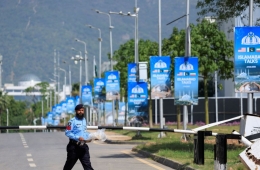
![[Image source=Yonhap News]](http://www.asiae.co.kr/news/img_view.htm?img=2019100710042311397_1570410264.jpg)
[Asia Economy Reporter Hyunju Lee] A new heatwave warning standard reflecting temperature and humidity will be established. The highest typhoon category, 'Super Strong,' will be newly introduced, and the Seoul area will be subdivided into four warning zones.
The Korea Meteorological Administration (KMA) announced on the 8th that it will change the criteria for issuing heatwave warnings and improve typhoon forecast information. These improvements were made in response to the increasing number of heatwave days and the trend of stronger typhoons.
To supplement the current heatwave warning criteria, which only consider the daily maximum temperature, an apparent temperature reflecting both temperature and humidity will be introduced, and new standards based on this will be established. Since the perceived temperature rises with increasing humidity at the same temperature, within the temperature range of 30 to 40 degrees Celsius, using 50% humidity as a baseline, an increase or decrease of 10% in humidity will correspond to an approximate 1-degree increase or decrease in apparent temperature. Accordingly, the heatwave warning criteria will change from daily maximum temperature to daily maximum apparent temperature, with threshold values set at 33 degrees Celsius for heatwave advisories and 35 degrees Celsius for heatwave warnings. Heatwave impact forecasts and heat discomfort index services will also provide information based on apparent temperature.
The forecast period for tropical depressions before typhoon development will be extended, and the highest typhoon intensity category, 'Super Strong,' will be newly established. Jung Kwan-young, head of the Forecast Policy Division at KMA, explained, "Since the sea surface temperature in tropical ocean areas is rising, there is a recent trend of stronger typhoons."
Tropical depressions and typhoons are types of tropical cyclones. In Korea, a wind speed of 17 m/s near the center is the boundary: below this is classified as a tropical depression, and above as a typhoon. To support preemptive typhoon disaster prevention, the forecast period for tropical depression information will be extended from the current 1 day to 5 days.
The typhoon intensity grade will be forecast as 'Super Strong' if the maximum wind speed is 54 m/s or higher. Among typhoons occurring in the past 10 years, the frequency of 'Very Strong' typhoons accounted for half. According to the newly applied criteria, from 2010 to 2019, four super strong typhoons affected Korea: Typhoon Sanba (No. 16) in 2012, Typhoon Neoguri (No. 8), Typhoon Halong (No. 11), and Typhoon Bongpong (No. 19) in 2014. The previous classification of typhoon size into small, medium, and large will be discontinued, and instead, the areas where strong winds (15 m/s or higher) and storm winds (25 m/s or higher) blow from the typhoon center will be provided.
Hot Picks Today
 Applied Just for Skin Soothing...Study Finds It...
- "Only the Top 1% Winning Big in Stocks Smile... '300 Million Won Splurges' or '1...
- 46 Voice Phishing Ring Members Repatriated from Cambodia Sentenced to Prison in ...
- "If You Pay, I'll Close the Case"... Former Korea Customs SJPO Who Took 145 Mill...
- "Please Launch It in Korea!" After All the Hype... This Coffee Finally Arrives i...
Meanwhile, to prepare for localized heavy rain and heatwaves in Seoul due to climate change, the Seoul warning zones will be divided from the entire city into four detailed zones: Northwest, Northeast, Southwest, and Southeast. Over the past five years, the number of times heatwave advisories reached the criteria varied by zone, with a maximum of 134 times in the Southeast zone and a minimum of 105 times in the Northwest zone, showing a difference of 29 occurrences.
© The Asia Business Daily(www.asiae.co.kr). All rights reserved.



![Is This a Boom or a Recession? Queues for Both Luxury and Bargain Goods [K-Shaped Consumption Era]](https://cwcontent.asiae.co.kr/asiaresize/307/2026042114133834494_1776748418.png)