Korean Intellectual Property Office Establishes 'Appraisal Support System'
Editor's Note
The global counterfeit market is estimated at 2,000 trillion won. Fake products are becoming more sophisticated, and their distribution is bolder than ever. It is not only high-end luxury brands that are suffering. While consumers remain silent about counterfeit goods, K-brands that have entered the global market are being copied in the same way. Local brokers preempt trademarks, blocking market entry, and companies are being frustrated by massive legal costs. In the borderless online marketplace, there are limits to enforcement and monitoring. Asia Economy exposes the realities of the counterfeit market, which has grown explosively since the COVID-19 pandemic, and explores solutions to prevent the copying of K-brands that have made waves in the global market.
The global counterfeit market is estimated at 2,000 trillion won. Fake products are becoming more sophisticated, and their distribution is bolder than ever. It is not only high-end luxury brands that are suffering. While consumers remain silent about counterfeit goods, K-brands that have entered the global market are being copied in the same way. Local brokers preempt trademarks, blocking market entry, and companies are being frustrated by massive legal costs. In the borderless online marketplace, there are limits to enforcement and monitoring. Asia Economy exposes the realities of the counterfeit market, which has grown explosively since the COVID-19 pandemic, and explores solutions to prevent the copying of K-brands that have made waves in the global market.
As damages from counterfeit goods, including those targeting K-brands, continue to rise, government crackdowns have become more thorough. In particular, with the surge of counterfeits in the online market, the government is planning to utilize artificial intelligence (AI) technology to quickly and accurately detect fake products. However, there are concerns that it is difficult to regulate the recent surge in counterfeit sales through live broadcasts on platforms like YouTube and TikTok, and that K-brand counterfeits distributed worldwide must be dealt with individually by affected companies. As a result, there are calls for the government to expand budget support.
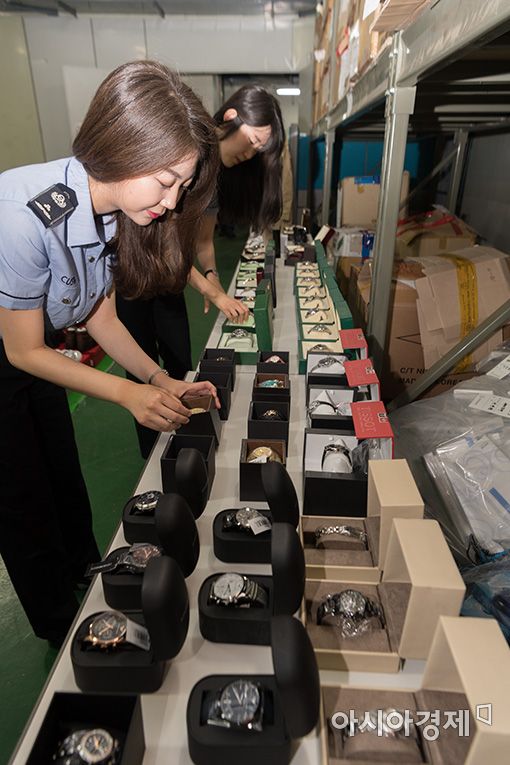
According to Asia Economy's coverage on September 11, the Korean Intellectual Property Office has allocated approximately 2.9 billion won in next year's government budget to build a consumer-centered "Appraisal Support System." The plan is to establish a platform that enables two-way communication between brand manufacturers (rights holders) and consumers, allowing consumers to determine whether the products they purchase are counterfeit. An official from the Korean Intellectual Property Office stated, "Even if consumers want a refund for products purchased on e-commerce platforms, the rights holder must first confirm whether the item is counterfeit," adding, "To reduce the appraisal burden on rights holders, we are considering having a public institution handle the appraisal work."
AI Reads Authenticity Similarity
Rights Holders Access Platform
To Verify Appraisal Details
Rights Holders Access Platform
To Verify Appraisal Details
Reduces Cost Burden for Rights Holders
Speeds Up Counterfeit Appraisal Process
Speeds Up Counterfeit Appraisal Process
Over 160 Brands Participating This Year
Expanding to Over 500 by 2027
Expanding to Over 500 by 2027
AI Technology Integrated...Korean Intellectual Property Office Launches 'Appraisal Support System'
The core of this platform is counterfeit appraisal powered by AI. After the AI analyzes the similarity to authentic products, rights holders can access the platform to verify the appraisal details. The Korean Intellectual Property Office plans to use AI to reduce costs for rights holders and speed up the counterfeit appraisal process.
To this end, at the beginning of this year, the Korean Intellectual Property Office held discussions on the appraisal support system with the Korea Intellectual Property Protection Agency, an affiliated organization, and member companies of the public-private "Council for Preventing the Distribution of Counterfeit Goods." At that time, rights holders reportedly expressed concerns about participating in the platform, as information related to appraisals constitutes trade secrets. In response, the Korean Intellectual Property Office decided to establish robust protection measures so that such information is used only in the public sector and to consult with brand companies regarding the scope of information shared.

Previously, the Korean Intellectual Property Office allocated a new budget of 700 million won last year to implement AI-based counterfeit detection. This was an investment in technology to block counterfeit goods distributed in online markets such as e-commerce and social networking services (SNS). This year, about 160 brands have participated, and the plan is to expand to over 500 brands by 2027. The office is also working to advance the technology so that it can precisely detect altered trademarks and image composites by analyzing images and text simultaneously.
Collaboration among relevant ministries is also being strengthened. The Korean Intellectual Property Office will notify the Korea Customs Service of goods detected by AI so that they can be blocked before entering the country. It also plans to coordinate with the Korea Communications Standards Commission to block access to sales sites and to facilitate the removal of posts by overseas operators. An official from the Korean Intellectual Property Office explained, "Each department has different capabilities and areas of responsibility, but our goal is to activate information exchange and establish an integrated response system," adding, "Following the Korea Customs Service and the Ministry of Agriculture, Food and Rural Affairs, we will sequentially sign memorandums of understanding (MOUs) with each ministry."
In July, the government announced a "Comprehensive Plan to Prevent the Distribution of Counterfeit Goods" at a policy coordination meeting of ministers presided over by Prime Minister Kim Minseok. The new plan shifts the focus of counterfeit crackdowns from luxury brands to the protection of K-brands and includes a commitment to target covert distribution channels such as SNS and live broadcasts. To this end, the regions monitored for K-brand counterfeits have been expanded from six countries-China, Thailand, Indonesia, Vietnam, Singapore, and Malaysia-to include India. In addition, punitive damages for trademark infringement have been expanded to up to five times the amount.

'Separately, Yet Together'...Reducing Information Gaps Is Essential
In Korea, the protection of intellectual property (IP) rights and the blocking of counterfeit distribution are handled separately by the Korean Intellectual Property Office, Korea Customs Service, Fair Trade Commission, and National Police Agency. In addition, all ministries, including the Ministry of Agriculture, Food and Rural Affairs, Ministry of Oceans and Fisheries, Ministry of Trade, Industry and Energy, and Ministry of Foreign Affairs, are involved by industry sector. The Korea Customs Service and its affiliate, the Trade-Related Intellectual Property Protection Association (TIPA), crack down on counterfeits during the import clearance process, while the Korean Intellectual Property Office and its affiliate, the Korea Intellectual Property Protection Agency, are responsible for counterfeits distributed domestically and for supporting domestic rights holders. The Korean Intellectual Property Office handles anti-counterfeiting measures, while the National Police Agency is responsible for investigations and crackdowns.
Because of this, there are calls for a stronger collaborative system to respond to counterfeits more swiftly and to protect domestic rights holders' IP more efficiently. An industry official noted, "Although the system reflects the characteristics of a national alliance, in the European Union (EU), which is a leader in anti-counterfeiting enforcement, brand companies upload product information to the IPEP system so that customs and domestic regulatory agencies can utilize it," adding, "A unified system is needed to reduce the fatigue felt by brand companies and to ensure transparent information sharing."

Some argue that the government should allocate more budget to respond to K-brand counterfeits. Although measures such as online monitoring support, overseas trademark and design application support, and consulting are being prepared by industry, there is a lack of budget at the association level. An association official, speaking on condition of anonymity, said, "As the number of counterfeits affecting K-brands increases, we have repeatedly requested the Korean Intellectual Property Office for a budget to support IP protection, but have not been able to secure it," adding, "Overall, awareness of IP protection and counterfeit consumption has improved, but it still lags far behind the United States and Europe."
In reality, brands find it difficult to respond proactively in overseas markets where counterfeits are manufactured and sold. Not only are the legal costs of trademark disputes overwhelming, but there is also the risk of alienating local consumers. An official from the cosmetics industry explained, "Most counterfeits are produced overseas, so we have to look into legal costs for litigation in order to respond, but the costs are so high that it is burdensome. In practice, we are only able to monitor counterfeits rather than take substantive action." An official from the food industry added, "If we get caught up in trademark disputes, it can foster anti-Korean sentiment among local consumers (in China), negatively affecting product sales. Although there are both tangible and intangible damages from infringement, it is difficult to publicize them actively due to concerns about sales impacts."
<To be continued in Part 7: The Counterfeit Invasion>
IndexJjaktung's Practice
- Booming 'Made-in-Korea' Counterfeits... Damage from Fakes Exceeds 11 Trillion Won
- 'MAGA' Blocked Counterfeit Crackdown Bills Stalled in the National Assembly
- The Rise of AI as a Game Changer...Wiping Out All Counterfeits
- "Just a Fine and It's Over"... China Rakes in Cash Copying 'K-Beauty'
- "Dior? Gucci? We Have Everything" Vietnam's Must-Visit Stop for Package Tours...
-

Reporter ming@asiae.co.kr
-

Reporter Park Jaehyun now@asiae.co.kr
-
Edit Choi Yujeong yjchoi@asiae.co.kr
© The Asia Business Daily(www.asiae.co.kr). All rights reserved.