However, AI can learn specific patterns and generate grammatically natural sentences, but it has not yet acquired the human abilities of 'understanding context' and 'empathy.' When we use language, we do not simply focus on grammatical accuracy; we use subtle sensibilities that consider relationships with others and express ourselves differently depending on the situation. With the advent of the AI era, we have started communicating with machines, but that does not make human communication skills any less important. On the contrary, as communication with machines increases, we must place even greater importance on linguistic empathy among humans. As AI establishes itself not just as a simple tool but as a daily conversational partner, I believe we will enter an era where more sophisticated language use and nonverbal elements must be considered simultaneously.
Editor's NoteAsia Economy has decided to examine, from the perspectives of both engineers and artists, how rapidly advancing generative AI will transform the field of artistic creation and what concerns 'humans' should have. Accordingly, we have launched a monthly series in which Professor Kim Daesik of KAIST's School of Electrical Engineering and Choreographer Kim Hyeyeon (CEO of Yeonist) engage in discussions or debates with artists about their works. The title 'AHA' in this series stands for 'AI, Human & Art.' We hope that, through Professor Kim Daesik, who passionately explores the future of generative AI, and Choreographer Kim Hyeyeon, who boldly fuses generative AI with dance, you will take a step closer to the profound questions of AI, humanity, and art.
⑫ 'Language Explorer' Professor Shin Jiyeong, Korea University
"The words you give to AI are a mirror reflecting your own language"
The era of generative artificial intelligence (AI) has heralded the emergence of a new kind of human: 'Homo Prompt.' The ability to ask and command AI has become crucial, as good answers are more likely to come from good questions. This is why linguistic and communication skills are gaining renewed attention. Professor Shin Jiyeong, who introduces herself as a 'language explorer,' is a professor in the Department of Korean Language and Literature at Korea University. Having analyzed the hierarchies and relationship-setting methods shaped by the Korean language, she explores the unique influence that the Korean linguistic system may have on interactions with AI. We discussed the increasing importance of nonverbal communication skills and uniquely human emotional expression in the AI era. The interview took place last month on the 22nd at Munhakgwa Jiseongsa in Seogyo-dong, Seoul.

Professor Shin Jiyoung of Korea University’s Department of Korean Language and Literature is giving an interview to Asia Economy at Munhakgwajiseongsa in Seogyo-dong, Seoul, on the 22nd of last month. Photo by Jo Yongjun
원본보기 아이콘- You introduced yourself as a 'language explorer' and professor in the Department of Korean Language and Literature at Korea University. Why do you refer to yourself as a 'language explorer' rather than a linguist?
▲Because I don't see language research as simply analyzing and organizing grammar, but as a process of exploring and pioneering new territories. For me, studying language is not just an academic exercise, but a journey of discovering and investigating unknown realms within the words we take for granted. Many people think grammar is rigid and uninteresting.
When I thought about why that is, I realized that everyone loves traveling?because of the excitement of escaping the everyday. To travel, you need money and time, but exploring the world of language is a journey you can take without those things. In fact, the process of discovering the unconscious rules we follow when learning and using a language is incredibly fascinating. For me, language is an endlessly explorable and intriguing world, and every time I discover a new pattern, I feel the joy of an explorer finding treasure.
- Most people in Korea speak Korean fluently. Is there still something we don't know? And what is the significance of language in the future as we enter the AI era?
▲In reality, we know everything. Linguists study how people know what they already know, so I can say this with confidence. Recently, however, we are in the AI era, and AI learns and generates sentences based on data. But whether that constitutes true 'communication' is questionable. There is a similarity in that just as AI acquires and operates on data, we also don't know exactly how we acquired language.
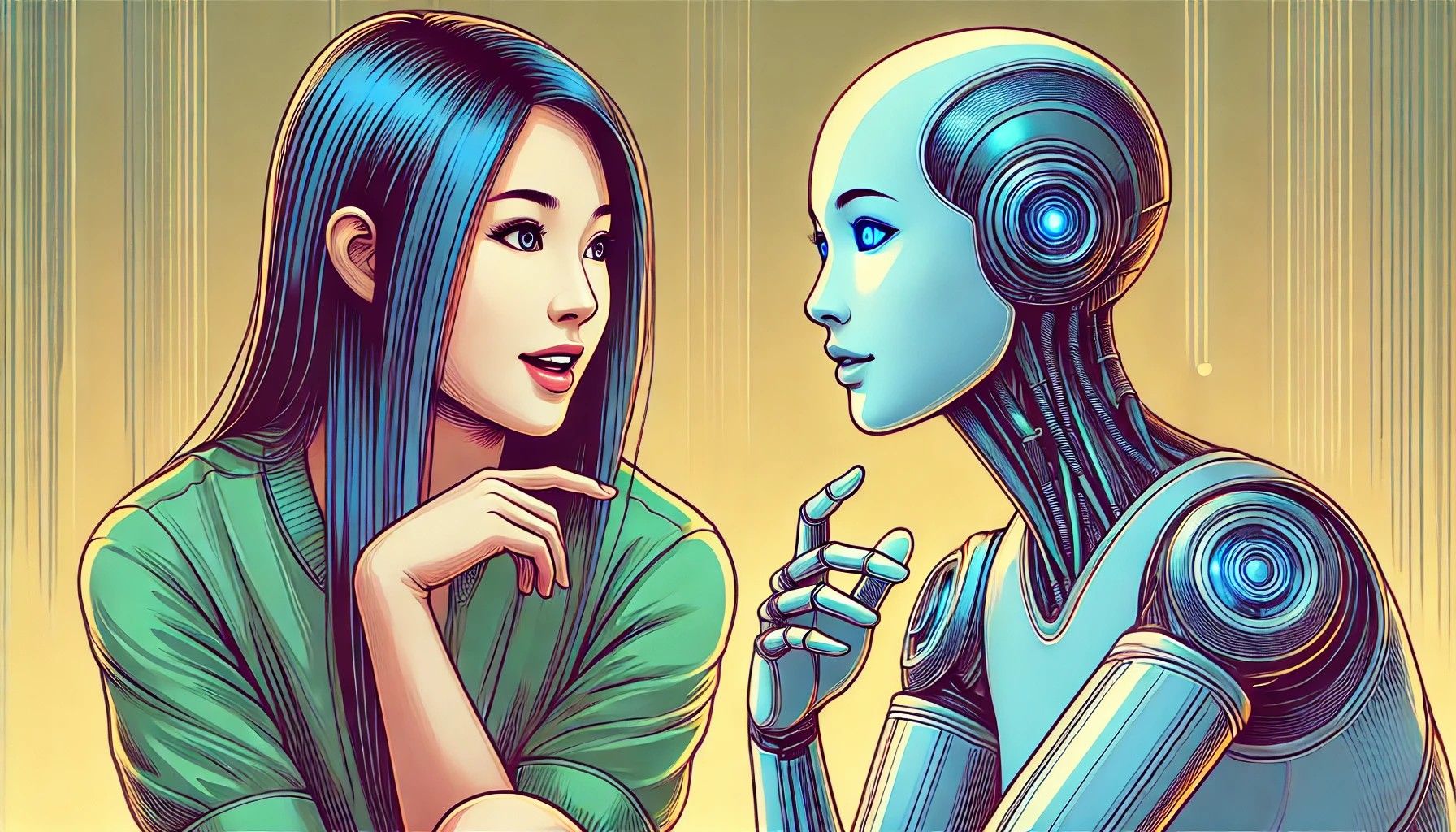
In the AI era, as communication with machines increases, linguistic empathy among humans becomes even more important
As AI becomes a conversational partner in daily life,
we must consider more sophisticated language use
and nonverbal elements at the same time
we must consider more sophisticated language use
and nonverbal elements at the same time
- When entering prompts to AI, some people use informal language and others use honorifics. How does the Korean honorific system, as seen in AI usage, affect communication?
▲Language is not just a tool for communication?it plays a crucial role in forming and maintaining social relationships. The Korean honorific system is especially important in this regard. Conversation is not a one-sided monologue; it involves setting up the other party, exchanging dialogue, and sometimes debating. It is natural that these linguistic features are reflected even in interactions with AI. Those who use informal language with AI tend to see it as a mere tool or a comfortable conversational partner, while those who use honorifics tend to treat AI as a formal conversational partner or someone to be addressed respectfully. This shows how much the Korean honorific system shapes our thinking and human relationships.
There are a few ways to have good conversations. First, equality is essential. If we think of a vertical relationship as water, it only flows from top to bottom, making conversation very difficult. Someone always has to give, and someone always has to receive. But the giver is not always comfortable, nor is the receiver always burdened. For smooth communication, both parties must interact from an equal position. Recently, there has been discussion about using more horizontal language to foster such a culture. Furthermore, being addressed by different titles depending on gender, position, rank, or relationship can also make communication more challenging. These characteristics are naturally reflected in conversations with AI as well. I believe this will be a unique linguistic experience for Korean speakers interacting with AI.
Ultimately, what matters in interaction with AI is not just linguistic form, but how we coordinate conversation and adapt it to context. For AI to communicate naturally with humans, it needs to learn not only grammar, but also the way Korean speakers form relationships through language. This goes beyond simply generating sentences; it is a key factor in creating truly meaningful conversational flow with humans. For us, it is also an opportunity to reflect on our communication with people before we think about communicating with AI.

Jiyoung Shin, professor at Korea University (center), is being interviewed at Munhakgwa Jiseongsa in Seogyo-dong, Seoul. Photo by Jo Yongjun
원본보기 아이콘- What about the 'title issue' in Korean society?
▲The issue of titles is not merely a linguistic feature, but an important element that directly reflects how we form relationships and hierarchies. Korean rarely uses second-person pronouns, so we must consider titles or social roles when addressing others. However, this title system is not applied equally to all professions and relationships. For example, 'professor' or 'lawyer' feels natural, but 'dancer' or 'singer' still sounds awkward. This is not just a linguistic habit, but is connected to the social tendency to regard certain professions as more authoritative.
Moreover, Korean has a strong feature of defining relationships even through sentence endings. The honorific system, which reflects hierarchy with the other party, is not just about using polite expressions; it requires careful reflection of the relationships among the subject, object, and listener in the sentence. For example, the phrase 'Americano naosyeotseumnida' (an honorific way of saying "Your Americano is ready") applies honorifics even to objects, reflecting how the speaker perceives the listener. Likewise, 'doranusilgeyo' (a softened command for "Please turn over") uses a first-person volitional form toward the second person as a linguistic strategy to soften a command. Korean is not just a tool for communication, but an important medium for coordinating social relationships.
Ultimately, the issue of titles is not just a matter of language use, but requires deep reflection on our society's hierarchy and relationship-setting methods. As times change, we need to seek new linguistic approaches that respect each other regardless of profession or age. Rather than simply following the existing title system, we need to consider together which titles are appropriate in the social relationships we are building.

Jiyoung Shin, a professor at Korea University (center), is being interviewed at Munhakgwa Jiseongsa in Seogyo-dong, Seoul. Photo by Jo Yongjun
원본보기 아이콘- You mentioned that this is a time to think about communication with people before communicating with AI. Why is intergenerational communication still difficult in Korean society?
▲The difficulty in intergenerational communication is not simply due to differences in values, but is rooted in the linguistic structure and hierarchical culture of relationship-setting. In the past, social status determined hierarchy; today, age, occupation, and family rank play that role. In Korean, you must always consider age and status when addressing someone, which further entrenches vertical relationships. The younger generation takes equality for granted, while the older generation naturally sets hierarchies through honorifics and titles.
The problem is that when this gap is not bridged, people give up on conversation altogether. In particular, the culture of forming friendships based on age narrows social networks and limits opportunities for diverse experiences and perspectives. In contrast, in other countries, it is common to become friends across generations. Just as we broaden our horizons by experiencing unfamiliar environments while traveling, we need to experiment with different linguistic sensibilities and communication methods across generations. Language is a tool for relationships, and those relationships must be smooth for communication to happen. Rather than being trapped in a vertical framework, it is important to cultivate linguistic sensitivity that helps us understand and coordinate with each other. Intergenerational conversation should not be just an exchange of opinions, but a process of expanding each other's linguistic frameworks.
The habit of speaking informally or giving commands to AI can unconsciously affect human conversations as well
Beyond simple information delivery,
effort to be considerate and understand context is essential
From facial expressions, intonation, gestures, to subtle atmosphere,
we must develop the ability to communicate sensorially
effort to be considerate and understand context is essential
From facial expressions, intonation, gestures, to subtle atmosphere,
we must develop the ability to communicate sensorially
- Then, what linguistic attitude should we consider in conversations with AI?
▲We must consider whether to treat AI as a mere tool or as an entity with which we can form relationships. All human relationships begin and are maintained with words; when words are cut off, so is the relationship. Thus, language is not just a means of communication, but the core of social relationships. So what linguistic attitude should we take in defining our relationship with AI? Many people use informal or commanding language with AI, while others use honorifics. This depends on how one perceives AI. Essentially, AI cannot feel emotions, but humans inevitably respond emotionally to their conversational partners.
Interestingly, when writing, people use neutralizing sentences to balance relationships, but in speech, immediate interaction leads to the establishment of hierarchy. This linguistic habit is also reflected when dealing with AI. Therefore, we need to consider how to define the linguistic relationship between AI and humans in society. I believe now is the time to seriously discuss what role AI will play in human conversation and how that relationship will affect our linguistic culture.

- What linguistic competencies should we prepare for in the AI era?
▲As AI becomes part of daily conversation, ironically, communication skills between humans will become even more important. AI can deliver information quickly and efficiently, but it cannot learn the nonverbal elements?emotions, expressions, and movements?that humans create. Ultimately, true relationship-building happens through empathy and interaction that go beyond language. The problem is that the way we interact with AI is likely to affect our conversational habits with other humans. Many people use informal or commanding language with AI, and this can unconsciously influence human-to-human conversations. On the other hand, using honorifics with AI and trying to form a relationship reflects an awareness of AI as a new conversational partner, not just a tool. Amid these changes, we must carefully consider how conversations with AI will affect our linguistic sensibilities and ways of forming relationships.
So what should we prepare for in the AI era? Beyond simply delivering information, the ability to be considerate of the other person and understand context is essential. AI analyzes language as text, but cannot fully grasp human emotions or nonverbal expressions. In human communication, however, facial expressions, intonation, gestures, and even subtle atmospheres play important roles. For example, the same words can have completely different meanings depending on facial expressions and body language. As we become more accustomed to communicating with AI, I believe we must make even richer use of nonverbal expressions and further develop our ability to communicate sensorially.

In other words, the AI era is not just about learning how to talk to machines, but about considering how to coordinate emotions and expressions within human relationships. As interactions with machines increase, we must strengthen our human elements even more. Conveying emotions through movement and facial expressions, and deepening our understanding of body language, will become even more essential communication skills in the AI era. AI is not only a recipient of our words, but also a mirror reflecting how we use language and our bodies. Therefore, the most important competency in preparing for the AI era is not the ability to handle technology, but learning how to connect more deeply with people.
Kim Daesik, Professor of Electrical Engineering, KAIST
Kim Hyeyeon, Choreographer (CEO of Yeonist)
IndexAHA by Kim Daesik and Kim Hyeyeon
- Aespa Coexisting with AI Avatars: Innovation Itself
- "Do Not Give Commands to AI as If You Are Speaking Informally"
- Do You Want a World Where AI Does Everything Instead of Humans?
- Hyunjoon Yoo: "Coexistence of AI and Architecture Is Already Underway"




![[Report] "A Culinary Destination with a View of Gyeongbokgung"... Kim Dong-sun's High-End Dining Takes Over Gwanghwamun](https://cwcontent.asiae.co.kr/asiaresize/304/2026042114562634571_1776750985.jpg)
![[Gallery Stroll] Red Robe, Black Lines... Danjong Returns with the Face of Wounds](https://cwcontent.asiae.co.kr/asiaresize/304/2026042014183532691_1776662315.jpg)