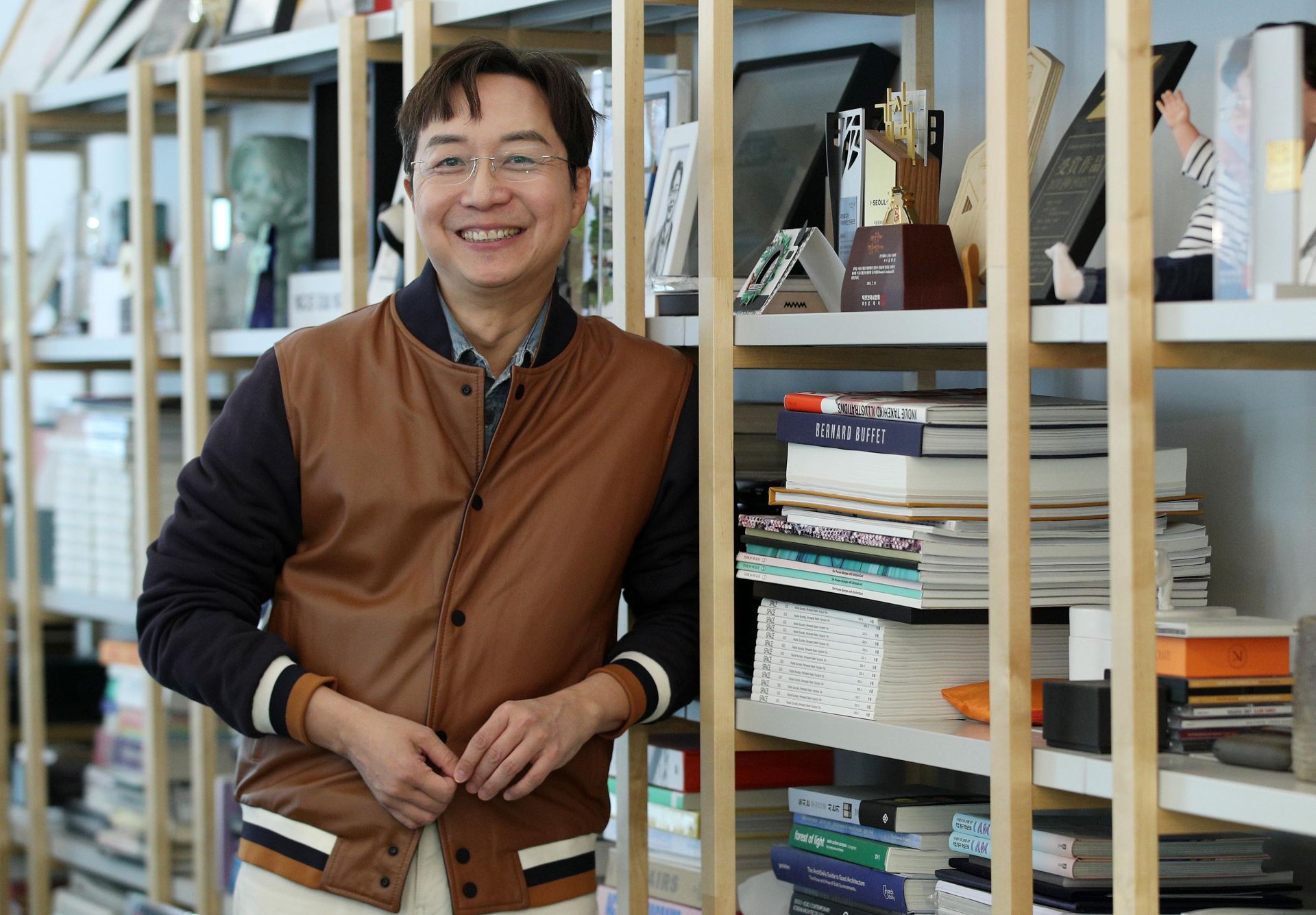
[Daesik Kim·Hyeyeon Kim's AHA] ⑭ Architect Hyunjoon Yoo, Professor at Hongik University
Architectural spaces must enable the coexistence of humans and machines
Architect Hyunjoon Yoo is a professor at the College of Architecture and Urban Studies at Hongik University and the head of Hyunjoon Yoo Architects. He is known for rethinking the relationship between cities and people through architecture. After earning a master's degree in architectural design from MIT and a master's in urban design from Harvard University, as well as obtaining his U.S. architectural license, he has been actively involved in both practice and theory, spanning domestic and international projects.
Through books such as "Space Human," "What Does the City Live On," "Where Will You Live," and "Space Made by Space," he has translated complex architectural concepts into everyday language, resonating deeply with the public. He has also played a key role in popularizing the social role of architecture and the meaning of cities through various TV programs such as tvN's "The Dictionary of Useless Knowledge," OtvN's "Accidental Adult," and SBS's "Master in the House."
He is constantly exploring how space defines and expands human behavior and thought, under the belief that "architecture is a framework for people." On April 4, we met him at Hyunjoon Yoo Architects, located on Dosan-daero in Gangnam-gu, Seoul. In this era where technology and art, humanity and the city intersect, Hyunjoon Yoo continues to ask: "What kind of space do we live in, and how does that space change us?"

Professor Hyunjoon Yoo of Hongik University's Department of Architecture is having a conversation with Professor Daesik Kim of KAIST and choreographer Hyeyeon Kim at an architectural office located in Gangnam-gu, Seoul, on the 4th. Photo by Hyunmin Kim
원본보기 아이콘-Was there a particular reason that led you to choose the path of architecture?
▲To be honest, I was never the type to immerse myself in just one thing. I disliked memorizing, and I wasn't good at following rigid schedules. So, studying for civil service exams was out of the question, and I didn't enjoy subjects like math or music that involved time pressure. The one thing I did like was drawing. With drawing, I could start and stop whenever I wanted. Naturally, I became interested in art, and among all the subjects in middle and high school, art was the only one where I felt I could truly express myself.
But just doing art alone felt lacking in some way. At the time, my father was a journalist, and because of the nature of his job, he often had to criticize people or things. Watching how he worked, I strongly felt, "Rather than just commenting on what others have done, I want to create something myself." With that in mind, I received various recommendations for future careers, but in the end, architecture was what remained. It wasn't purely humanities or science; it was somewhere in between, where arts and engineering intersect. Whenever I took aptitude tests, I always scored 50:50, and architecture was almost the only field I could choose.
Looking back, I think I wanted to do something that would truly "leave a mark on the world." For me, architecture is the result of choosing "action over words" and "creation over criticism," and it is the most human tool that connects me to the world.

-Were there any people who inspired you or served as role models?
▲In my twenties, I didn't have a clear role model. In fact, I believed that "the answers to architecture lie outside of architecture." So, I think I was more influenced by people from other fields than by architects. For example, I greatly admired Michael Jordan?not just because he was good at basketball, but because of how he overcame tension and anxiety in his own way during games. Watching him, I thought, "That's a real attitude toward life." I was also impressed by modern physicists, especially those who proved new concepts. Demonstrating something mathematically and experimentally, rather than just talking about it, seemed truly admirable to me.
As I got older, I gradually became more moved by architects as well. In my thirties, it was Louis Kahn; in my fifties, Le Corbusier resonated more with me. When I was younger, I preferred emotional language, but as I aged, I became drawn to structure, order, and the power to see through the times. So, even now, it's hard to pick just one role model, but I think the "ways of thinking" that resonated with me at different times have shaped who I am. What's important is not "wanting to become like someone," but rather following "how to think and live."

Professor Hyunjoon Yoo of Hongik University's Department of Architecture is having a conversation with Professor Daesik Kim of KAIST and choreographer Hyeyeon Kim at an architecture office located in Gangnam-gu, Seoul, on the 4th. Photo by Hyunmin Kim
원본보기 아이콘-What is the essence of 'space' and 'architecture'? Is there a particular philosophy you consider especially important?
▲My architectural philosophy can be summed up in two very simple sentences: "Space is information," and "Architecture is the design of relationships." Many people see architecture only in terms of function, but I always think beyond that. Function is just the baseline. For example, of course you need spaces for sleeping and eating. Those are what I call "mechanical conditions." But what really matters is the "relationships" between the people living in that space. Good spaces naturally and peacefully foster relationships among their inhabitants. So, designing a space isn't just about building walls and roofs; it's about determining the distances between people, directing lines of sight, and deciding whether people will naturally meet or not?in other words, it's about designing relationships.
To truly understand this, you need to consider the origins of space. I believe the human concept of space began with the "campfire." As people sat in a circle around a warm fire, distances and directions were naturally established, and boundaries between inside and outside, light and darkness, were created. That was the beginning of the space human. Animals don't have this sense of space. Only humans perceive the "distance from the fire" and start creating space by adjusting relationships. I think that's where architecture began.
The next stage is the "cave painting." The first attempt by humans to leave and share their thoughts was to draw on walls. This was a much more instinctive and powerful form of communication than speech. By leaving such symbols in spaces, we developed a sense of community, culture, and religion, and architecture became a "framework of memory" that contained all of these. So, I believe architecture is the oldest information technology, visualizing, organizing, and conveying human thoughts and emotions. Even today, small spaces like hospital waiting rooms, school hallways, and apartment verandas are all the result of calculating "how to move people."
Another important aspect is "circulation." Architecture is about designing how people move within a space, who they encounter, where they stop, and where their gaze lingers. In narrow corridors, conversations decrease, while in open spaces, people open up. That's why I say architecture is "the design of intangible order." It's not about confining people with physical structures, but about designing the flow and rhythm between those structures to make people freer. I believe architecture is not just about building houses, but about designing the habits of life. How we walk, where we sit, and how long we stay with others are all ultimately determined by space. In the end, architecture is the art and technology of designing invisible relationships and behaviors, rather than just visible structures.

Professor Hyunjoon Yoo of Hongik University's Department of Architecture is having a conversation with Professor Daesik Kim of KAIST and choreographer Hyeyeon Kim at an architectural office located in Gangnam-gu, Seoul, on the 4th. Photo by Hyunmin Kim
원본보기 아이콘-As the era of artificial intelligence (AI) becomes more prominent, what role will architects play in the future?
▲AI is entering the field of architectural design at an incredibly fast pace. Tasks that were once thought to be the sole domain of architects?such as coming up with initial ideas or proposing intuitive forms?are now performed by AI, which can generate hundreds or thousands of proposals much faster. So, what does the architect do now? The architect becomes the person who selects from among those many proposals and explains and persuades others as to why a particular choice was made.
In reality, architectural design is not just about drawing plans and creating spaces. The majority of the time is spent on communication. The architect must explain to the client why a particular space is needed and what functions are desired, and must constantly coordinate, adjust, and persuade numerous stakeholders, including government agencies, construction companies, structural engineers, and electrical teams. This process accounts for more than 80% of the entire design process. Therefore, as AI becomes more responsible for form generation, what will be required of human architects is the ability to explain "why a space must be the way it is," as well as insight and the ability to coordinate relationships. I believe this doesn't diminish the role of human architects, but rather clarifies it. The essence?that we are beings who create spaces for people?is something AI can never replace.
Initial idea generation and form proposals are now possible
Architects serve as the bridge to clients

Professor Hyunjoon Yoo of Hongik University's Department of Architecture is having a conversation with Professor Daesik Kim of KAIST and choreographer Hyeyeon Kim at an architectural office located in Gangnam-gu, Seoul, on the 4th. Photo by Hyunmin Kim
원본보기 아이콘-How is collaboration with AI actually taking place in your work?
▲I've had a connection with AI for quite some time. When I was studying at MIT, there was a concept in the architecture department called "shape grammar." This is the idea that architects develop designs through a certain grammar of thought. For example, if an architect designs a house with the entrance on the south side and arranges the rooms accordingly, but then decides to move the entrance to the west, the subsequent design will naturally change. There was a program where AI would learn from the architect's past design process and predict, "If it were you, you would change it this way," and suggest the next floor plan. I was amazed when I saw it. I realized that even an architect's "way of thinking" could be learned?not just generating drawings, but moving toward understanding the architect's cognitive structure.
And when you look at the images AI creates these days, they're all pixel-based. But architecture is the result of abstract thinking composed of lines. The thickness, density, and spacing of each line all have meaning. The reason AI can't fully replace architectural drawings yet is that it doesn't understand the "meaning of abstract lines." But once it does, architects and AI will truly "collaborate." I believe that the era when AI becomes more than just a tool and becomes a "partner" for architects is not far off. When that time comes, the role of the architect will need to be redefined.

-If, in the future, humanoids or non-human entities share everyday spaces with humans, how will architecture change?
▲It will definitely change. When AI first appeared, I thought it was still confined to "virtual space." Humans lived in physical space, while AI existed in digital space. But now, through the form of humanoids, AI is beginning to enter the analog world?the reality we live in. Machines that can walk on two legs, open doors, and go up and down stairs are now sharing human spaces.
This means that, from now on, we can't design home layouts with only people in mind. We have to consider robots as well. For example, door widths, ceiling heights, and furniture arrangements must not only be comfortable for people but also allow robots to operate easily. And it doesn't end with functional considerations; emotionally, sharing space with robots will create a completely new psychological environment for humans. Therefore, I believe architecture must newly design the ways in which humans and machines "coexist." Space is not just about walls and floors; it's a stage for relationships. Now, space must encompass relationships between people, between people and spaces, and between people and machines. This presents a very interesting and challenging task for architects.
It is time to redefine the relationships among people, machines, and spaces

-If there were no practical constraints such as budget or regulations, is there a space you would absolutely like to design?
▲I would like to design an entire city?not just a beautiful museum or a beautiful house. I've always wanted to try creating a truly proper smart city. The problems of our era can't be solved with a single building. As cities grow larger, people's movement patterns become more complex, and issues like climate, energy, conflict, and density are all interconnected, so designing a single building can't solve everything. That's why the entire system of the city itself needs to be redesigned from the ground up. For example, energy flows, the movement of people gathering and dispersing, the circulation of water and air, and the way information is transmitted?all of these need to be considered in an integrated way when planning spaces.
If there were truly no constraints, with unlimited budget, no regulations, and no political interests, I would want to create the most energy-efficient and most human-centered city possible, within the limits of physical laws. But I don't think building such a city is just a technical problem. Ultimately, what matters is what kind of life people will lead and what relationships they will form within that city. That's why architecture remains important?because "space changes lives, organizes relationships, and ultimately serves as the framework for designing society." The future, I believe, will be a contest over who can create "structures for people," not just technology.

-What advice would you most like to give to the younger generation studying architecture today?
▲When I look at young people today, I see that they worry about what they will become in the future or whether there will be jobs for them. But this is how I see it: architecture is not a field you study just to become an architect. What really matters is that, through the process, you learn "how to think, how to organize, and how to express yourself." In architecture school, you end up touching on philosophy, engineering, art, sociology, and psychology. There's a lot to study, a lot of assignments, and many sleepless nights. But the strength you gain from that process lasts a long time. And even if you don't draw blueprints, whatever field you go into, that strength will manifest in your own way. Not everyone who graduates from architecture becomes an architect; these days, people go into all sorts of fields?construction, marketing, strategic planning, even broadcasting or content creation.
And your perspective on the world changes. Even when traveling to Rome, someone who has studied architecture will see the layers of time hidden in the city. That's one of the greatest gifts architecture gives you. Whatever your job is, whatever changes in the world, the ability to read spaces and think structurally will make your life much richer. So even now, if I could go back to being 20, I would choose architecture again. I think many architects would answer the same way.
Daesik Kim, Professor at KAIST School of Electrical Engineering · Hyeyeon Kim, Choreographer (CEO of Yeonist)
IndexAHA by Kim Daesik and Kim Hyeyeon
- Aespa Coexisting with AI Avatars: Innovation Itself
- "Do Not Give Commands to AI as If You Are Speaking Informally"
- Do You Want a World Where AI Does Everything Instead of Humans?
- Hyunjoon Yoo: "Coexistence of AI and Architecture Is Already Underway"
-
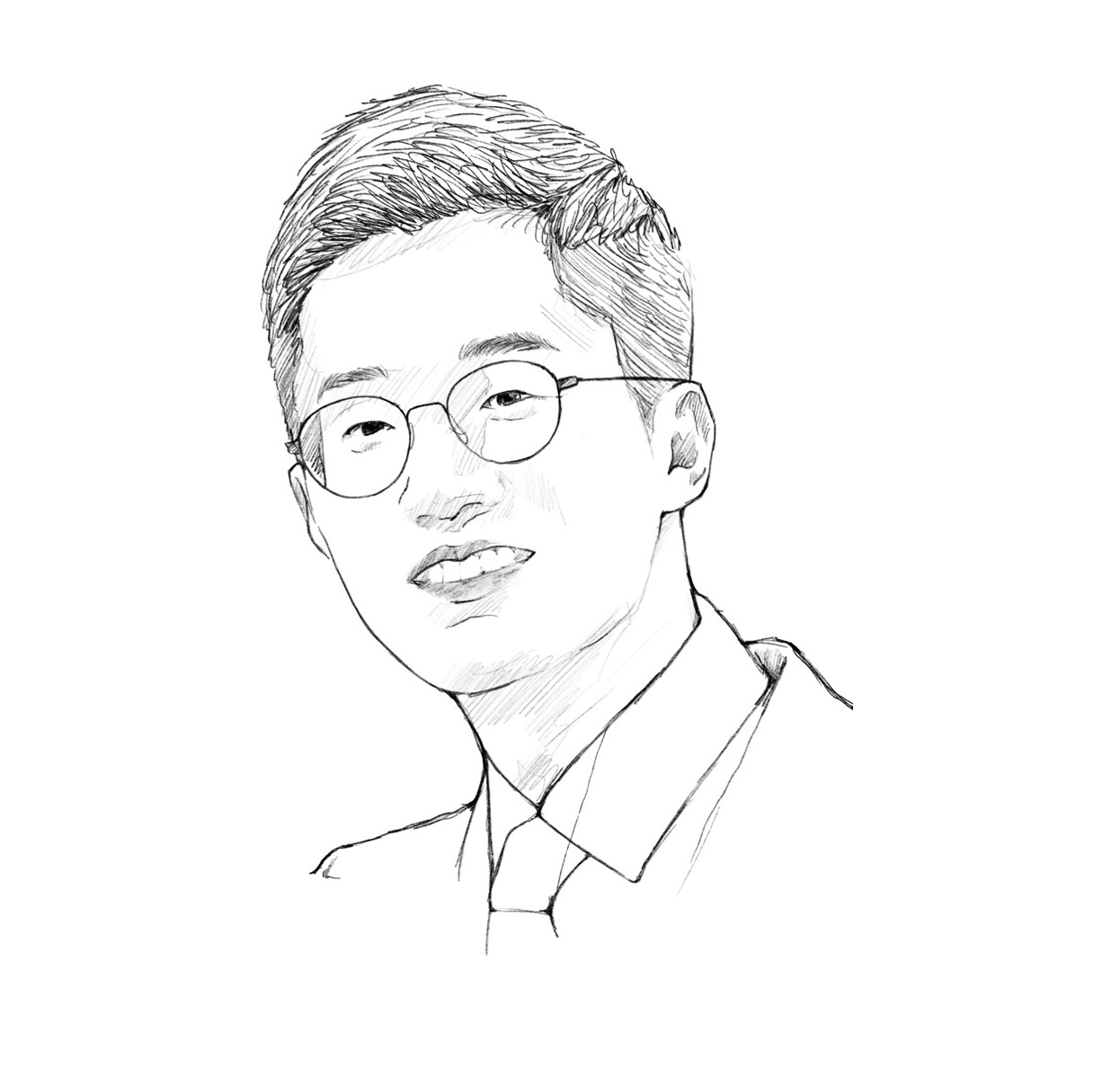
Reporter Kim Dongpyo letmein@asiae.co.kr
-
Edit Sung Kiho kihoyeyo@asiae.co.kr
© The Asia Business Daily(www.asiae.co.kr). All rights reserved.




![[Report] "A Culinary Destination with a View of Gyeongbokgung"... Kim Dong-sun's High-End Dining Takes Over Gwanghwamun](https://cwcontent.asiae.co.kr/asiaresize/304/2026042114562634571_1776750985.jpg)

![[Gallery Stroll] Red Robe, Black Lines... Danjong Returns with the Face of Wounds](https://cwcontent.asiae.co.kr/asiaresize/304/2026042014183532691_1776662315.jpg)