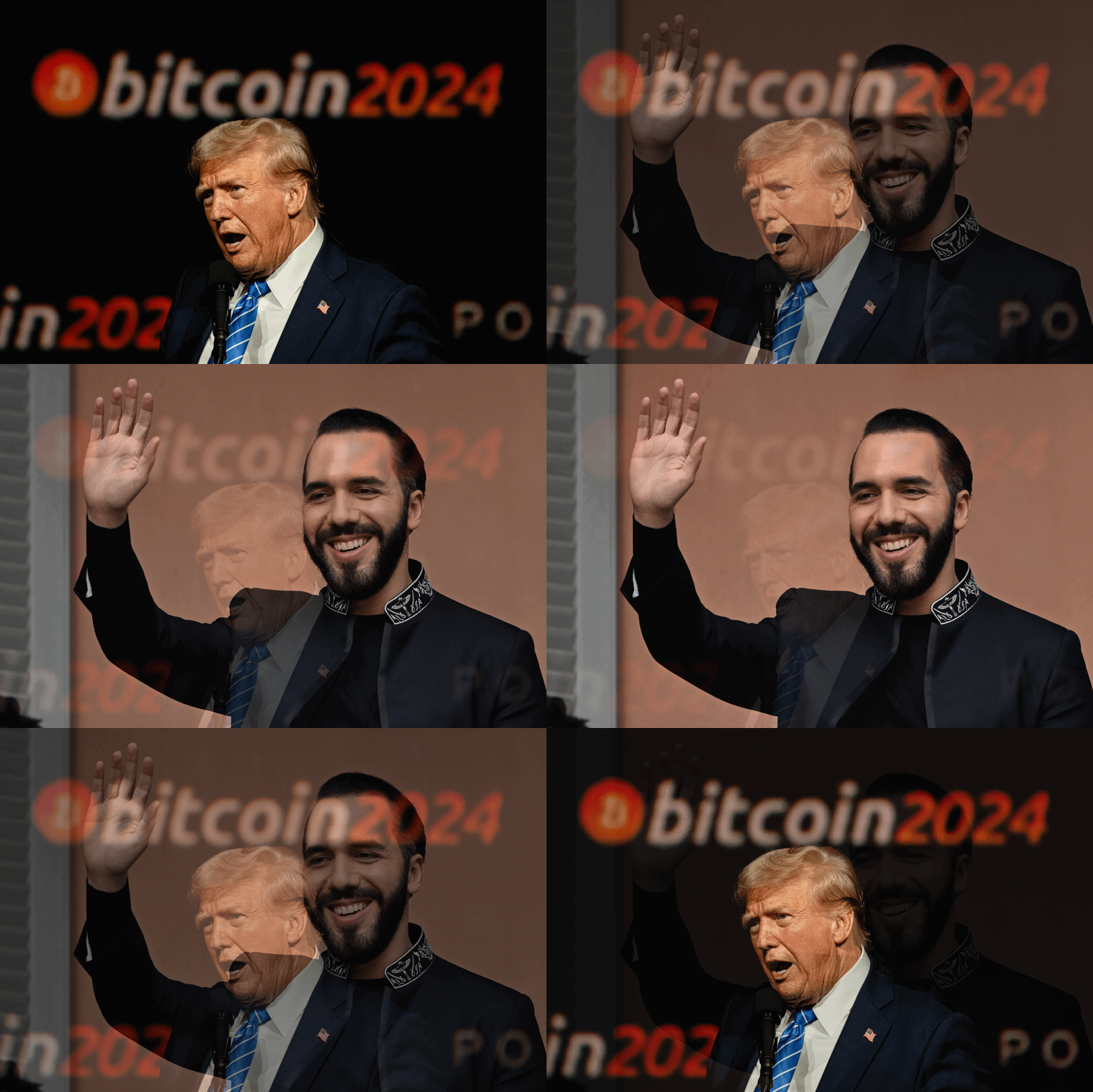
El Salvador and Bhutan Succeed in 'Coin Hodling'
Expectations for Russian Coin Influx After End of Ukraine War
Policy Benefits Likely to Grow From Trump’s Second Term
Bitcoin hit an all-time high, surpassing the $90,000 mark, following the reelection of former US President Donald Trump. Amid this sharp surge in Bitcoin, El Salvador and Bhutan have emerged as the biggest beneficiaries. There is also growing anticipation that, if the war in Ukraine ends, various cryptocurrencies, including Bitcoin, which have been tied up in Russia, will once again circulate, further revitalizing the cryptocurrency market.
El Salvador: The Country That Succeeded in a 3-Year Coin Hold


In September 2021, President Nayib Bukele of El Salvador adopted Bitcoin as legal tender and allocated a budget to purchase Bitcoin. At the time, the international community voiced concerns over El Salvador’s decision, as the country was suffering from massive national debt. In particular, the International Monetary Fund (IMF) officially warned that adopting cryptocurrency as legal tender was too great a risk.
President Bukele’s decision also sparked backlash among his own citizens. The policy was announced suddenly, without building public consensus or conducting surveys. Protests were intense, and there were even incidents where some Bitcoin ATMs were set on fire or destroyed. Nevertheless, President Bukele pushed ahead with his pro-Bitcoin policies.
The background to El Salvador’s adoption of Bitcoin as legal tender involved diplomatic friction with the United States. El Salvador had previously used the US dollar as its official currency, making it difficult to implement independent economic policies. The country was structurally dependent on US interest rate and economic policies. Especially during Trump’s first administration in 2017-18, when US aid was drastically cut, El Salvador’s economy was shaken, highlighting the need for economic independence.
El Salvador has been a representative pro-US country under American influence since the 19th century and still receives annual aid from the US. However, after the Trump administration’s aid cuts, calls to break free from economic dependence on the US grew louder. Although there was a need for a new legal tender, issuing its own currency was unrealistic due to difficulties in securing credit and the high cost of issuance. In this context, Bitcoin emerged as an extreme but feasible alternative.
Currently, El Salvador is known to hold about 5,930 Bitcoins. With an average purchase price around $40,000, the current price exceeding $90,000 means the country has more than doubled its investment. El Salvador’s Bitcoin purchases, totaling about $240 million (approximately 334.1 billion KRW), have now risen in value to around $500 million (about 696.1 billion KRW).
Bhutan, Hit Hard by COVID-19 Tourism Slump, Revitalized by Crypto

Meanwhile, Bhutan, one of the world’s poorest countries, began accumulating Bitcoin in 2017 and is now reported to hold over 12,500 Bitcoins?more than twice as many as El Salvador. Bhutan’s Bitcoin holdings were first revealed earlier this year, with most of the coins reportedly acquired through mining.
Bhutan was able to amass such a large amount of Bitcoin after Chinese mining farms relocated there following the COVID-19 pandemic. China began cracking down on mining operations around 2020 due to the pandemic and power shortages. At that time, China accounted for over 75% of global Bitcoin mining, and these mining farms dispersed to Russia, Central Asia, and Bhutan.
Located in the Himalayan highlands, Bhutan was ideally suited for mining operations. It benefits from favorable conditions for hydro and solar power generation, and with a population of less than 800,000, electricity consumption is low. The cold climate of the highlands also helps prevent server overheating. Moreover, the impact of COVID-19 was comparatively limited, allowing mining operations to continue without lockdowns.
Ceasefire Mood in Ukraine War... Will Russian Coins Return?


Russia has also recently proposed building an electronic currency payment platform among BRICS countries and is actively moving into the Bitcoin market by legalizing cryptocurrency mining. Before the Ukraine war, Russia was the world’s third-largest holder of Bitcoin after the US and China, but international sanctions have made it difficult for Russia to trade Bitcoin globally since the war began.
Russia has faced significant difficulties in international transactions due to being cut off from the international SWIFT payment system. This has been particularly devastating for its main exports, oil and gas, which are traded in dollars. In response, Russia, since the end of July, has allowed individuals and corporations to freely mine coins and has enacted laws to enable cryptocurrency payments in international transactions.
Experts point out that the policy direction of the Trump administration will be crucial for Bitcoin’s future. Expectations that the Trump administration will incorporate Bitcoin as a mainstream asset are driving the current rally. Until now, Bitcoin has been seen more as an alternative asset than a mainstream one like stocks or bonds, and has sometimes been associated with transactions by terrorist groups, sanctioned countries, or criminal organizations.
Bitcoin: Possessing Both Currency and Commodity Characteristics

However, for Bitcoin to function as a currency, its current high price volatility must be resolved. Bitcoin has characteristics not only as a currency but also as a commodity, resulting in price differences by country and extreme volatility due to its 24-hour trading nature. This contradicts the stability required of a currency.
Additionally, as the Ukraine war enters a ceasefire phase, Bitcoins that have been trapped in Russia may re-enter the market, and if trade disputes with China are resolved, the global Bitcoin market is expected to expand further. China still has many exchanges and mining farms, so improvement in US-China relations could be a key factor in expanding the Bitcoin market.
If Bitcoin becomes established as an international transaction method, it could reduce transaction costs and enable fast international remittances. For developing countries excluded from the dollar-based payment system, this could present new opportunities for economic development. However, Bitcoin’s high price volatility could pose risks in international transactions. Ultimately, the key issue for Bitcoin’s future development will be whether it can find a balance between its value as an investment asset and its function as a currency.
IndexAK Radio
-

Reporter Lee Hyunwoo knos84@asiae.co.kr
-
Reporter Song Yunjung singasong@asiae.co.kr
-
Reporter Lee Kyungdo lgd0120@asiae.co.kr
-
Edit Choo Myeonghoon chox2mh@asiae.co.kr
© The Asia Business Daily(www.asiae.co.kr). All rights reserved.