Rediscovering Food Waste ⑥
Agrain Produces Grain Flour from Spent Brewer's Grains
Retired Hens for Chicken Stock, Discarded Crabs for Fermented Broth
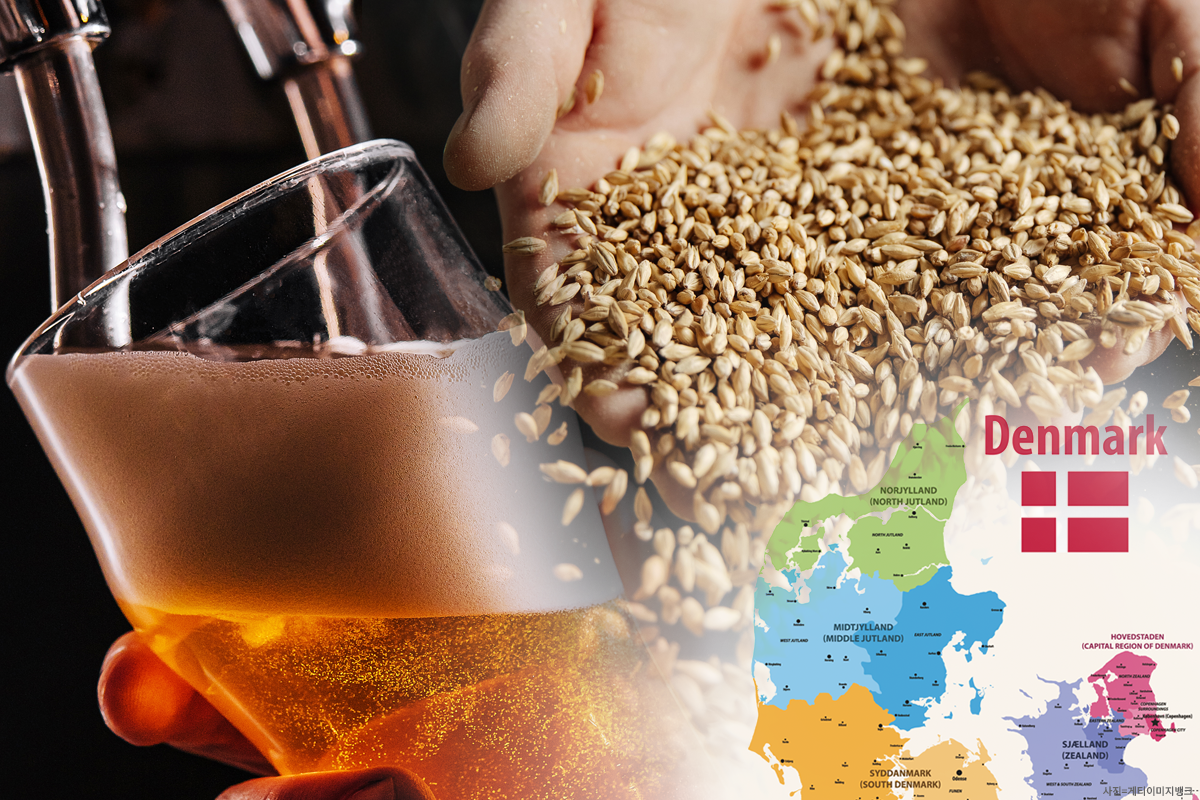
After traveling for more than a full day from Korea, I arrived at a quiet rural village called Gummersmarkvej in Denmark, where I found a food upcycling production plant recommended by ChatGPT. On a spacious site of about 9,000 square meters, the food upcycling company Agrain has established a 1,000-square-meter factory. Agrain produces various types of grain flour with unique flavors and textures by utilizing 맥주박Spent brewer’s grains, a byproduct left after brewing beer, known for its high content of protein, fiber, minerals, and vitamins. from beer brewing. This grain flour is used in a variety of recipes, including bread, pizza, and desserts.

The Transformation of 'Agrain' Spent Brewer's Grains...A Versatile High-Protein Grain Flour
Denmark was once considered the largest waste-producing country in Europe. According to Eurostat, the annual per capita waste generation in 2015 was about 789 kg, ranking first among European Union (EU) member states. However, as social awareness of eco-friendliness changed, Denmark became a country that successfully reduced waste in a short period.
![(From left) The existing 'Linear Economy' system progresses through the process of 'resource extraction → mass production → disposal,' while the 'Circular Economy' system establishes a circulation network for discarded resources to minimize the input of resources and energy. [Image source=Getty Images Bank]](http://www.asiae.co.kr/news/img_view.htm?img=2024092509491338401_1727225353.png)
![(From left) The existing 'Linear Economy' system progresses through the process of 'resource extraction → mass production → disposal,' while the 'Circular Economy' system establishes a circulation network for discarded resources to minimize the input of resources and energy. [Image source=Getty Images]](http://www.asiae.co.kr/news/img_view.htm?img=2024092509491738402_1727225357.png)
'Circular Food Technology,' the company operating Agrain, also began with the awareness that the current economic system can no longer be sustained. Moving away from the traditional 'linear economy'?the process of 'resource extraction → mass production → disposal'?they believed that building a circular network for discarded resources and minimizing the input of resources and energy in a 'circular economy' system is the key to securing the sustainability of the global economy and reducing the burden on future generations.
Founded in Copenhagen in 2018, Circular Food Technology launched the food upcycling brand Agrain and has been introducing related products. True to its name, which means 'grain,' Agrain focuses on upcycling discarded grains.
Aviaja Riemann-Andersen, the founder and CEO of Circular Food Technology, said, "The problem of resource waste in the linear food system, which exceeds ecological capacity, can be easily observed around us." She added, "If you want to change a fairly conservative system like food, you need to choose ingredients that play a key role in the diet. Since grains are essential ingredients in the diets of all cultures, I thought they were the optimal material in terms of versatility and scalability."

(From left) Aviaja Riemann Andersen, CEO of Danish upcycling food company Circular Food Technology, and Jesper Clement, Chief Operating Officer. Photo by Eunmo Gu
원본보기 아이콘Agrain produces various grain flours and crackers using spent brewer's grains left after beer brewing. About 40 million tons of spent brewer's grains are generated worldwide every year, and countless breweries in Denmark, including Carlsberg, produce large quantities as well. However, the reuse rate is close to zero, and most of it is discarded, releasing large amounts of carbon during landfill and incineration processes.
Agrain determined that spent brewer's grains are an ideal starting material for food upcycling because, according to European Food Safety Authority (EFSA) regulations, they are a food byproduct that can be safely used as a food ingredient, and since most are discarded without purpose, the supply is stable. CEO Riemann-Andersen said, "Agrain's technological strength lies in the algorithm of the production process?such as temperature, timing, and mixing ratios for handling the ingredients?rather than the equipment or the process itself," adding, "Food upcycling does not require the development of complex new technologies, and the resources already exist, so it will become a core area of food tech".

Brewing residue (left) as the raw material and grain powder completed through upcycling.
Photo by Eunmo Koo

In fact, Agrain's production process can be simplified into three stages: 'pressing → drying → grinding.' The raw spent brewer's grains are pressed in a screw press to reduce the moisture content by half, then transferred to a dryer where hot air dries the grains. The thoroughly dried grains are ground into powder at the micrometer (μm, 0.001mm) level, and after packaging, become the final product.
Currently, Agrain is planning to expand its commercial scale through licensing its spent brewer's grains upcycling technology and process. She said, "If the technology and equipment are complicated, expansion can be slow, but the equipment we use can be purchased anywhere in the world, and the technology can be utilized anywhere if the license is transferred," adding, "I look forward to the day when, if someone asks ChatGPT about food upcycling, it will answer with Agrain."
Adding Deep Flavor to Food with Retired Hens
'Reduced', located in Nordhavn in northern Copenhagen, was established in 2020 with the goal of reducing various ingredients and byproducts lost in the food supply chain, as well as the massive food waste generated during consumption.


Reduced produces a variety of broths and stock products using less marketable livestock byproducts, vegetables, and fruits. Chicken stock made from laying hens is a representative product. Laying hens have tough meat, making them generally unsuitable for consumption. As a result, when laying hens can no longer produce eggs, they are mostly used as animal feed or simply discarded, amounting to 8 million kg annually in Denmark alone. Lorenzo Tirelli, Reduced's Head of Research & Development (R&D), explained, "We roast and grind the laying hens, then ferment them to extract flavor and make stock," adding, "Since producing 1 kg of chicken emits 8 kg of carbon dioxide, upcycling laying hens instead of discarding them helps make better use of valuable natural resources."
![Lorenzo Tirelli, Head of Reduced Research and Development (R&D), is explaining the production process. <br>[Photo by Eunmo Koo]](http://www.asiae.co.kr/news/img_view.htm?img=2024092014032733722_1726808607.jpg)
Lorenzo Tirelli, Head of Reduced Research and Development (R&D), is explaining the production process.
[Photo by Eunmo Koo]
They also produce broth using coastal crabs. Along Denmark's coast, 12 billion crabs thrive, and their numbers are increasing every year. However, most of these are invasive species that threaten the populations of fish and shellfish. Tirelli, the R&D head, explained, "Many of these crabs are caught during fishing operations, and since Denmark classifies them as harmful species, they cannot be returned to the sea and ultimately become waste on land. We buy these crabs, which have hard shells and little meat and that no one wants, for about 50?80 cents per kilogram and transform them into a rich seafood broth."
Reduced mainly utilizes fermentation technology to produce its products. Tirelli, who is from Rome, Italy, said, "Before joining Reduced, I worked as a chef in restaurants and learned how to use fermentation. I was greatly inspired by Asian fermented foods such as kimchi, miso, shoyu, and amazake." He added, "Fermentation helps extend the shelf life of food and, above all, is an excellent way to create flavor, making it effective in enhancing the umami of stock and broth products." Even when making the Japanese fermentation starter 'koji,' they upcycle broken rice grains generated during the polishing process.

Reduced uses broken rice from the polishing process as an upcycled ingredient when making the fermentation starter (Japanese-style koji) used in the upcycling process.
Photo by Gu Eunmo
Tirelli, the R&D head, emphasized, "Food upcycling is an old future already familiar in our daily lives", adding, "Just as you make new soup from old bread, elements of upcycling have already been incorporated into cooking during my 10 years as a chef." CEO Riemann-Andersen also said, "When my mother bought a chicken, she used everything without wasting anything," explaining, "Upcycling is not something entirely new, but rather a return to the way we used to produce and prepare food in the past".
※ This project was supported by the Press Promotion Fund, created from government advertising fees.
IndexRediscovery of Eumseo
- Turning Discarded Watermelon Rinds into a 26.5 Billion Won Annual Sales Miracle
- Food Upcycling and Lost Muscle... Slowing Down Climate Change
- "Open Only at Night"... Tokyo Bakery Sells Out Within an Hour
- No Longer Food Waste... Japan Finds a 'Gold Mine' by Changing Perspective
- The Country Once Known for the Most Waste in Europe... Turning Beer Residue into High-Protein Grain Powder
-
Reporter gooeunmo@asiae.co.kr
-
Edit Hong Jayeon hongzaa@asiae.co.kr
© The Asia Business Daily(www.asiae.co.kr). All rights reserved.
!["Please Help Us": How Much Do Those Bowing 90 Degrees These Days Actually Earn? [Data Pick]](https://cwcontent.asiae.co.kr/asiaresize/323/2026052010120870131_1779239528.png)