In Depth
2026 Future Enterprise Forum
-
26.05.13 16:05
- "Domestic Space Industry Needs Increased Government Budget...Investment Set to Accelerate"
-
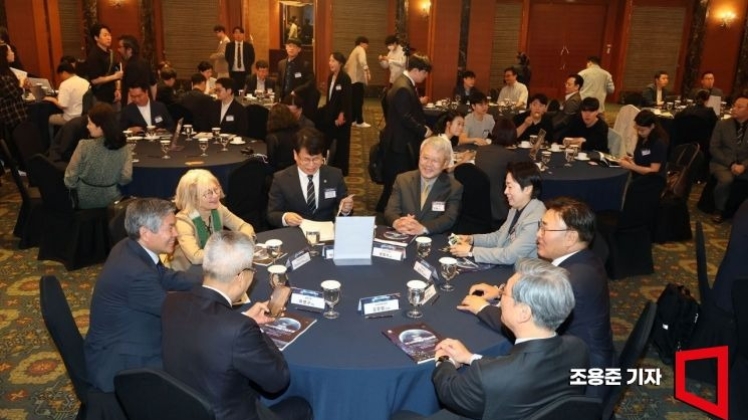
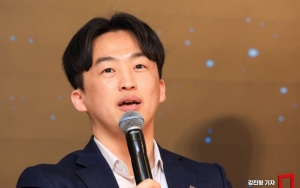
The financial investment industry has suggested that the government should play a more active role, such as increasing budget allocations, in order to advance the domestic space industry and raise public interest. Jihun Jeong, Researcher at Eugene Investment & Securities Aerospace Research Center, made these remarks during a panel discussion at the “2026 Asia Future Enterprise Forum” held at Lotte Hotel in Sogong-dong, Seoul, on May 13. Researcher Jeong emphasized, “China is making massive budget investments at a truly astonishing pace, and the same goes for India, Japan, and Europe, where significant amounts are being invested. In comparison, I feel that Korea is still somewhat lacking in this regard. If government-level support increases, it will raise interest in the industry and lead to more investment opportunities.” Iltae Kim, Head of Investment Division 2 at Sema Investment, commented, “This year, two companies are preparing to go public, and many companies are receiving inves
-
26.05.13 12:29
- "Making Money in Space"... Declaration to Become a 'Service-Oriented' Space Powerhouse
-
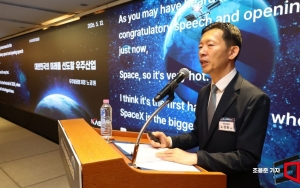
South Korea has declared a major transformation from a country focused solely on satellite manufacturing to becoming a 'space economic powerhouse' that generates continuous revenue through space business and services. No Kyungwon, Deputy Administrator of Korea Aerospace Administration (KASA), presented the future vision for South Korea's space industry during his keynote speech at the '2026 Asia Future Business Forum' held at Lotte Hotel, Sogong-dong, Seoul, on May 13. He stated, "South Korea now stands at the threshold of a 'great space navigation era', where we must move beyond being a country that explores space to becoming a country that creates economic value in space." Deputy Administrator No explained that the paradigm of the satellite industry has been rapidly changing recently. He noted, "The private sector paradigm, led by companies like SpaceX and Blue Origin, has shifted significantly, and launch costs have dropped to less than one-tenth of their previous levels." He partic
-
26.05.13 12:26
- Samsung: "K-Semiconductors Are Key to Leading the Space Market... High-Performance, Low-Power Technology Is Crucial"
-
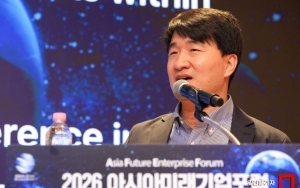
Jinwoo Han, Executive Director at Samsung Electronics Semiconductor Research Center, stated that "K-Semiconductors will play the most significant role in enabling Korea to take the lead in the global 'space economy'." He predicted that as the era of space data centers and satellite artificial intelligence (AI) becomes full-fledged, the competition for high-performance, low-power, and high-density semiconductor technologies will intensify further. Han, who joined Samsung Electronics after working for 13 years at NASA, made these remarks during his keynote presentation at the "2026 Asia Future Enterprise Forum" held at Lotte Hotel in Sogong-dong, Seoul, on May 13. He emphasized, "The essence of the space infrastructure era ultimately lies in semiconductor competitiveness." Recently, global big tech companies and space corporations have been accelerating the construction of space-based data centers and satellite computing. In particular, following the emergence of SpaceX, the cost of lau
-
26.05.13 11:57
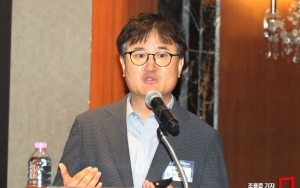
- "In the Era of Space Data Centers... The Key Is High-Reliability, Low-Power Memory"
-
"Even in the new era of space data centers, memory will always remain at the core." Yoo Minsu, Vice President of SK hynix, revealed strategies for next-generation memory technologies tailored for space environments at the "2026 Asia Future Enterprise Forum" held on May 13 at Lotte Hotel in Sogong-dong, Seoul. He stated, "With the explosive increase in space data, space data centers are emerging as a key solution to supplement terrestrial infrastructure." Recently, space data has been surging due to the expansion of Earth observation satellites and low-Earth orbit communication networks such as Starlink. However, as data transmission to Earth faces physical bandwidth limits and latency bottlenecks, the need for "space computing"—processing data directly in space—has become increasingly apparent. Vice President Yoo predicted, "Space data centers will not simply replace terrestrial infrastructure, but rather play a complementary role by strengthening the connection between Earth and space
-
26.05.13 11:43
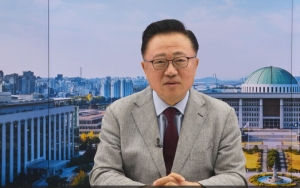
- Hwang Jeonga and Ko Dongjin: "Space Technology Is a National Strategic Asset... Korea Must Rise to the Top 5 Space Powers"
-
There has been a suggestion from the political community that all of the nation's capabilities must be mobilized to gain leadership in the space industry. Lawmakers emphasized that space technology is a core strategic asset that will determine national security and future growth engines, pledging robust legislative and policy support. Hwang Jungah, a member of the Democratic Party of Korea, stated in her congratulatory speech at the 2026 Asia Future Business Forum held at Lotte Hotel in Sogong-dong, Seoul on the 13th, "Space technology has become a national strategic asset that determines the country's competitiveness, serving as a future growth engine organically combining national security, advanced industries, and private sector innovation." She continued, "The Lee Jaemyung administration, based on this understanding, has ushered in the era of a 1 trillion won budget for the Korea Aerospace Administration, and successfully completed the fourth Nuri launch last year. In addition, int
-
26.05.13 11:27
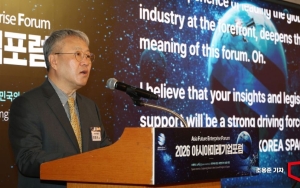
- "The Space Industry as a New Growth Engine... Securing the Technological Ecosystem Is the Key to Competition"
-
Jang Beomsik, CEO of The Asia Business Daily, defined the space industry as a new market that can break through the limitations of the terrestrial economy, emphasizing that securing a lead in the technological ecosystem will be the key to future competition.In his opening remarks at the 2026 Asia Future Enterprise Forum held at Lotte Hotel in Sogong-dong, Seoul, on May 13, Jang stated, "The space we are witnessing now is a new market where massive capital and technology converge, and a strong alternative to overcoming the boundaries of the terrestrial economy." He further diagnosed, "The stage of innovation is shifting from the ground to the sky." Jang added, "Low Earth orbit satellite communications, which will complete the era of hyperconnectivity; space manufacturing, which will make processes impossible on Earth a reality; and the Moon and planets, which are treasure troves of limitless resources—space is no longer a vague fantasy," and continued, "Space has now become a business a
-
26.05.13 11:23
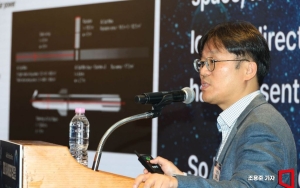
- Earth Is Too Small, Now to Space... '24-Hour Solar Power' Ushers in the Era of Orbital Data Centers
-
"Space solar cells have become a key enabler for large-scale, AI-based satellite systems." On May 13, Professor Myunghoon Shin of Korea Aerospace University presented space solar cells as next-generation energy infrastructure technology that will lead the 'New Space' era at the 2026 Asia Future Business Forum held at Lotte Hotel in Sogong-dong, Seoul. He assessed that overcoming the limitations of terrestrial power supply and enabling 'orbital data centers' that operate 24 hours a day could become a game changer for the AI industry. Currently, terrestrial data centers face limits to scaling up due to enormous power consumption and cooling challenges. In this context, Elon Musk, CEO of Tesla, predicted at the 2026 Davos Forum that "the most cost-effective place to deploy AI will be space." Space-based AI computing is not only free from environmental regulations or power supply issues on Earth, but also provides strong economic competitiveness due to its ease of long-term expansion. Glob
-
26.05.13 11:22
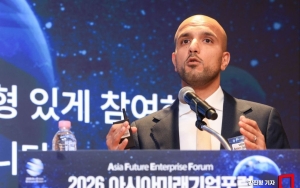
- "UAE Launched Its First Satellite with Korea... Rising as the Middle East Space Hub"
-
The United Arab Emirates (UAE), a major oil-producing nation, has emerged as a key player in the Middle Eastern space industry, achieving independent satellite development and Mars probe orbit entry just over a decade after launching its first satellite through cooperation with Korea. Amer Al Sayeh Al Ghaffari, Deputy Secretary of the Space Engineering Division at the Mohammed Bin Rashid Space Centre (MBRSC), identified a clear national vision and consistent project execution as core drivers of the growth in the space industry. In his keynote speech at the "2026 Asia Future Business Forum" held at Lotte Hotel in Sogong-dong, Seoul, on May 13, Al Ghaffari stated, "Korea has strong capabilities in fields such as satellites, launch vehicles, artificial intelligence (AI) technology, robotics, and manufacturing." He suggested, "The key is to unite these strengths under a clear national vision and to pursue them consistently over the long term." The UAE's space development began to grow bas
-
26.05.13 11:22
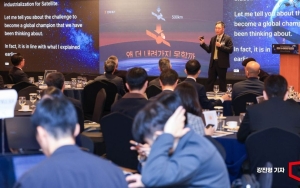
- "Satellites in Ultra-Low Earth Orbit Below 400km... Korea Will Plant Its Flag First"
-
"SpaceX has already opened up the 500km low Earth orbit (LEO) market. However, ultra-low Earth orbit (below 400km altitude) remains an unexplored space territory where no one has yet been able to provide stable commercial services." Seon Kim, Executive Vice President of Space Business at Hanwha Group, made this statement at the '2026 Asia Future Enterprises Forum' held at Lotte Hotel in Sogong-dong, Seoul, on May 13. He added, "We will be the first to plant the Korean flag in ultra-low Earth orbit." In his presentation, Kim identified ultra-low Earth orbit (VLEO), which lies at altitudes even lower than traditional low Earth orbit satellites, as the core market for the next-generation space industry. He explained, "As altitude decreases, communication latency is reduced and image resolution improves," and noted, "The industry structure, which has been centered on geostationary satellites, is now shifting to the era of clustered LEO satellites." Kim further assessed that ultra-low Earth
-
26.05.13 11:21
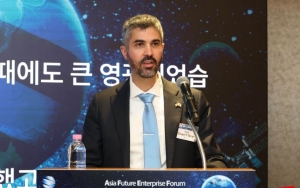
- Sean Wilson: "In the Space Economy Era... Korean Companies Must Leverage Strengths in Semiconductors and AI"
-
Sean Wilson, Founder and CEO of Mirai Group (TMG), emphasized, "Korean companies should leverage their existing industrial strengths in semiconductors, AI, telecommunications, and robotics to enter the U.S. market by integrating them with the space industry." During his keynote speech at the "2026 Asia Future Business Forum" held at Lotte Hotel in Sogong-dong, Seoul, on May 13, Wilson stated, "The largest opportunity in the space economy is undoubtedly the U.S. market," adding, "The United States accounts for an overwhelming share of the global market in most space industry sectors, including launches, satellite communications, and remote sensing." He explained, "The U.S. launch market represents about 55-60% of the global market, and even in remote sensing data procurement, the U.S. government alone accounts for roughly half of the global commercial market." He added, "The space communications sector also constitutes approximately 40% of the global market." Wilson analyzed that the su