[2026 Asia Future Business Forum] "Satellites in Ultra-Low Earth Orbit Below 400km... Korea Will Plant Its Flag First"
Seon Kim, Executive Vice President of Hanwha Space Business, Presents Keynote
Declares Hanwha's Ambition to Lead the Next-Generation Space Industry in VLEO
Technological Challenges Ahead, Including Atmospheric Drag
Developing 10cm-Cla
"SpaceX has already opened up the 500km low Earth orbit (LEO) market. However, ultra-low Earth orbit (below 400km altitude) remains an unexplored space territory where no one has yet been able to provide stable commercial services."

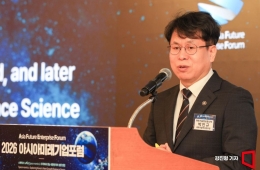
Seon Kim, Executive Vice President of Space Business at Hanwha Group, is giving a presentation on the topic "New Space: Challenges and Tasks" at the '2026 Asia Future Enterprises Forum' held on the 13th at Lotte Hotel in Jung-gu, Seoul. Photo by Jinhyung Kang
View original imageSeon Kim, Executive Vice President of Space Business at Hanwha Group, made this statement at the '2026 Asia Future Enterprises Forum' held at Lotte Hotel in Sogong-dong, Seoul, on May 13. He added, "We will be the first to plant the Korean flag in ultra-low Earth orbit."
In his presentation, Kim identified ultra-low Earth orbit (VLEO), which lies at altitudes even lower than traditional low Earth orbit satellites, as the core market for the next-generation space industry. He explained, "As altitude decreases, communication latency is reduced and image resolution improves," and noted, "The industry structure, which has been centered on geostationary satellites, is now shifting to the era of clustered LEO satellites."
Kim further assessed that ultra-low Earth orbit is not simply about lowering satellite altitudes, but represents an area that fundamentally changes the business structure of the space industry itself. He explained that companies capable of integrating launch vehicles, satellites, data analysis, and artificial intelligence (AI) services into a single system will take the lead in the market.
He pointed out, however, that there are technical challenges in ultra-low Earth orbit, such as increased atmospheric drag and atomic oxygen. Because atmospheric resistance shortens satellite lifespans and causes oxidation and erosion problems, he emphasized the need for new design and coating technologies.
Kim also revealed a strategy focused on market preemption rather than perfecting technology. He said, "We chose to prioritize market entry over technological superiority," and explained, "Our plan is to load proven satellite components with ample fuel, launch them, and then relaunch when they fall due to atmospheric drag, thereby securing the market."
Currently, Hanwha is developing an ultra-low Earth orbit radar observation satellite with a resolution of 10 centimeters. Kim emphasized, "In low Earth orbit, there is a trade-off between resolution and noise, but by moving to ultra-low Earth orbit, we can achieve higher resolution and lower noise simultaneously," adding, "We aim to change the rules of the game itself."
He also presented a vertical integration strategy that combines launch vehicles and satellites. By optimizing ultra-low Earth orbit satellites for Hanwha's launch vehicles, more satellites can be launched at lower costs and at desired times. Based on this, the company aims to establish a cluster satellite system in ultra-low Earth orbit capable of photographing the entire globe every 30 minutes.
Kim stressed that having a structure that does not rely on external parties for launch schedules and costs will be key to future competitiveness in the space industry. He explained that designing satellites and launch vehicles simultaneously allows for mission-specific optimization and improves launch efficiency.
Hanwha also plans to actively apply AI to satellite image analysis. Kim said, "The value of satellite data lies not in the images themselves, but in their interpretation," and added, "With proprietary AI models, we can analyze more images faster and more accurately." He continued, "By utilizing large language models (LLMs), we aim to enable users to check image analysis results through human-like conversations."
He cited defense and security, Arctic shipping routes, and disaster response as potential applications. Kim said, "A 10-centimeter ultra-high-resolution radar satellite can accurately identify camouflage equipment such as fake missile launchers, and it will also allow us to analyze Arctic ice movements and flood risks in near real-time."
Hot Picks Today
 Even with High Oil Price Relief Payment, Additional 300,000 Won Per Person to Be Provided... Applications Open from the 18th in This Region
- "Invested 95% in Hynix and Reached 10 Billion Won"... Japanese Investor's Proof Post Goes Viral
- Seoul Real Estate Formula Collapses: "Just Follow Gangnam" Is Now a Thing of the Past [Home-Tech]
- "You Don't Need to Go to the Gym": The Best Exercises for Lowering Hypertension
- "That Thing Wakes Up Every Night" ... Suspicious Object Covers Rural Village
Kim concluded, "Hanwha's goal is not merely to be a satellite manufacturer or launch vehicle provider," emphasizing, "We will build a 'Space Hub' that integrates satellites, launch vehicles, and AI into a single system to provide the services our customers want."
© The Asia Business Daily(www.asiae.co.kr). All rights reserved.