[2026 Future Enterprise Forum] "UAE Launched Its First Satellite with Korea... Rising as the Middle East Space Hub"
Al Ghaferi Delivers Keynote Address at MBRSC
"The Core of Space Industry Growth Lies in a Clear National Vision"
UAE Achieves Independent Satellite Launch in Just a Decade
Aiming for Lunar Far-Side Exploration and Actively Investing i
The United Arab Emirates (UAE), a major oil-producing nation, has emerged as a key player in the Middle Eastern space industry, achieving independent satellite development and Mars probe orbit entry just over a decade after launching its first satellite through cooperation with Korea. Amer Al Sayeh Al Ghaffari, Deputy Secretary of the Space Engineering Division at the Mohammed Bin Rashid Space Centre (MBRSC), identified a clear national vision and consistent project execution as core drivers of the growth in the space industry.
In his keynote speech at the "2026 Asia Future Business Forum" held at Lotte Hotel in Sogong-dong, Seoul, on May 13, Al Ghaffari stated, "Korea has strong capabilities in fields such as satellites, launch vehicles, artificial intelligence (AI) technology, robotics, and manufacturing." He suggested, "The key is to unite these strengths under a clear national vision and to pursue them consistently over the long term."

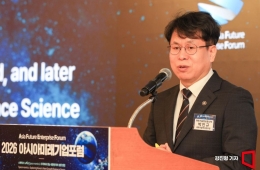
Amer Al Sayeh Al Ghaferi, Deputy Secretary of the Space Engineering Division at Mohammed Bin Rashid Space Center, is delivering the keynote speech titled "From the Desert to Space: The Rise of the Middle Eastern Space Industry and the UAE's Challenge" at the "2026 Asia Future Business Forum" held at Lotte Hotel in Jung-gu, Seoul on the 13th. 2026.5.13 Photo by Jinhyung Kang
View original imageThe UAE's space development began to grow based on the establishment of MBRSC in 2006. MBRSC is now the UAE's core space institution, employing more than 200 staff members. Al Ghaffari has played a pivotal role in major projects since the center's inception. He also participated in the development of 'KhalifaSat,' the first satellite independently developed by the UAE.
Collaboration with Korea played a crucial role in the early growth of MBRSC's space industry. In 2006, the center partnered with Korea's satellite developer Satrec Initiative to successfully develop its first satellites, 'DubaiSat-1' and 'DubaiSat-2.' He remarked, "The essence of the UAE space program began here in Korea," adding, "Collaboration with Satrec Initiative greatly contributed to building the foundation and growth of the UAE space industry."

Amer Al Sayeh Al Ghaffari, Deputy Secretary of the Space Engineering Division at Mohamed bin Rashid Space Centre, is delivering a keynote speech on the topic "From Desert to Space: The Rise of Middle Eastern Space Industry and UAE's Challenge" at the "2026 Asia Future Business Forum" held at Lotte Hotel in Jung-gu, Seoul on May 13, 2026. Photo by Kang Jinhyung
View original imageWithin just over a decade of its establishment, MBRSC achieved explosive technological growth, including the development of the independently built KhalifaSat in 2018. Last year, the UAE was able to launch its fourth Earth observation satellite, 'MBZ-SAT,' which is regarded as the most advanced satellite in the Middle East. Environmental testing for the satellite was conducted at facilities of the Korea Aerospace Research Institute (KARI), and MBRSC and KARI also signed a memorandum of understanding (MOU) for cooperation in space activities and knowledge exchange.
Al Ghaffari emphasized that the achievements in satellite development go beyond mere accumulation of technology. He explained that not only has the UAE's international standing in satellite design and manufacturing risen, but also that local UAE companies are now manufacturing satellite components, winning contracts for satellite system development and data analysis, and thereby expanding the country's space industry ecosystem.

Amer Al Sayeh Al Ghaffari, Deputy Director of Space Engineering at Mohammed Bin Rashid Space Centre, is giving a keynote speech on the theme "From Desert to Space: The Rise of the Middle East Space Industry and the UAE's Challenge" at the "2026 Asia Future Business Forum" held on May 13 at Lotte Hotel in Jung-gu, Seoul. 2026.5.13 Photo by Jinhyung Kang
View original imageMBRSC is actively investing in the advancement of the industry by training astronauts and conducting lunar far side exploration. In 2019, the UAE sent its first astronaut to the International Space Station (ISS), and in 2021, another astronaut carried out a long-term mission. Al Ghaffari stressed, "The UAE’s investment in astronaut training aims to spread an exploration culture throughout society and to establish a new future vision based on a knowledge economy."
Hot Picks Today
 Even with High Oil Price Relief Payment, Additional 300,000 Won Per Person to Be Provided... Applications Open from the 18th in This Region
- "Invested 95% in Hynix and Reached 10 Billion Won"... Japanese Investor's Proof Post Goes Viral
- Seoul Real Estate Formula Collapses: "Just Follow Gangnam" Is Now a Thing of the Past [Home-Tech]
- "You Don't Need to Go to the Gym": The Best Exercises for Lowering Hypertension
- "That Thing Wakes Up Every Night" ... Suspicious Object Covers Rural Village
The UAE's space development is considered a successful example of a latecomer, having started with technical cooperation with Korea under a clear national vision and progressing to independent satellite development and Mars exploration. MBRSC plans to further advance its space industry ecosystem by expanding lunar rover development and astronaut training programs. Al Ghaffari stated, "We do not see space as a means of competition," adding, "Space is where we cooperate and where we grow together."
© The Asia Business Daily(www.asiae.co.kr). All rights reserved.