[2026 Asia Future Business Forum] Earth Is Too Small, Now to Space... '24-Hour Solar Power' Ushers in the Era of Orbital Data Centers
Professor Myunghoon Shin Presents Keynote at Korea Aerospace University
Hybrid Deployment of Solar Cells for Space Missions
Efficiency of III-V Cells vs. Cost Effectiveness of Perovskite
"Space solar cells have become a key enabler for large-scale, AI-based satellite systems."
On May 13, Professor Myunghoon Shin of Korea Aerospace University presented space solar cells as next-generation energy infrastructure technology that will lead the 'New Space' era at the 2026 Asia Future Business Forum held at Lotte Hotel in Sogong-dong, Seoul. He assessed that overcoming the limitations of terrestrial power supply and enabling 'orbital data centers' that operate 24 hours a day could become a game changer for the AI industry.

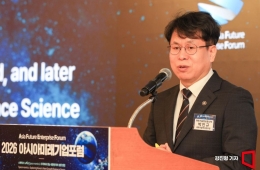
Professor Myunghoon Shin of the Department of Avionics and Information Engineering at Korea Aerospace University is delivering a keynote speech titled "Current Status and Business Opportunities of Space Solar Power Technology" at the 2026 Asia Future Business Forum held at Lotte Hotel in Sogong-dong, Seoul on the 13th. 2026.5.13 Photo by Yojongjun
View original imageCurrently, terrestrial data centers face limits to scaling up due to enormous power consumption and cooling challenges. In this context, Elon Musk, CEO of Tesla, predicted at the 2026 Davos Forum that "the most cost-effective place to deploy AI will be space." Space-based AI computing is not only free from environmental regulations or power supply issues on Earth, but also provides strong economic competitiveness due to its ease of long-term expansion.
Global big tech companies are already racing to pioneer space. SpaceX has reportedly submitted plans to the U.S. Federal Communications Commission (FCC) to operate over one million orbital data center satellites. Amazon and Blue Origin are pushing to build gigawatt-scale space data centers through 'Project Sunrise.' Google is also planning to launch a demonstration satellite equipped with a solar-powered satellite cluster containing Tensor Processing Units (TPUs) in 2027.
Professor Shin named CEO Musk as one of the leading figures in the commercialization of space data centers. He noted that Musk has built a vertically integrated ecosystem that goes beyond simple technology development to encompass solar cell production, launch, operation, and service. Tesla provides battery, power electronics, and energy storage technologies, while SpaceX transports infrastructure into space at low cost with reusable launch vehicles. This is combined with Starlink's satellite communications network, xAI's AI models, and X (formerly Twitter)'s real-time data streams, forming a vast, integrated ecosystem.
Professor Shin said, "SpaceX is accumulating expertise by independently launching rockets and sorting out which components, including solar cells, are truly suitable for use in space," and stressed, "It is impossible for Korean companies to compete directly with SpaceX using the same model right now. Even if the scale is smaller, it is important to maintain a self-sustaining space business ecosystem that can consume what it produces."

Professor Myunghoon Shin of the Department of Avionics and Information Engineering at Korea Aerospace University is giving a presentation titled 'Current Status and Business Opportunities of Space Solar Power Technology' at the 2026 Asia Future Business Forum held on May 13 at Lotte Hotel in Sogong-dong, Seoul. 2026.5.13 Photo by Yongjun Cho
View original imageFrom a technical standpoint, making strategic choices between efficiency and cost has become crucial. The traditional space industry has relied on III-V multi-junction solar cells, which have high efficiency and reliability, but their per-watt price is hundreds of times higher than terrestrial versions. As a result, Chinese companies that dominate the terrestrial solar cell market are seeking to enter the space market with next-generation materials such as perovskite. In particular, tandem cells that combine perovskite and silicon are considered strong candidates for future space data centers, as they are lightweight, flexible, and can dramatically reduce manufacturing costs.
Among Korean companies, Flexell Space and Solletop, which are collaborating with Hanwha Systems, are accelerating their efforts to secure flight heritage for perovskite tandem cell technology.
Hot Picks Today
 Even with High Oil Price Relief Payment, Additional 300,000 Won Per Person to Be Provided... Applications Open from the 18th in This Region
- "Invested 95% in Hynix and Reached 10 Billion Won"... Japanese Investor's Proof Post Goes Viral
- Seoul Real Estate Formula Collapses: "Just Follow Gangnam" Is Now a Thing of the Past [Home-Tech]
- "You Don't Need to Go to the Gym": The Best Exercises for Lowering Hypertension
- "That Thing Wakes Up Every Night" ... Suspicious Object Covers Rural Village
Professor Shin predicted, "The space solar power industry is shifting to a mission-optimized and hybrid approach that combines high efficiency with low cost," and added, "Ultimately, advances in solar cell efficiency, materials, and manufacturing technologies will play a decisive role in realizing large-scale space energy systems such as orbital data centers."
© The Asia Business Daily(www.asiae.co.kr). All rights reserved.