[2026 Future Business Forum] "Making Money in Space"... Declaration to Become a 'Service-Oriented' Space Powerhouse
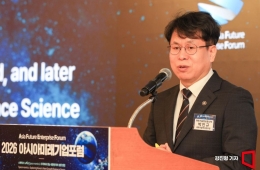
No Kyungwon, Deputy Administrator of KASA, Delivers Keynote Speech
Emphasizes Generating Revenue Beyond Satellite Manufacturing Through Services
Opportunities from Rising Demand for Launch Services in Asia
Strengthening Private Sector Capabilities Through Startup Fostering
South Korea has declared a major transformation from a country focused solely on satellite manufacturing to becoming a 'space economic powerhouse' that generates continuous revenue through space business and services.

No Kyungwon, Deputy Administrator of Korea Aerospace Administration (KASA), is delivering a keynote speech titled "Space Industry Leading the Future of Korea" at the 2026 Asia Future Business Forum held at Lotte Hotel, Sogong-dong, Seoul, on May 13, 2026. Photo by Jo Yongjun
View original imageNo Kyungwon, Deputy Administrator of Korea Aerospace Administration (KASA), presented the future vision for South Korea's space industry during his keynote speech at the '2026 Asia Future Business Forum' held at Lotte Hotel, Sogong-dong, Seoul, on May 13. He stated, "South Korea now stands at the threshold of a 'great space navigation era', where we must move beyond being a country that explores space to becoming a country that creates economic value in space."
Deputy Administrator No explained that the paradigm of the satellite industry has been rapidly changing recently. He noted, "The private sector paradigm, led by companies like SpaceX and Blue Origin, has shifted significantly, and launch costs have dropped to less than one-tenth of their previous levels." He particularly emphasized, "With falling launch costs, both the way we launch satellites and the way we manufacture them must change as well. This is the 'COTS (Commercial Off-The-Shelf) revolution.'"
He further stressed that "in order to respond to this major transformation, South Korea must also shift from being a 'manufacturing country' to a 'service-oriented country', and become a nation that does not stop at satellite manufacturing but continues to generate revenue through satellite data and services."
South Korea is recognized for having sufficient foundational capabilities, as it became the seventh country in the world to place a practical satellite weighing over 1 ton into orbit using a domestic launch vehicle, following the successful launch of Nuri. The nation also boasts world-class competitiveness in semiconductors, shipbuilding, and ICT sectors.
Deputy Administrator No outlined specific strategies for entering the commercial launch service market, including securing repeated launch capabilities, transferring government technology to the private sector, acquiring reusable launch vehicle technology by 2035, and establishing a service ecosystem encompassing launch insurance and global sales operations. He stated that "Europe's stagnation and Western reluctance toward Russian and Chinese launch vehicles are providing opportunities for us," and expressed his commitment to fostering domestic small launch vehicle startups such as Innospace and Perigee Aerospace.
Hot Picks Today
 Even with High Oil Price Relief Payment, Additional 300,000 Won Per Person to Be Provided... Applications Open from the 18th in This Region
- "Invested 95% in Hynix and Reached 10 Billion Won"... Japanese Investor's Proof Post Goes Viral
- Seoul Real Estate Formula Collapses: "Just Follow Gangnam" Is Now a Thing of the Past [Home-Tech]
- "You Don't Need to Go to the Gym": The Best Exercises for Lowering Hypertension
- "That Thing Wakes Up Every Night" ... Suspicious Object Covers Rural Village
A detailed blueprint has also been drawn up to connect space science technology with new ground-based industries. First, the plan is to nurture space medicine technologies that utilize the microgravity environment in low Earth orbit as a core asset in the medical industry, and to create a space weather forecasting service market through solar observation and other initiatives. In addition, the technologies gained during the development of orbiters and probes will be applied to the terrestrial robotics market, and the domestication of Korean space telescope technology will maximize its ripple effect by transferring it to industries such as semiconductors, medical imaging devices, military optical equipment, and the content industry.
© The Asia Business Daily(www.asiae.co.kr). All rights reserved.