"Media Power and Water Cutoff" Former Minister Lee Sangmin Sentenced to 9 Years in Appellate Court... 2 Years Longer Than Original Verdict
"Minister of the Interior and Safety Endangered Public Safety and Suppressed the Press"
Guilty Verdict Same as First Trial... Court Accepts Prosecutor's Argument on Sentencing
Former Minister of the Interior and Safety Lee Sangmin, who was put on trial for conveying instructions to cut off electricity and water to media companies during the 12·3 Martial Law, was sentenced to nine years in prison in the appellate court. This sentence is two years longer than the initial verdict, which had sentenced him to seven years in prison.

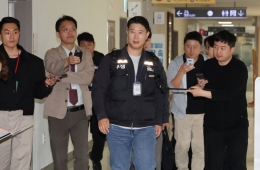
Former Minister of the Interior and Safety Sangmin Lee attended the first trial on charges including engaging in important tasks of rebellion on October 17 last year at the Seoul Central District Court in Seocho-gu, Seoul. Photo by Joint Press Corps
View original imageThe Criminal Division 1 of the Seoul High Court (presiding judge Yoon Sung-sik) on May 12 overturned the original verdict and sentenced Lee, who was indicted on charges including participation in major tasks related to rebellion, to nine years in prison. The court’s judgment on guilt or innocence was the same as in the first trial. Lee was found guilty of participating in major tasks related to rebellion and for perjury regarding the delivery of martial law-related documents. The previous rulings of not guilty for charges of abuse of power and perjury for allegedly witnessing the handover of martial law documents to the Minister of Economy and Finance were also maintained. However, the court stated, “The sentence handed down by the lower court was considered too lenient, and the prosecutor’s argument regarding the inappropriateness of the sentence was accepted. Therefore, the original verdict is overturned, and the defendant is sentenced to nine years in prison.”
The court found that, although Lee was in a position as the Minister of the Interior and Safety overseeing the safety and disaster management of the public, his act of directing the Fire Service Commissioner to cooperate with cutting off electricity and water to certain media companies not only physically infringed on the freedom of the press, but also seriously endangered the lives and physical safety of the people working there. The court ruled that this was an illegal act that cannot be allowed even under legitimate martial law circumstances.
Although the cutoff of electricity and water to the media companies was ultimately not carried out, the court ruled that this could not be fully considered in Lee’s favor. This was because the delay in declaring martial law, the National Assembly’s earlier-than-expected decision to lift martial law, and the fact that the Fire Service Commissioner and Deputy Commissioner, recognizing the illegality of the directive, relayed it in a less direct, more roundabout manner, were all key reasons—rather than any restraint or intent on Lee’s part. Lee’s active perjury during the Constitutional Court’s impeachment proceedings, aimed at concealing the facts of his wrongdoing, was also considered an aggravating factor.
It was also acknowledged that Lee received directive documents from former President Yoon Suk Yeol, which included hour-by-hour plans to blockade major institutions such as the National Assembly, as well as instructions for the Fire Service to cut off electricity and water to certain media companies. The court found that the document stated, “22:00 National Assembly, 23:00 Democratic Party Headquarters and National Election Commission, 24:00 Media companies, Fire Service, electricity and water cutoff,” and so on.
Lee’s phone call to the Fire Service Commissioner, during which he mentioned a specific media company and said, “The police will be deployed at 24:00, so if the police make a request, cooperate and take appropriate measures,” was also regarded as an instruction to cooperate with police requests for electricity and water cutoffs.
Hot Picks Today
!["Those Who Hesitated at 3,000 Still Haven't Bought" 7 Trillion-Won Asset Manager Says "Opportunities Remain" [Investment Strategies of the Wealthy] ⑦](https://cwcontent.asiae.co.kr/asiaresize/93/2026050715101553735_1778134216.jpg) "Those Who Hesitated at 3,000 Still Haven't Bought" 7 Trillion-Won Asset Manager Says "Opportunities Remain" [Investment Strategies of the Wealthy] ⑦
"Those Who Hesitated at 3,000 Still Haven't Bought" 7 Trillion-Won Asset Manager Says "Opportunities Remain" [Investment Strategies of the Wealthy] ⑦
- "Why Are My Child's Grades Like This?" Surge in Overprotected, Isolated, and Reclusive University Students [University Students in Crisis] ⑧
- "Not Just Olive Young"... Word-of-Mouth Drives Foreigners to Pharmacies, Spending Surges 156%
- "Don't Come to Work from Tomorrow": Two Million Face Unemployment Crisis...Iran Shaken by War Shock
- "SK hynix Could Reach 2.8 Million Won; Why Securities Firms Are Confident That the Main Chapter of AI Has Not Even Begun Yet [Click eStock]"
Meanwhile, the court acknowledged some circumstances favorable to Lee as well: ▲no evidence that he conspired or prepared for rebellion prior to the declaration of martial law; ▲he did not take a leading role in planning the electricity and water cutoff; ▲his involvement in the overall rebellion and riotous acts was not considered significant; and ▲he had no prior criminal record.
© The Asia Business Daily(www.asiae.co.kr). All rights reserved.