"If You Steal Public Funds, You'll Lose Everything"... Ministry of Economy and Finance Uses Advanced AI to Detect Subsidy Fraud
Machine Learning Enhances Pattern Detection to Uncover Suspicious Flows
"Improved Detection Rates Ahead of Next-Generation e-Naradoum Launch"
President Lee: "Those Who Steal Public Funds Will Face Ruin"
The government is set to further strengthen its artificial intelligence (AI) monitoring network to crack down on fraudulent claims of national subsidies, often referred to as "tax money theft." The plan is to upgrade the system so that AI can not only track patterns from past cases but also independently learn to detect "suspicious financial flows."

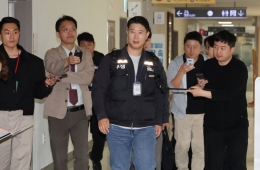
President Lee Jae-myung is heading to his seat after the national anthem ceremony at the Senior Secretary Meeting held at the Cheong Wa Dae Yeomin Hall on the 7th. Photo by Yonhap News
View original imageAccording to relevant ministries on May 12, the Budget Subsidy Fraud Management Group at the Ministry of Economy and Finance and the Korea Fiscal Information Service have launched efforts to upgrade the Suspicious Fraud Detection System (SFDS) within the "e-Naradoum" integrated management platform for national subsidies. The current system relies on "memorizing past criminal methods and searching for similar patterns" (rule-based pattern detection). However, as fraudulent tactics have become increasingly sophisticated, there have been growing concerns about the limitations of the existing rule-based approach. For example, one company falsified documents to disguise low-cost imported software as high-end domestic equipment, diverting subsidies worth approximately 5 billion won. In another case, the head of an association established a company under a family member's name and used a public distribution center essentially as a private restaurant, and was subsequently caught.
The new AI that the government plans to introduce is a more advanced machine learning-based system. It will autonomously learn from tens of thousands of past cases and identify "abnormal flows" that deviate from normal transactions. For instance, if a particular company suddenly applies for subsidies that are excessive relative to its sales volume, or if funds are used in ways that are entirely different from the regional or industry averages, the AI will automatically flag these as suspicious. A government official explained, "In the past, humans set the rules and the system followed them. Going forward, AI will independently learn and detect the potential for fraud," adding, "The aim is to screen for suspicious signs before on-site investigations, thereby improving the effectiveness of detection."
The government is accelerating the reinforcement of the AI monitoring system because the scale of fraudulent subsidy claims has surged recently. Last year, 992 cases of subsidy fraud were uncovered—a record high. President Lee Jaemyung stressed at a Senior Secretary Meeting at Cheong Wa Dae in February, "When the public's hard-earned tax money is treated as easy money, large-scale theft inevitably occurs," and emphasized, "We need to impose such severe penalties that people will fear losing everything if caught for subsidy fraud."
In addition to strengthening the AI system, the government is ramping up pressure from all directions. The number of cases subject to inspection will be increased tenfold compared to previous levels. The penalty surcharge, which is levied in addition to the recovery of fraudulently obtained funds, has also been raised to as much as eight times the original amount. This means that if someone is caught fraudulently receiving 100 million won, they could face not only a full recovery of the principal but also up to an additional 800 million won in penalties. Whistleblower protections are also being enhanced, with informants eligible to receive up to 30% of the recovered amount as a reward.
Hot Picks Today
!["Those Who Hesitated at 3,000 Still Haven't Bought" 7 Trillion-Won Asset Manager Says "Opportunities Remain" [Investment Strategies of the Wealthy] ⑦](https://cwcontent.asiae.co.kr/asiaresize/93/2026050715101553735_1778134216.jpg) "Those Who Hesitated at 3,000 Still Haven't Bought" 7 Trillion-Won Asset Manager Says "Opportunities Remain" [Investment Strategies of the Wealthy] ⑦
"Those Who Hesitated at 3,000 Still Haven't Bought" 7 Trillion-Won Asset Manager Says "Opportunities Remain" [Investment Strategies of the Wealthy] ⑦
- "Why Are My Child's Grades Like This?" Surge in Overprotected, Isolated, and Reclusive University Students [University Students in Crisis] ⑧
- "Not Just Olive Young"... Word-of-Mouth Drives Foreigners to Pharmacies, Spending Surges 156%
- "Don't Come to Work from Tomorrow": Two Million Face Unemployment Crisis...Iran Shaken by War Shock
- "SK hynix Could Reach 2.8 Million Won; Why Securities Firms Are Confident That the Main Chapter of AI Has Not Even Begun Yet [Click eStock]"
This system upgrade will be applied immediately to the current platform in the short term and will be incorporated into the "next-generation e-Naradoum" system, slated to go live in 2031. Since its launch in 2017, the current e-Naradoum has faced persistent concerns about obsolescence due to a surge in usage and data volume. The government aims to move beyond basic accounting management and build an "intelligent monitoring system" in which AI will track the potential for fraud in real time.
© The Asia Business Daily(www.asiae.co.kr). All rights reserved.