Was Kim Yongbeom’s “AI National Dividend” the Cause of the KOSPI Plunge? Examining the SNS Post and Market Trends
Kim Yongbeom’s Facebook Emerges as Key Channel for Lee Jaemyung Administration’s Economic Vision
This Time, Proposes Principles for Utilizing Excess AI Tax Revenue
Aligns with President Lee’s “AI-Based Society” Initiative
Bloomberg Interpre
Kim Yongbeom, policy chief at the Blue House, has emerged as a major conduit for gauging the direction of economic policy under the Lee Jaemyung administration through his posts on social networking services (SNS). On topics ranging from the semiconductor boom and KOSPI revaluation to the issue of excess tax revenue in the era of artificial intelligence (AI) infrastructure, Kim’s posts have served as an advance channel for the government’s key aides to publicly share their awareness of such issues before any official policy announcements. However, as the line between his personal opinions and policy signals remains ambiguous, both the market and the political sphere have repeatedly interpreted his remarks as immediate government policy, fueling controversy and prompting calls for more meticulous message control.

The controversy surrounding the sharp intraday decline in the KOSPI on the 12th originated from a lengthy post titled “A Nation on a Different Level: Korea’s Long-term Strategy in the AI Era,” which Kim uploaded to Facebook late on the 11th. Kim assessed that amid fierce competition over AI infrastructure, the Korean economy has the potential to shift from its traditional cyclical export-driven model to a tech-monopoly economic structure. The contentious part was his mention of a “national dividend” (tentative name), which he introduced as a topic that warrants discussion about the principles for utilizing excess tax revenue and growth dividends that could arise as a result of AI infrastructure expansion. He prefaced his remarks by saying, “If there is no excess tax revenue, the idea of a national dividend is nothing but an illusion,” but added that if Korea’s strategic position in the AI infrastructure supply chain leads to a structural boom and excess tax revenue, it is necessary to carefully consider how those funds should be used.
He also presented several ideas in this regard. Kim mentioned options such as reducing national debt and building a sovereign wealth fund as long-term reserves. He also listed concrete uses such as funding for youth entrepreneurship, a basic income for rural communities, support for artists, boosting pensions for the elderly, and AI transition education accounts. Rather than advocating for a specific form of cash handouts, his proposal was closer to suggesting how the dividends of growth in the AI era could be institutionalized through a new social contract.
This latest post is also in line with Kim’s recent economic proposals. In a previous post titled “At the Threshold of KOSPI 7,500 and 10,000,” he argued that the semiconductor boom is difficult to fully capture using the current GDP statistics and tax revenue estimation systems, and called for improvements to outdated systems in light of unprecedented tax revenues. His latest post can be seen as a follow-up discussion on the principles for utilizing this revenue.
This also aligns with President Lee Jaemyung’s long-standing vision of an “AI-based fundamental society (basic income).” President Lee has repeatedly stressed the need for institutional devices to socially distribute the dividends of growth, as AI can simultaneously boost productivity and corporate profits, while exacerbating polarization in jobs and income. However, as controversy spread, the Blue House drew a line at interpreting Kim’s post as immediate government policy. A Blue House official said, “The content posted by the policy chief on SNS reflects his personal opinion and is unrelated to internal discussions or reviews within the Blue House.”
Bloomberg Says Kim’s SNS Triggered Stock Market Volatility... Is There Causality?

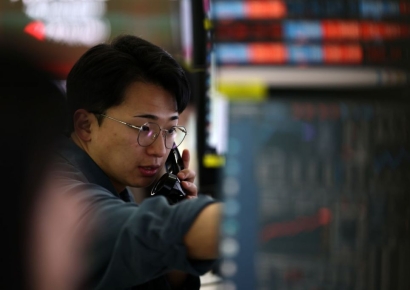
As the KOSPI index took a breather just below the 8000 mark, on the 12th, an employee was monitoring the stock and foreign exchange markets from the dealing room at Hana Bank's headquarters in Jung-gu, Seoul. On the day, the KOSPI opened at 7,953.41, up 1.68% from the previous trading day. May 12, 2026 Photo by Jo Yongjun
View original imageOn the same day, Bloomberg published an article titled “Korea’s Stock Market Roiled by AI Dividend Proposal,” reporting that Kim’s national dividend proposal had caused confusion among investors and triggered sharp volatility in the Korean stock market. Bloomberg’s follow-up report stated that the KOSPI fell as much as 5.1% intraday, only paring losses after Kim clarified that his post was not a proposal for a new windfall tax but rather an idea for utilizing excess tax revenue generated from the AI boom.
Bloomberg wrote, “A senior Korean policy official stated that the government should use taxes generated from AI profits to pay a ‘dividend’ to the people,” adding, “This shows growing pressure within the government to redistribute the profits of the AI boom, which has made semiconductor companies such as Samsung Electronics and SK hynix wealthy.” While discussing the concentration on Samsung Electronics and SK hynix, the burden from this year’s KOSPI rally, and trends of foreign investors selling, Bloomberg also diagnosed, “Kim’s SNS post caused significant volatility in the Korean stock market. As investors struggled to interpret the scope of Kim’s proposal, the KOSPI fell as much as 5.1% intraday.”
However, when examining the timing of Kim’s SNS post and the market’s trajectory, the causal relationship remains uncertain. On this day, the KOSPI opened at 7,953.41, up 131.17 points from the previous session. In the early session, it rose to as high as 7,999.67, coming within just 0.33 points of the 8,000 mark. Despite Kim’s post having been released the previous night, the market started higher, reflecting strength in U.S. semiconductor stocks and expectations of an AI rally, rather than any steep decline. Samsung Electronics and SK hynix followed the same trend. Samsung Electronics set a new all-time high, rising to 2,915,000 won in early trading, while SK hynix also hit a new record at 1,967,000 won.
The market’s direction shifted around 10 a.m. After peaking early, the KOSPI gradually gave up gains, falling as low as 7,421.71 intraday, and eventually closed at 7,643.15. Although Bloomberg noted that losses were partially recovered after Kim clarified, “It’s not about imposing a new windfall tax on corporate profits but about using naturally increased excess tax revenue,” the index further widened its losses in the afternoon session before closing. This has prompted commentary that it is more natural to view the market movement as the result of multiple overlapping factors, such as pressure from the recent rapid rally, foreign investors taking profits, caution ahead of the U.S. consumer price index release, and instability in the Middle East.
Ruling and Opposition Parties Clash Over Kim’s Remarks... Ruling Party Raises Ideological Critique, Opposition Says “Clear Distraction From the Main Point”
As the controversy grew, the opposition parties, including the People Power Party, defined Kim’s proposal as “recouping corporate profits” and “anti-market policy,” launching a fierce attack. They questioned whether it was appropriate for a key Blue House aide to use terms like “excess profits” and “national dividend” at such a sensitive time for the market. Even if the policy chief’s post was a personal opinion, the market could still interpret it as a government policy signal, making it inappropriate in their view. In particular, Jang Donghyuk, leader of the People Power Party, at the Gyeongbuk Provincial Party’s election committee launch event, said, “For the government to take money earned by companies and redistribute it— isn’t that something only the Communist Party does?” raising an ideological critique.
However, some counter that interpreting Kim’s post as interference in corporate dividend policy or as a forced recoupment of profits is excessive. Furthermore, there was no official proposal for tax reform or confiscation of corporate profits. In fact, Kim’s remarks were closer to a long-term strategic proposal to avoid squandering excess tax revenue from the AI and semiconductor boom in the short term and instead set out principles for its strategic use at the national level in advance.
Ando Geol, a member of the National Assembly’s Planning and Finance Committee from the Democratic Party, explained that Kim’s proposal was intended to ensure that, in the event of massive excess corporate tax revenue, resources would not be spent arbitrarily in the short term, but that systematic principles for their use would be established in advance. He wrote on Facebook, “It is not about forcing companies to share profits with the government,” and criticized, “To frame it as if the government is coercing companies to directly distribute profits to the people is a clear distraction from the main point.” He also pointed out that labeling it as “socialist” based on an ideological critique is nothing more than wasteful politicking that detracts from serious consideration of future strategy.
Hot Picks Today
 Investment Warnings Surge... "Warning Light" Flashes as KOSPI Nears 8,000 Points
- "Those Who Hesitated at 3,000 Still Haven't Bought" 7 Trillion-Won Asset Manager Says "Opportunities Remain" [Investment Strategies of the Wealthy] ⑦
- Snapping a Careless 'V' Pose... "All Your Personal Data Could Be Stolen" Warning Spreads on SNS
- "SK hynix to Soar to 2.8 Million Won, 'Main Chapter of AI Hasn't Even Begun Yet'—Why KB Securities Is Confident [Click e-Stock]"
- 'Drugs to Prevent Aging' Enter Their First Target Year... First Patient Dosed in the US [New Path for Bio, Anti-Aging] ①
However, some within the ruling party suggest that, given the sensitive timing ahead of local elections, more carefully crafted messaging is needed. One ruling party official said, “Public posts by key government aides have the advantage of broadening policy imagination and bringing long-term issues into public debate early,” but added, “In sensitive situations, even a single word can be interpreted as a policy signal, leading to controversy and greater market volatility.”
© The Asia Business Daily(www.asiae.co.kr). All rights reserved.