[2026 Future Business Forum] "In the Era of Space Data Centers... The Key Is High-Reliability, Low-Power Memory"
Yoo Minsu, Vice President of SK hynix
Unveils “Memory Strategy for the Era of Space Data Centers”
"Even in the new era of space data centers, memory will always remain at the core."
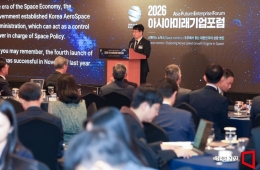
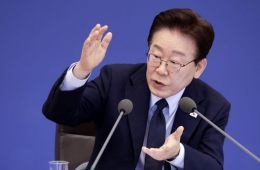
Yoo Minsu, Vice President of SK hynix, unveiled a next-generation memory technology strategy tailored to the space environment at the "2026 Asia Future Business Forum" held at Lotte Hotel in Sogong-dong, Seoul on May 13. He stated, "Due to the explosive growth of space data, space data centers are emerging as a key solution to complement terrestrial infrastructure."

Yoo Minsu, Vice President of SK hynix, is giving a keynote speech titled "Memory Strategy for the Space Data Center Era" at the 2026 Asia Future Enterprise Forum held on May 13 at Lotte Hotel in Sogong-dong. 2026.5.13 Photo by Jo Yongjun
View original imageRecently, the explosive increase in space data has been driven by the expansion of Earth observation satellites and low-Earth orbit communications networks such as Starlink. However, as data is transmitted down to Earth, the physical limitations of bandwidth and latency have become bottlenecks, highlighting the need for "space computing," which directly processes data in space.
Yoo forecast that "Space data centers will not simply replace terrestrial infrastructure, but will play a complementary role by strengthening the connection between Earth and space and optimizing data movement to expand overall artificial intelligence (AI) computing capabilities." In particular, he projected that with the current level of rocket launch technology, if weekly launches are sustained, a maximum of 0.8GW of power could be secured within five years, making it possible to build space infrastructure comparable to that of a terrestrial hyperscale data center (1GW).
However, memory systems operating in space require a completely different level of technology compared to those on Earth. This is because the harsh space environment is filled with cosmic radiation, which can cause not only transient data errors such as "bit flips" but also permanent component failures.
To address this, Yoo outlined three essential requirements for space memory. First, since component replacement or maintenance is impossible in space and a single chip failure can lead to the permanent loss of the entire system, "absolute reliability" must be ensured. Second is "high performance" for real-time AI inference. The third requirement is "ultra-low power" technology to overcome the environment where reliance on solar panels is necessary.

Yoo Minsu, Vice President of SK hynix, is giving a keynote speech titled "Memory Strategy in the Era of Space Data Centers" at the 2026 Asia Future Business Forum held at Lotte Hotel, Sogong-dong on May 13, 2026. Photo by Cho Yongjun
View original imageTo overcome these challenges, Yoo presented the "Space RAS" architecture as a core strategy. RAS is a technology that minimizes system errors (Reliability), maintains operation even during failures (Availability), and enables rapid repair (Serviceability). Yoo explained that by combining enhanced RAS technology with commercial off-the-shelf (COTS) components, errors caused by cosmic radiation in space can be effectively managed.
For maximizing power efficiency, he mentioned "Processing-in-Memory (PIM)" and "custom High Bandwidth Memory (HBM)" technologies. Yoo explained that by applying PIM technology, which enables AI computation directly inside memory, computational speed can be increased by approximately tenfold and power efficiency by about sevenfold compared to conventional HBM.
Hot Picks Today
 Even with High Oil Price Relief Payment, Additional 300,000 Won Per Person to Be Provided... Applications Open from the 18th in This Region
- Is the Union Still Aiming for the 45 Trillion Won Bonus?... Samsung Union Rejects Government Mediation as Countdown to May 21 General Strike Begins
- Grabbing Wrists, "Miss, Anyang 60,000 Won"... Late-Night Illegal Taxis Turn Seoul into a Lawless Zone
- 'Drugs to Prevent Aging' Enter Their First Target Year... First Patient Dosed in the US [New Path for Bio, Anti-Aging] ①
- "I'm Younger and Fitter Than Your Husband, Get a Divorce"... Suspicious Messages Between Wife and Fitness Trainer
Yoo stated, "At the center of the AI computing revolution expanding beyond Earth into space, ever-evolving memory technology will always be present," expressing SK hynix's ambition to lay the technological foundation for the era of space data centers.
© The Asia Business Daily(www.asiae.co.kr). All rights reserved.