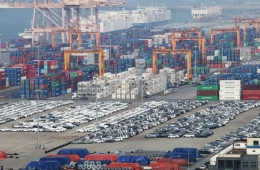
[Inside Chodong] Why Has KOSDAQ Become the Symbol of the Lesser Sibling Compared to KOSPI?
KOSDAQ Overshadowed by KOSPI's Unprecedented Rally
Left Behind Amid Large-Cap Semiconductor Boom
Persistent Deep-Rooted Distrust Lingers Over KOSDAQ
Revitalization Policies Needed to Restore Trust in KOSDAQ
![[Inside Chodong] Why Has KOSDAQ Become the Symbol of the Lesser Sibling Compared to KOSPI?](http://www.asiae.co.kr/news/img_view.htm?img=2026042109372233866_1776731842.jpg)
Celebratory fireworks are erupting daily in the Korean stock market as the KOSPI continues to hit record highs. After an unprecedented rally this year, the KOSPI is now on the verge of reaching the "8,000-point" milestone. In fact, there are even predictions among securities firms of a future "10,000-point" level.
In contrast to the KOSPI's historic performance, the KOSDAQ appears lackluster. It is reminiscent of a younger sibling unable to present their own report card in front of an older sibling who has ranked first in the school. Both last year and this year, the KOSDAQ's performance was not bad; it recorded gains in the 30% range, and last month it surpassed the 1,200-point mark for the first time in 26 years. While this is a commendable performance for the KOSDAQ itself, the problem is that the KOSPI, the "older sibling," performed exceptionally well. If the KOSDAQ took first place in its class, the KOSPI ranked first in the entire school. Having surged more than 80% since the beginning of the year, the KOSPI has posted the highest rate of increase among major global stock indices, demonstrating overwhelming strength. The speed of this rise is also remarkable: it took just three months to climb from the 4,000-point level to 5,000, and barely a month after surpassing 5,000, it broke through 6,000. Even the unexpected Iran war did not slow it down, as it surpassed 7,000 just two months later. On the previous trading day, it reached as high as 7,999.67 during trading hours, putting the 8,000-point milestone within immediate reach.
The diverging fortunes of the two markets are due to the bull run in the stock market since last year, which has been driven by large-cap stocks, including semiconductor companies. In particular, Samsung Electronics and SK hynix, the leading blue chips, have soared rapidly, propelling the KOSPI upward. As the AI industry experienced explosive growth, foreign capital flocked to large-cap stocks like Samsung Electronics and SK hynix, fueling the relentless rise of the KOSPI. In contrast, the KOSDAQ has lagged behind since the secondary battery craze that once led the market subsided, with no strong new leading sector to take its place. Furthermore, even the pharmaceutical and biotech sector, the KOSDAQ's major blue chips, have seen investor sentiment weaken due to a series of negative events affecting individual companies, causing them to be sidelined in the current bull market.
Another factor underpinning the recent bull market has been expectations for "value-up" initiatives, which have also been concentrated among large-cap stocks. With large-cap companies leveraging solid earnings to pursue proactive shareholder returns, capital seeking stable income and dividends has gravitated toward the KOSPI, while the KOSDAQ's small- and mid-cap stocks—characterized by higher volatility and a reliance on future growth potential—have inevitably been pushed down the list of investment priorities.
The trickle-down effect seen in the past has not yet materialized. Previously, when large-cap stocks rose, the warmth would gradually spread to the KOSDAQ, where materials, parts, and equipment stocks are clustered. However, recently, money has flowed exclusively into stocks with proven earnings and clear momentum.
In truth, the KOSDAQ's underperformance is also rooted in a deep-seated distrust of the market. Over the years, investors have more often referred to the KOSDAQ as a "graveyard for retail investors" rather than a "land of opportunity." Embezzlement and breach of trust scandals at some listed companies have recurred whenever they were nearly forgotten, and many companies that went public touting promising technologies have subsequently failed to deliver results. The increase in so-called "zombie companies" has further cemented the KOSDAQ's negative image.
Amid the KOSDAQ's marginalization, market attention is now focused on the government's KOSDAQ revitalization policies. As early as October this year, a "promotion and relegation" system will be introduced. The KOSDAQ will be divided into three segments—Premium, Standard, and Watchlist—for management. Well-qualified companies that meet strict requirements will receive corresponding benefits, while companies with ongoing losses or poor performance will be assigned to the Watchlist for swift delisting. The aim is to foster a healthy investment ecosystem where strong companies can smoothly secure the funding necessary for growth.
Hot Picks Today
 Even with High Oil Price Relief Payment, Additional 300,000 Won Per Person to Be Provided... Applications Open from the 18th in This Region
- Merck Scores First Invalidation of Halozyme Patent...Positive Signal for Alteogen and Keytruda SC Dispute
- Investment Warnings Surge... "Warning Light" Flashes as KOSPI Nears 8,000 Points
- "Those Who Hesitated at 3,000 Still Haven't Bought" 7 Trillion-Won Asset Manager Says "Opportunities Remain" [Investment Strategies of the Wealthy] ⑦
- "I'm Younger and Fitter Than Your Husband, Get a Divorce"... Suspicious Messages Between Wife and Fitness Trainer
The KOSDAQ stands at a new turning point. There is growing interest in whether these revitalization policies will transform the KOSDAQ from a "market too risky to trust" into a "cradle of trustworthy growth companies."
© The Asia Business Daily(www.asiae.co.kr). All rights reserved.