[46th Anniversary of May 18] "The Driving Force That Stopped Martial Law That Day Was the 'Spirit of May in Gwangju'"
Chief Park Taejin Stands Against Martial Law Troops at the National Assembly
Aides Fight Alongside Him, Spraying Fire Extinguisher Powder to Help Convene the Main Session
"Learned the Value of Democracy Protected by Blood from My Parents as a Ch
A Sudden Blow on a Calm Evening... The People's Parliament Thrown into Chaos
The guns and swords of the martial law forces were truly terrifying. But someone had to act, and that someone just happened to be me."
On the day of South Korea's seventeenth declaration of martial law in constitutional history, December 3, the area in front of the main entrance to the National Assembly building in Yeouido, Seoul, was literally a battleground. Taejin Park, Chief of Staff to the Leader of the Party for National Innovation, was one of those who stood off against the armed martial law forces using red fire extinguisher powder in the pitch-black darkness. On the 12th, he calmly recounted the tense situation during martial law.
Park first heard the news of the martial law declaration around 10 p.m. on the 3rd. He was on his way to a late dinner after finishing an internal party meeting when the news struck him like lightning. He said, "It felt as if I'd been hit on the head with a hammer, and I wondered if it was a dream." However, the constant notifications on his phone quickly made him realize it was reality. He immediately headed to the National Assembly.
By 11 p.m., the main entrance to the National Assembly was already blocked by police. Park and his fellow aides protested, demanding a clear legal basis for the entry ban, but were met only with silence. In the end, after a physical struggle, they managed to enter the main building just before midnight.

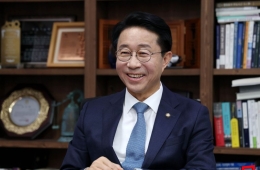
Taejin Park, Chief of Staff to the Leader of the Party for National Innovation, is explaining the situation at the site during martial law inside the National Assembly building in Yeongdeungpo-gu, Seoul, on the morning of December 10, 2024. Photo by Min Hyunki
View original imageA Single Fire Extinguisher Against a Crowbar... A Desperate 'Delay Tactic' by the Aides
However, inside the main building, an even greater crisis awaited. Armed soldiers landed by helicopter on the National Assembly field and were trying to enter the main building, and although Speaker Woo Won-shik began the vote on a resolution demanding the lifting of martial law, more time was needed to reach the quorum of 151 members.
The opposition party aides, including Park, acted in perfect coordination to defend the main chamber. They gathered every piece of furniture nearby—desks and chairs—to build barricades at the main entrance. Yet their numbers were clearly insufficient. When the main entrance was blocked, the martial law forces attempted to break through the windows and enter from another route.
Park recalled, "When we were pushed back to the last wooden door leading to the main chamber, I remember the feel of the wood and the sound of my colleagues' breathing behind me." The martial law troops began breaking down the door with a crowbar, and sharp pieces of metal thrust through the broken gaps like weapons. In that critical moment, Park grabbed a nearby fire extinguisher and sprayed it. As the powder clouded the soldiers' vision, they bought precious seconds to defend democracy.
The DNA of May in Gwangju Awakened... "We Must Pass on Democracy to Our Children"
The driving force that allowed him to resist so fiercely was the deeply rooted "spirit of May 18." Park, who is from Gwangju, grew up under parents who had experienced firsthand the horrors of May 1980. He said, "Since I was a child, my parents told me how many people shed blood to protect democracy," adding, "Going through this crisis, I felt a mission to pass down a democracy I would not be ashamed of to my own children."
Ultimately, the time Park and his fellow aides won through their struggle became the decisive foundation for lawmakers to gather in the main chamber. At 1:01 a.m., the resolution demanding the lifting of martial law passed unanimously with all 190 lawmakers present voting in favor.
Inside and outside political circles, many now view Park's actions as a 2026 reenactment of the "spirit of resistance against injustice" displayed in Gwangju in May 1980. Standing up against the state violence of martial law, the representatives of the people put their bodies on the line to defend constitutional order, demonstrating that the spirit of May 18 is not a relic of the past, but a living driving force of democracy.
Martial Law Was Stopped, but Constitutional Reform Failed... The Spirit of May Remains an 'Unfinished Task'
The recent move to enshrine the "spirit of the May 18 Democratization Movement" in the preamble of the Constitution appeared to gain momentum in the wake of these events. However, on the 8th, the attempt to amend the Constitution for the first time in 39 years collapsed when a large number of National Power Party lawmakers failed to attend the plenary vote. In effect, the voices of those who physically blocked the martial law forces on the ground were erased in the face of political calculation.
Hot Picks Today
 Even with High Oil Price Relief Payment, Additional 300,000 Won Per Person to Be Provided... Applications Open from the 18th in This Region
- "Invested 95% in Hynix and Reached 10 Billion Won"... Japanese Investor's Proof Post Goes Viral
- Parents Sue After Losing Son Who Followed ChatGPT Advice to "Take the Medication"
- "You Don't Need to Go to the Gym": The Best Exercises for Lowering Hypertension
- "That Thing Wakes Up Every Night" ... Suspicious Object Covers Rural Village
Park said, "I endured with nothing but the hope that if I could delay the troops for even a few seconds, I could protect democracy," adding, "That hope was rooted in the spirit of May 18, and it was that spirit that protected South Korea from martial law this time."
© The Asia Business Daily(www.asiae.co.kr). All rights reserved.