[2026 Asia Future Business Forum] "Satellites in Ultra-Low Earth Orbit Below 400km... Korea Will Plant Its Flag First"
Seon Kim, Executive Vice President of Hanwha Space Business, Presents Keynote
Declares Hanwha's Ambition to Lead the Next-Generation Space Industry in VLEO
Technological Challenges Ahead, Including Atmospheric Drag
Developing 10cm-Class Satellites Utilizing AI Models
"SpaceX has already opened up the 500km low Earth orbit market. However, the ultra-low Earth orbit below 400km remains an unexplored space frontier, with no one yet able to provide stable commercial services."

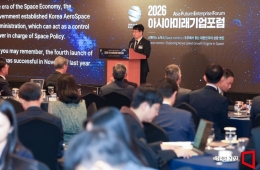
Seon Kim, Executive Vice President of Space Business at Hanwha Group, is giving a presentation on the topic "New Space: Challenges and Tasks" at the '2026 Asia Future Enterprises Forum' held on the 13th at Lotte Hotel in Jung-gu, Seoul. Photo by Jinhyung Kang
View original imageSeon Kim, Executive Vice President of Space Business at Hanwha Group, made these remarks at the "2026 Asia Future Business Forum" held at Lotte Hotel in Sogong-dong, Seoul on the 13th, stating, "We will be the first to plant the flag of the Republic of Korea in ultra-low Earth orbit."
In his presentation, Kim identified ultra-low Earth orbit (VLEO), which is at a lower altitude than traditional low Earth orbit (LEO) satellites, as the key market for the next-generation space industry. He explained, "The lower the altitude, the less communication latency and the higher the image resolution. The industry, which has focused on geostationary satellites, is now shifting toward the era of low Earth orbit satellite constellations."
Kim also emphasized that ultra-low Earth orbit is not simply about lowering satellite altitude, but about transforming the entire business structure of the space industry. He explained that companies capable of integrating launch vehicles, satellites, data analysis, and artificial intelligence (AI) services into a single system will ultimately take the lead in the market.
However, he pointed out that there are technological challenges in ultra-low Earth orbit, such as increased atmospheric drag and atomic oxygen. These factors shorten satellite lifespans and cause oxidation and erosion issues, highlighting the need for new design and coating technologies.
He also revealed a strategy focused on securing market share rather than achieving technical perfection. Kim stated, "We have chosen market preemption over technological superiority. By loading proven satellite components with ample fuel and relaunching them whenever they are brought down by atmospheric drag, we intend to secure the market first."
Hanwha is currently developing an ultra-low Earth orbit radar observation satellite with a resolution of 10 centimeters. Kim remarked, "In low Earth orbit, there is a trade-off between resolution and noise, but by moving to ultra-low Earth orbit, we can achieve both higher resolution and lower noise. We intend to change the rules of the game itself."
He also presented a vertical integration strategy, combining launch vehicles and satellites. By optimizing ultra-low Earth orbit satellites for Hanwha's launch vehicles, more satellites can be launched at lower cost and on the desired schedule. Based on this, the company aims to establish an ultra-low Earth orbit satellite constellation system capable of imaging the entire planet at 30-minute intervals.
Kim further emphasized that being independent from external launch schedules and costs will be a key factor in future space industry competitiveness. By designing satellites and launch vehicles simultaneously, they can be optimized for mission objectives and launch efficiency can be increased.
AI technology will also be actively applied to satellite image analysis. Kim explained, "The value of satellite data lies not in the images themselves, but in their interpretation. By using proprietary AI models, we can analyze more images faster and more accurately." He added, "We will make it possible to review image analysis results through conversations, just like talking to a person, by utilizing large language models (LLMs)."
As application cases, he cited national defense and security, Arctic sea routes, and disaster response. He said, "A 10-centimeter ultra-high-resolution radar satellite can accurately identify even disguised equipment such as fake missile launchers. It will also be possible to analyze Arctic ice drift and flood risks in near real time."
Hot Picks Today
 Even with High Oil Price Relief Payment, Additional 300,000 Won Per Person to Be Provided... Applications Open from the 18th in This Region
- Is the Union Still Aiming for the 45 Trillion Won Bonus?... Samsung Union Rejects Government Mediation as Countdown to May 21 General Strike Begins
- Grabbing Wrists, "Miss, Anyang 60,000 Won"... Late-Night Illegal Taxis Turn Seoul into a Lawless Zone
- Investment Warnings Surge... "Warning Light" Flashes as KOSPI Nears 8,000 Points
- "I'm Younger and Fitter Than Your Husband, Get a Divorce"... Suspicious Messages Between Wife and Fitness Trainer
Kim stressed, "Hanwha's vision is not simply to be a satellite manufacturer or a launch vehicle company. We will build a 'Space Hub' that integrates satellites, launch vehicles, and AI into a single system to provide customers with the services they desire."
© The Asia Business Daily(www.asiae.co.kr). All rights reserved.