[2026 Future Business Forum] Hwang Jeonga and Ko Dongjin: "Space Technology Is a National Strategic Asset... Korea Must Rise to the Top 5 Space Powers"
Hwang Jeonga of the Democratic Party of Korea
Dongjin Ko of the People Power Party Delivers Congratulatory Speech
Asia Future Business Forum 2026
There was a proposal from the political community that all of the nation's capabilities must be mobilized in order to secure leadership in the space industry. Lawmakers emphasized that space technology is a core strategic asset that will determine national security and future growth engines, pledging unwavering support through legislation and policy measures.

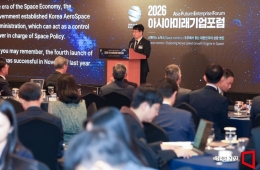
Hwang Jungah, a member of the Democratic Party of Korea, is delivering a congratulatory speech at the 2026 Asia Future Business Forum held at Lotte Hotel in Sogong-dong, Seoul on the 13th, under the theme "Space Nomics, South Korea's Growth Engine Found in Space." 2026.5.13 Photo by Jo Yongjun
View original imageHwang Jeonga, a member of the Democratic Party of Korea, stated in her congratulatory speech at the 2026 Asia Future Business Forum held at the Lotte Hotel in Sogong-dong, Seoul on May 13, "Space technology has become a national strategic asset—a future growth engine organically combining national security, cutting-edge industry, and private sector innovation, and a key factor in determining the country's competitiveness."
She continued, "The Lee Jaemyung administration, based on this recognition, has ushered in the era of the 1 trillion won budget for the Korea Aerospace Administration, and last year successfully completed the fourth launch of the Nuri rocket. In addition, international space cooperation is being further solidified, as evidenced by the recent inclusion of the K-RADCube in NASA's Artemis II mission."
She added, "As a member of the National Assembly's Science, ICT, Broadcasting and Communications Committee and as chair of the Democratic Party's Special Committee on Science and Technology Innovation, I will do my utmost to support the space industry as Korea's new growth engine through legislative and policy efforts." Hwang Jeonga is a former principal researcher at the Korea Astronomy and Space Science Institute, who developed the payload for Korea's first science technology satellite, Wooribyul-4, and the Doyosat (a microsatellite) carried by Nuri rocket.

Goh Dongjin, a member of the People Power Party, is delivering a video congratulatory speech at the 2026 Asia Future Business Forum held at Lotte Hotel in Sogong-dong, Seoul on the 13th. Photo by Goh Dongjin's Office
View original imageDongjin Ko, a member of the People Power Party and former CEO of Samsung Electronics, also delivered a congratulatory speech, saying, "Just as Columbus’ discovery of the New World brought about a great transformation in human history during the Age of Exploration, the world is now entering another era of space exploration. By around 2040, the global space industry market size is expected to exceed 1.5 trillion dollars, and competition among nations to secure space supremacy is intensifying day by day."
He went on to say, "Korea has set a goal to land a domestically developed lunar lander on the moon by 2032, and to achieve a 10% share of the global space market by 2045. Now is the time for all of us to combine our capabilities so that Korea can play a key role in the future space industry."
Hot Picks Today
 Even with High Oil Price Relief Payment, Additional 300,000 Won Per Person to Be Provided... Applications Open from the 18th in This Region
- Is the Union Still Aiming for the 45 Trillion Won Bonus?... Samsung Union Rejects Government Mediation as Countdown to May 21 General Strike Begins
- President Lee: "Kim Yongbeom Meant 'Excess Tax Revenue'... National Dividend from Excess Profits Is Fake News"
- 'Drugs to Prevent Aging' Enter Their First Target Year... First Patient Dosed in the US [New Path for Bio, Anti-Aging] ①
- "I'm Younger and Fitter Than Your Husband, Get a Divorce"... Suspicious Messages Between Wife and Fitness Trainer
He added, "In that sense, this forum, held under the theme 'Space Nomics, Korea's Growth Engine Found in Space,' is a very meaningful occasion to seek changes and response strategies for the space industry. With experts from the space sector gathered here today, I look forward to in-depth discussions on the roles that the government, National Assembly, industry, academia, and research institutes should play in propelling Korea to become one of the world's top five space powers."
© The Asia Business Daily(www.asiae.co.kr). All rights reserved.